
Home » 2013 (Page 4)

Yearly Archives: 2013

Labor Day – A Day for Reflection

Labor Day. For much of the world this is a day of reflection to honor the martyrs who stood up to wealthy capitalists in the fight for dignified employment, the eight-hour workday and the five-day work week. It is a day to honor those who sacrificed their lives so that we might be home in time to eat dinner with our families and to have Saturday’s off to watch our children play baseball or soccer. It is a reminder that many of the blessings we take for granted today came at a terrible price.  If we forget how we got these benefits they will slowly erode over time and history will reap itself.

Much of the world celebrates Labor Day not in August, but in May. Have you ever wondered why? Would you be surprised to learn that labor celebrations around the world commemorate events that took place in Chicago in 1816?  Students of history will recognize this as the Haymarket, or May Day Massacre.  Below is one account from the Encyclopedia of Chicago History via Wikipedia.  http://www.encyclopedia.chicagohistory.org/pages/571.html

Haymarket and May DayLABOR UNREST, 1886 (MAP)

On May 1, 1886, Chicago unionists, reformers, socialists,anarchists, and ordinary workers combined to make the city the center of the national movement for an eight-hour day. Between April 25 and May 4, workers attended scores of meetings and paraded through the streets at least 19 times. On Saturday, May 1, 35,000 workers walked off their jobs. Tens of thousands more, both skilled and unskilled, joined them on May 3 and 4. Crowds traveled from workplace to workplace urging fellow workers to strike. Many now adopted the radical demand of eight hours’ work for ten hours’ pay. Police clashed with strikers at least a dozen times, three with shootings.

At the McCormick reaper plant, a long-simmering strike erupted in violence on May 3, and police fired at strikers, killing at least two. Anarchists called a protest meeting at the West Randolph Street Haymarket, advertising it in inflammatory leaflets, one of which called for “Revenge!”

The crowd gathered on the evening of May 4 on Des Plaines Street, just north of Randolph, was peaceful, and Mayor Carter H. Harrison, who attended, instructedpolice not to disturb the meeting. But when one speaker urged the dwindling crowd to “throttle” the law, 176 officers under Inspector John Bonfield marched to the meeting and ordered it to disperse.

Then someone hurled a bomb at the police, killing one officer instantly. Police drew guns, firing wildly. Sixty officers were injured, and eight died; an undetermined number of the crowd were killed or wounded.

The Haymarket bomb seemed to confirm the worst fears of business leaders and others anxious about the growing labor movement and radical influence in it. Mayor Harrison quickly banned meetings and processions. Police made picketing impossible and suppressed the radical press. Chicago newspapers publicized unsubstantiated police theories of anarchist conspiracies, and they published attacks on the foreign-born and calls for revenge, matching the anarchists in inflammatory language. The violence demoralized strikers, and only a few well-organized strikes continued.
HAYMARKET POSTER, 2002

Police arrested hundreds of people, but never determined the identity of the bomb thrower. Amidst public clamor for revenge, however, eight anarchists, including prominent speakers and writers, were tried for murder. The partisan Judge Joseph E. Gary conducted the trial, and all 12 jurors acknowledged prejudice against the defendants. Lacking credible evidence that the defendants threw the bomb or organized the bomb throwing, prosecutors focused on their writings and speeches. The jury, instructed to adopt a conspiracy theory without legal precedent, convicted all eight. Seven were sentenced to death. The trial is now considered one of the worst miscarriages of justice in American history.

Many Americans were outraged at the verdicts, but legal appeals failed. Two death sentences were commuted, but on November 11, 1887, four defendants were hanged in the Cook County jail; one committed suicide. Hundreds of thousands turned out for the funeral procession of the five dead men. In 1893, Governor John Peter Altgeld granted the three imprisoned defendants absolute pardon, citing the lack of evidence against them and the unfairness of the trial.

Inspired by the American movement for a shorter workday, socialists and unionists around the world began celebrating May 1, or “May Day,” as an international workers’ holiday. In the twentieth century, the Soviet Union and other Communist countries officially adopted it. The Haymarket tragedy is remembered throughout the world in speeches, murals, and monuments. American observance was strongest in the decade before World War I. During the Cold War, many Americans saw May Day as a Communist holiday, and President Eisenhower proclaimed May 1 as “Loyalty Day” in 1955. Interest in Haymarket revived somewhat in the 1980s.

A monument commemorating the “Haymarket martyrs” was erected in Waldheim Cemetery in 1893. In 1889 a statue honoring the dead police was erected in the Haymarket. Toppled by student radicals in 1969 and 1970, it was moved to the Chicago Police Academy.

DOJ Let’s Halliburton off the Hook for Destroying Gulf Oil Spill Evidence

It seems possible that Halliburton Energy Services didn’t what it’s three-dimensional computer simulations of what when wrong in the Macondo Well blow-out to get into the hands of federal prosecutors. The simulations were destroyed and the DOJ filed criminal charges against Halliburton for this destruction of evidence. Halliburton was subsequently allowed to settle the charges of destroying evidence with the DOJ, pleading to just one count. Sen. John McCain is among those who feel that justice was not being served here. The following excerpt is from E&E News. A link to the full article is found below as is a PDF copy of Sen. McCain’s letter.

Republican questions Halliburton’s Gulf spill settlement

Jeremy P. Jacobs, E&E reporter

Published: Thursday, August 1, 2013

http://www.eenews.net/special_reports/gulf_spill/stories/1059985487

Arizona Sen. John McCain today expressed deep concerns about the Department of Justice’s recent settlement with Halliburton Energy Services Inc. over the destruction of evidence following the 2010 Deepwater Horizon oil spill.

The Republican asked DOJ several questions about how the $200,000 settlement came about and whether it is sufficient given the nature of the allegations. [SNIP]

Halliburton admitted to one count of destroying evidence and agreed to pay the maximum statutory penalty of $200,000. Additionally, Halliburton faces three years of probation and has agreed to cooperate with DOJ’s ongoing investigation into the Gulf of Mexico explosion and spill that killed 11 rig workers.

The settlement stems from three-dimensional computer simulations that Halliburton ran after the blowout on the Macondo well. Engineers were trying to determine whether BP PLC’s decision to use fewer centralizers around the well’s casings than Halliburton had recommended may have caused the blowout. [SNIP]

“Why did DOJ settle this case for such a relatively small fine rather than choose to prosecute Halliburton to the full extent of its culpability in the Deepwater Horizon disaster?” McCain asked.

McCain also raised questions about Halliburton’s decision to contribute $55 million to the National Fish and Wildlife Foundation separate from the settlement.

Read John McCain’s Letter Here: http://www.eenews.net/assets/2013/08/01/document_pm_01.pdf

NSA Data Collection Can’t Be Made Safe

President Obama said, ” Between all the safeguards and checks that we put in place within the executive branch, and the federal court oversight that takes place on the program, and congressional oversight, people are still concerned as to whether their emails are being read or their phone calls are being listened to.”

ObamaPhone

Wrong premise, Mr. President! I am upset because a government program directs that my emails and phone calls be collected and stored somewhere. Whether the government ever reviews them is beside the point. The whole concept of the NSA’s data collection ideology is unconstitutional. For government to collect private communications is a criminal act, one the United States would have forcefully condemned if this had taken place in the former Soviet Union.

Sending emails or placing calls isn’t like putting out the trash. I willingly release my garbage to the  public streets. Any passerby can grab it, so I have a diminished expectation of privacy. This isn’t true of my personal communications. My neighbors can’t read every email I send.  I do expect that personal communications are not in public view. But even if the government required trash haulers to catalogue and save the contents if my garbage it would be an outrage.

Governments need systems of checks and balances more robust than then the character of those who administer them. The mass collection of domestic communications by or for the NSA already crosses the line, so no safeguards or checks can make it safe or acceptable.

It’s Time for Citizens to Take Control of Our Democracy

alg_turmoil_polls


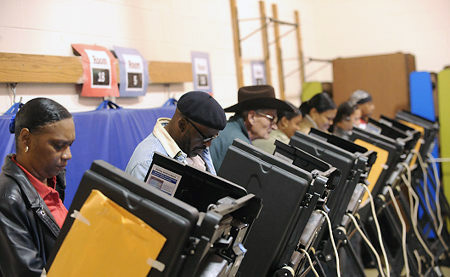
North Carolina doesn’t want you to vote if you live in a college dormitory in that state. They don’t want you to vote if you don’t have a special state identification card. There is a provision in state law that polling places can serve a maximum of 1500 voters, but in Boone, where college students nearly caused the parish to go for Barak Obama, you must now travel out of your way to the one polling place left, which serves over 9,000 voters. With only 45 parking spaces the parking lot will need to fill and empty every 6 or 7 minutes to accommodate everyone.  Of course, accommodating all the voters is the last thing this Republican controlled local voting board has in mind.

Throughout the South and in other conservative stronghold around the country the story is pretty much the same.  Since the United States Supreme Court struck down part of the Voting Rights Act an ideologically obstinate Republican Party, which is in demographic  decline, is responding to growing pluralism and power sharing by rejecting democratic majority rule in favor of vote manipulation and dirty tricks.  In one voting precinct in Texas, changes to the distribution of voting machines would have predominately African-American polling places handle ten times the number of voters as predominately White polling places.  In every Republican controlled state the voting districts have been redrawn to make it nearly impossible for them to lose their incumbency.  And all these changes are not random developments but elements of a nationwide plot to project conservative power and suppress opposing or alternative social views.

Admitting  that there is a problem with our democratic process is difficult enough. Fixing it will be even harder. Elections are the province of state governments, each with unique constitutions, chapter laws and administrative policies. In a previous post [http://wp.me/p2WIGz-7B ] I reported on the results of a survey I conducted of the constitutional voting rights articulated in every state constitution. The results were disturbing.  Most of the rights we think we have are not supported in the language of most state constitutions and no state constitution has adequately defined voting rights.

Voting is, of course, the cornerstone of democracy.  It is the means by which political power is aggregated and distributed within a democratic society. Each vote is a transfer of power collected by the chosen candidate.  The integrity of the voting process is therefore critical to a democratic society. It is too precious to entrust in partisan hands. The administration of the election process should be pre-partisan, outside of total government control.  It should be directly under citizen control.

Our present system of election relies on election administrators appointed by the party in power.  In most states that means the State Secretary of State. Keeping in mind that most states don’t have constitutionally secure voting rights, the legislatures have significant control over election procedures and the Secretary of States have great leeway over how these laws are implemented. Among the strange consequences this has cause is the turning over of elections to private voting companies. Most or our votes are cast and counted by private companies using electronic machines run on proprietary software. The voting companies are accountable to no one. We citizens didn’t ask for this and there was no discussion about this prior to hiring these private firms to collect and count our votes.  Since these companies have taken over the election process we have had some of the most unusual and controversial elections in modern times.  I have written extensively on this subject in the past (see below).

How should we protect our voting rights? By electing non-partisan, independent citizen boards to run our elections.  All voting policies and procedures should be approved through public referendum developed by these citizen Boards of Election.  Citizens on these boards should have no party affiliations and should not hold any public office.  These citizen boards should be responsible  for everything from drawing congressional districts, maintaining voter registrations preparing ballots, assigning polling places, etc. right down to training poll workers and monitoring elections. Any significant changes in voting policy should have to be put to a public vote.  If private companies are to be hired to count our votes, it is the voters who should decide whether or not to use them.  In my view, there should be nothing involving the franchise that isn’t itself subject to direct citizen approval.

The candidate who collects the most votes wins the consent to govern. In the bargain, the candidate in a representative democracy is expected to represent everyone, even those opposed to him or her.  In exchange, all the people consent to be governed by majority rule even if there candidate didn’t win. Representatives should do what is right for the greatest good even if it isn’t what is popular at the moment or aligned with the interests of those who supported the candidate.  Of course, this is the ideal, not the practice.  But today, the basic bargain that makes a Republic work has broken down. Elected representatives are narrowly pursuing the interests of their political donors and party constituents almost exclusively. The Republican minority in the Senate no longer accepts majority rule, using filibusters to forcing super-majorities on nearly every vote. With this same disregard they are making it harder for citizens who don’t agree with them to vote in public elections. Governments and powerful interests have broken faith with democracy.  It’s time for ordinary citizens to take back control over the democratic voting process.

MY BLOGLIOGROPHY ON VOTING ISSUES

The sorry state of voting rights in America, a 50 state comparison
http://aseyeseesit.blogspot.com/2012/03/sorry-states-of-voting-rights-in.html

How voter ID laws might block you from voting
http://aseyeseesit.blogspot.com/2012/07/seven-ways-voter-id-could-block-you.html

Republicans have a 5% election fraud handicap built into the voting system
http://aseyeseesit.blogspot.com/2012/08/republicans-have-5-election-fraud.html

Many state are unprepared for a fair and free election
http://aseyeseesit.blogspot.com/2012/07/many-states-unprepared-for-fair-and.html

Outsourcing or privatized voting process overseas
http://aseyeseesit.blogspot.com/2012/07/outsourcing-our-privatized-voting.html

Voting rights denied to a record number of “felons”
http://aseyeseesit.blogspot.com/2012/07/voting-rights-denied-for-record-numbers.html

Ireland Scraps Electronic Voting Machines for Good
http://aseyeseesit.blogspot.com/2012/06/ireland-scraps-electronic-voting.html

Secret flawed voting software discovered and exposed
http://aseyeseesit.blogspot.com/2012/06/ireland-scraps-electronic-voting.html

Does voter suppression have a new target in Florida (Latino’s)
http://aseyeseesit.blogspot.com/2012/05/does-voter-suppression-have-new-target.html

To know your Voting Rights you must know your state constitution
http://aseyeseesit.blogspot.com/2012/03/voting-know-your-rights-know-your-state.html

Can a convicted, or formerly convicted felon vote? Lots of confusion
http://aseyeseesit.blogspot.com/2012/04/can-convicted-felon-vote-major.html

Colorado sues for voting privacy, but do we have that right
http://aseyeseesit.blogspot.com/2012/02/colorado-group-sues-for-vote-privacy.html

A private company has the first peek at election results
http://aseyeseesit.blogspot.com/2012/02/company-wprivate-access-to-vote-totals.html

Voter suppression in America to get a hearing at the United Nations
http://aseyeseesit.blogspot.com/2012/03/voter-suppression-in-america-to-get.html

Caucus voting flubs highlight election system flaws
http://aseyeseesit.blogspot.com/2012/02/caucus-voting-flubs-highlight-our.html

South Carolina out sources vote count to Spain
http://aseyeseesit.blogspot.com/2012/01/south-carolina-outsources-vote-count-to.html

A voters “Bill of Rights”
http://aseyeseesit.blogspot.com/2011/10/voters-bill-of-rights.html

Fukushima, A Crisis Still Unfolding

What follows is a report on Fukushima that is chilling.  Wm Boardman published this over at OpEdNews.  A portion of it is posted here for those following this blog and those trying to find follow-up news on what is happening at Fukushima.

Fukushima Spiking All of a Sudden

opednews.com

By William Boardman

Reader Supported News is the Publication of Origin for this work. Permission to republish is freely granted with credit and a link back toReader Supported News.

Bad as the situation is at Fukushima, it’s gotten worse.

Perhaps you’ve heard that radiation levels of the water leaving the Fukushima, Japan, nuclear power plane and flowing into the Pacific Ocean have risen by roughly 9,000 per cent. Turns out, that’s probably putting a good face on it.

By official measurement, the water coming out of Fukushima is currently 90,000 times more radioactive than officially “safe” drinking water.

These are the highest radiation levels measured at Fukusmima since March 2011, when an earthquake-triggered tsunami destroyed the plant’s four nuclear reactors, three of which melted down.

As with all nuclear reporting, precise and reliable details are hard to come by, but the current picture as of July 10 seems to be something like this:

”   On July 5, radiation levels at Fukushima were what passes for “normal,” which means elevated and dangerous, but stable, according to measurements by the owner, the Tokyo Electric Power Company (TEPCO).

”   On July 8, radiation levels had jumped about 90 times higher, as typically reported.  TEPCO had no explanation for the increase.

”   On July 9, radiation levels were up again from the previous day, but at a slower rate, about 22 per cent.  TEPCO still had no explanation.

”   On July 10, Japan’s Nuclear Regulation Authority (NRA) issued a statement saying that the NRA strongly suspects the radioactive water is coming from Fukushima’s Reactor #1 and is going into the Pacific.

We Must Do Something About This Thing With No Impact

“We must find the cause of the contamination . . . and put the highest priority on implementing countermeasures,” NRA Chairman Shunichi Tanaka told an NRA meeting, according to Japan Times.

As for TEPCO, the paper reported, “The utility has claimed it has detected “no significant impact’ on the environment.”

“in the SNAFU sense of “Normal'”

Neither the NRA nor TEPCO has determined why the level of radioactivity has been increasing. Both characterize the increase as a “spike,” but so far this is a “spike” that has not yet started to come down.

Here’s another perspective on the same situation:

”   10 becquerels per liter — The officially “safe” level for radioactivity in drinking water, as set by the NRA.

A becquerel is a standard scientific measure of radioactivity, similar in some ways to a rad or a rem or a roentgen or a sievert or a curie, but not equivalent to any of them.  But you don’t have to understand the nuances of nuclear physics to get a reasonable idea of what’s going on in Fukushima.  Just keep the measure of that safe drinking water in mind, that liter of water, less than a quart, with 10 becquerels of radioactivity.

”  60 becquerels per liter — For nuclear power plants, the safety limit for drinking water is 60 becquerels, as set by the NRA, with less concern for nuclear plant workers than ordinary civilians.

”   60-90 becquerels per liter — For waste water at nuclear power plants, the NRA sets a maximum standard of 90 becquerels per liter for Cesium-137 and 60 becquerels per liter of Cesium-134.

At some of Fukushima’s monitoring wells, radiation levels were in fractions of a becquerel on July 8 and 9. At the well (or wells) that are proving problematical, TEPCO has provided no baseline readings.

”  9,000 becquerels per liter — On July 8, according to TEPCO, the company measured radioactive Cesium-134 at 9,000 becquerels per liter.  Since TEPCO characterized this as 90 times higher than on July 5, the implication is that the earlier reading (about 100) was less than twice as toxic as the allowable limit and only 10 times more toxic than drinking water for civilians.

”   11,000 becquerels per liter — TEPCO’s measurement of Cesium-134 on July 9.    

”    18,000 becquerels per liter — TEPCO measurement of  Cesium-137 on July 8.

”    22,000 becquerels per liter — TEPCO’s measurement of Cesium-137 on July 9.

”    900,000 becquerels per liter — TEPCO’s measurement of the total radioactivity in the water leaking from Reactor #1.  This radiation load includes both Cesium isotopes, as well as Tritium, Strontium and other beta emitters.  There are more that 60 radioactive substances that have been identified at the Fukushima site.

A becquerel is a measure of the radioactivity a substance is emitting, a measure of thepotential danger. There is no real danger from radiation unless you get too close to it — or it gets too close to you, especially from inhalation or ingestion.

Nobody Knows If It Will Get Worse, Get Better, or Just Stay Bad

The water flow through the Fukushima accident site is substantial and constant, both from groundwater and from water pumped into the reactors and fuel pools to prevent further meltdowns.

In an effort to prevent the water from reaching the ocean, TEPCO is building what amounts to a huge, underground dike — “a deeply sunken coastal containment wall.”  The NRA is calling on TEPCO to finish the project before its scheduled 2015 completion date.

Meanwhile, radiation levels remain high and no one knows for sure how to bring them down, or even if they can be brought down by any means other than waiting however long it takes.
Canadian Tar Sands Leak Still a Mystery

Canadian Tar Sands Leaking a Mystery Still

Here is another reason why we shouldn’t be anxious for approve pipe lines for Canadian Tar Sands oil.  I haven’t read this yet in the US main stream media.  I suppose they’ll get around to it.  For pictures and more information, please go to the The Star’s website at the URL provided below.  What is causing this spill is a mystery as is everything else surrounding it.

News / Canada

‘Nobody understands’ spills at Alberta oil sands operation

Oil spills at an oil sands operation in Cold Lake, Alberta have been going on for weeks with no end in sight, according to a government scientist.

 By: Emma Pullman and Martin Lukacs Special to the Star, Published on Fri Jul 19 2013

Oil spills at a major oil sands operation in Alberta have been ongoing for at least six weeks and have cast doubts on the safety of underground extraction methods, according to documents obtained by the Star and a government scientist who has been on site.

Canadian Natural Resources Ltd. has been unable to stop an underground oil blowout that has killed numerous animals and contaminated a lake, forest, and muskeg at its operations in Cold Lake, Alta.

The documents indicate that, since cleanup started in May, some 26,000 barrels of bitumen mixed with surface water have been removed, including more than 4,500 barrels of bitumen.

The scientist said Canadian Natural Resources is not disclosing the scope of spills in four separate sites, which have been off bounds to media and the public because the operations are on the Cold Lake Air Weapons Range, where there is active weapons testing by the Canadian military.

The company says it is effectively managing and cleaning up the spills.

“The areas have been secured and the emulsion is being managed with clean up, recovery and reclamation activities well underway. The presence of emulsion on the surface does not pose a health or human safety risk. The sites are located in a remote area which has restricted access to the public. The emulsion is being effectively cleaned up with manageable environmental impact,” the company said in a statement.

The documents and photos show dozens of animals, including beavers and loons, have died, and that 30,600 kg of oily vegetation has been cleared from the latest of the four spill zones.

The company’s operations use an “in situ” or underground extraction technology called “cyclic steam stimulation,” which involves injecting thousands of gallons of superhot, high-pressure steam into deep underground reservoirs. This heats and liquefies the hard bitumen and creates cracks through which the bitumen flows and is then pumped to the surface.

The scientist, who asked not to be named for fear of losing their job, said the operation was in chaos.

“Everybody (at the company and in government) is freaking out about this,” said the scientist. “We don’t understand what happened. Nobody really understands how to stop it from leaking, or if they do they haven’t put the measures into place.”

In response to emailed questions from the Star, Canadian Natural Resources said it was co-operating with the regulator.

“We are investigating the likely cause of the occurrence, which we believe to be mechanical,” the company said.

“Canadian Natural has existing groundwater monitoring in place and we are undertaking aquatic and sediment sampling to monitor and mitigate any potential impacts. As part of our wildlife mitigation program, wildlife deterrents have been deployed in the area to protect wildlife.

“We are saddened that unfortunately some animal fatalities occurred between the time of the incident and the deployment of our animal deterrent systems. All of the fatalities have been reported to the Alberta Energy Regulator.”

The company added that it has “taken appropriate steps to ensure no additional impact to wildlife or the environment and that the incident site is reclaimed.”

Canadian Natural Resources did not respond to the charge that they aren’t disclosing the scope of the spills.

Oil companies have said in situ methods are more environmentally friendly than the open-pit mining often associated with the Alberta oil sands, but in situ is more carbon and water-intensive.

“In the course of injecting steam they’ve created fractures from the reservoir to the surface that they didn’t expect,” said the scientist, who is speaking out over concern that neither the company nor Alberta’s regulatory bodies would properly address the situation.

On Thursday, the Alberta Energy Regulator confirmed there were four spills in the last few months, and ordered Canadian Natural Resources to restrict its steam injections and enhance monitoring at the operations in Cold Lake.

Regulator official Bob Curran said the latest spill is spread across 40 hectares.

Canadian Natural Resources disputed that figure Friday. “We have the mapped area impacted to be significantly less than 40 hectares with the area being reduced daily through effective cleanup efforts,” the company said.

Critics say such spills raise questions about the safety and viability of in situ extraction, which by 2020 is expected to account for as much as 40 per cent of Canada’s oil sands production, because many of Alberta’s deposits cannot be mined.

“This is a new kind of oil spill and there is no ‘off button,’ ” said Keith Stewart, an energy analyst with Greenpeace who teaches a course on energy policy and environment at the University of Toronto. “You can’t cap it like a conventional oil well or turn off a valve on a pipeline.

“You are pressurizing the oil bed so hard that it’s no wonder that it blows out. This means that the oil will continue to leak until the well is no longer pressurized,” which means the bitumen could be seeping from the ground for months.

The company said the process is sound and has a good track record over 30 years in Alberta. It said that nevertheless it is reviewing its wellbores “to enhance wellbore integrity and modify steaming strategies to prevent the remote possibility of these events in the future.”

The Cold Lake operations are on the traditional territory of the Beaver Lake Cree First Nation, which is pursuing a constitutional challenge that argues the cumulative impacts of oil sands industrial development are infringing their treaty rights to hunt, fish and trap.

As well, the First Nation says there are graves alongside the lake in the area affected by the spills, and that band members have been unable to access that area.

Helen Thomas – R.I.P.

A wonderful person and a journalist of historic significance

It is sad to read of Helen Thomas’ passing. She lead an exemplary life as a journalist and a woman. She has had a very positive impact on journalism. The nation’s history during her time with us is a bit more honest and open because of her. She asked the tough questions that her male colleagues didn’t think or dare to ask. Presidents were forced to anticipate her questions when planning what to say. Which Washington pool reporter today has that impact on the White House?

Ms. Thomas would find it a fitting tribute if in reviewing her life, career, and her impeachable integrity as a journalist, that we use her example to deepen our examination of journalism as it is practiced today. This is especially opportune at a time when whistle blowers are pursued as traitors, telephones at news agencies are bugged and journalists turn on their own for printing what every American has a right to know about what government is doing. I hope some of the young journalists coming up today will take some lessons from Helen Thomas and show the courage that she displayed over her career. And I hope that news organizations find the courage to challenge their corporate over lords and empower journalists to uncover what is true and important for the rest of us know.


On a more personal note, while I never met Ms. Thomas, she was very kind and welcoming to two young journalists in my familly when they first arrived in Washington. She was, and remains an inspiration for many. Knowing how much I admired her my family gave me a copy of her book, “Watchdogs of Democracy” which she very kindly signed for me. Thank you, Helen.

Texas, Where Carbon is King

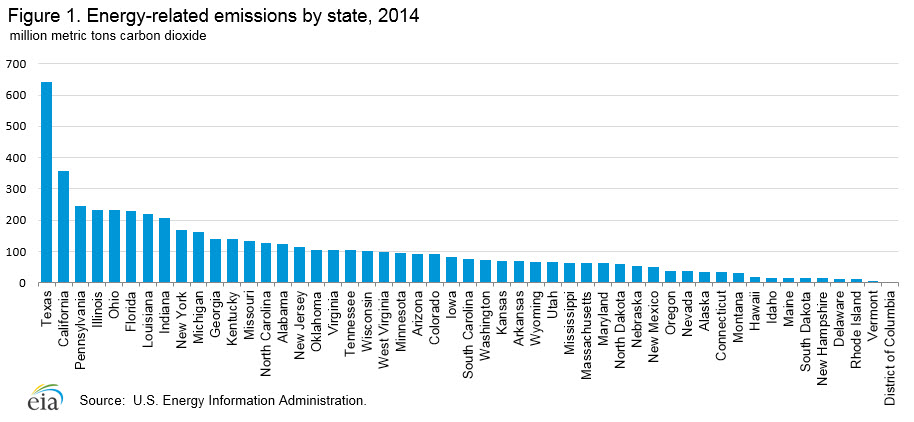
Take one look at the state-by-state CO2 admission rates and it is immediately apparent that two states stand out from the rest, California and Texas. Of these two, Texas stands head and shoulders over California. Over the span of ten years Texas produced over 7.5 trillion metric tons of CO2, That is more than the 19 lowest emissions states plus D.C. combined. Amost 12% of al the CO2 emissions generated in the United States came from Texas. Californai produced 6.6% while Pensyulvania, Ohio, Florida and Illinois each produce between 4.6% and 4% of the nations CO2 emissions.

What are the implications for carbon conservation when more than one-sixth (18.3%) of all CO2 emissions are coming from just two states? For one thing it suggests that focusing national efforts on Texas and California can produce the biggest improvements in the short term. Furthermore, the data suggests that half the states with the lowest emissions are already working harder to reduce further carbon emissions that higher CO2 producing states. Among the higher CO2 producing states, Florida, Georga, Kentucky, Missouri, Oklahoma, Arizona, Colorodo and South Carolina increased their carbon polution between 2000 and 2010.  Of these, the states with the highest rate of increase were Arazona (9.9%) and Colorado (11.8%). The largest state increase in carbon emissions over ten years was Nabraska (16.0%). So focusing our national effort on just a hand full of states might be the best strategy to make the biggest and quickest improvements in our carbon footprint in the world.
US ENERGY INFORMATION ADMINISTRATION

http://www.eia.gov/environment/emissions/state/analysis/


Release Date:
 May 13, 2013  |  Next Release Date: May 2014  |   full report State-Level Energy-Related Carbon Dioxide Emissions, 2000-2010

Overview
Energy-related carbon dioxide emissions vary significantly across states (Figure 1), whether considered on an absolute or per capita basis. The overall size of a state, as well as the available fuels, types of businesses, climate, and population density, play a role in both total and per capita emissions. Additionally, each state’s energy system reflects circumstances specific to that state. For example, some states are located near abundant hydroelectric supplies, while others contain abundant coal resources.This paper presents a basic analysis of the factors that contribute to a state’s carbon dioxide profile. This analysis neither attempts to assess the effect of state policies on absolute emissions levels or on changes over time, nor does it intend to imply that certain policies would be appropriate for a particular state.
The term “energy-related carbon dioxide emissions” as used in this paper, includes emissions released at the location where fossil fuels are used. For feedstock application, carbon stored in products such as plastics are not included in reported emissions for the states where they are produced.
Table 1. State energy-related carbon dioxide emissions by year (2000 – 2010)
million metric tons carbon dioxide
Change
 2000 to 2010
State 2000 2001 2002 2003 2004 2005 2006 2007 2008 2009 2010 Percent Absolute
District of Columbia 4.3 4.1 4.2 3.9 4.0 3.9 3.2 3.4 3.1 3.2 3.3 -23.6% -1.0 40.6
Vermont 6.8 6.6 6.4 6.5 7.0 6.8 6.7 6.6 6.1 6.3 6.0 -10.8% -0.7 71.9
Rhode Island 11.6 12.1 11.6 11.3 10.8 11.0 10.4 11.0 10.6 11.3 11.0 -4.8% -0.6 122.6
South Dakota 14.1 13.4 13.7 13.6 13.7 13.2 13.3 13.9 15.1 14.9 15.1 7.3% 1.0 154.1
Delaware 16.3 15.7 15.5 16.1 16.1 17.0 15.8 16.7 15.9 11.8 11.7 -27.9% -4.5 168.7
Idaho 15.6 15.5 14.9 14.2 15.5 15.7 15.8 16.3 15.8 15.4 16.2 4.0% 0.6 170.9
New Hampshire 17.5 16.9 17.6 20.8 21.9 21.3 19.4 19.3 19.1 17.3 17.0 -2.8% -0.5 208.0
Hawaii 18.8 19.2 20.5 21.5 22.6 23.2 23.5 24.4 19.7 18.9 18.9 0.7% 0.1 231.1
Maine 22.3 22.4 24.0 23.4 24.0 23.1 21.3 21.0 19.4 18.6 18.5 -17.1% -3.8 238.1
Montana 31.3 31.9 30.7 32.7 34.5 35.5 35.8 37.8 36.1 32.5 34.9 11.4% 3.6 373.6
Connecticut 42.8 41.5 39.9 42.3 44.4 43.9 40.9 40.3 38.2 36.5 36.9 -13.7% -5.8 447.7
Oregon 41.2 40.6 39.1 39.3 40.6 41.0 40.3 43.8 43.2 41.2 40.3 -2.4% -1.0 450.6
Nevada 45.3 44.6 41.4 43.4 47.7 49.8 41.5 41.8 41.2 39.7 38.1 -15.9% -7.2 474.3
Alaska 44.3 43.4 43.6 43.5 46.8 48.1 45.8 44.1 39.5 37.9 38.7 -12.6% -5.6 475.6
Nebraska 41.4 42.7 42.2 43.0 43.1 43.5 44.1 44.5 46.5 46.8 48.0 16.0% 6.6 485.7
North Dakota 50.8 51.7 51.4 50.9 49.5 52.4 50.8 52.6 53.1 51.4 52.5 3.3% 1.7 567.1
New Mexico 58.0 58.2 55.2 57.3 58.5 59.1 59.9 59.1 57.6 58.5 54.8 -5.5% -3.2 636.2
Arkansas 63.2 62.4 60.9 61.3 61.9 59.7 61.6 63.1 63.7 61.6 66.1 4.6% 2.9 685.8
Wyoming 62.7 63.0 61.7 63.4 63.4 62.8 63.7 66.1 66.8 63.7 64.9 3.5% 2.2 702.3
Mississippi 60.6 69.4 61.9 63.2 64.8 63.2 65.4 67.7 64.1 60.4 65.5 8.0% 4.9 706.1
Utah 65.1 62.9 62.1 62.7 65.3 67.0 68.3 70.4 69.9 65.0 64.2 -1.3% -0.9 723.0
Kansas 76.1 71.8 76.6 78.4 75.8 72.0 72.1 80.1 76.9 75.0 75.0 -1.3% -1.0 829.7
Maryland 77.5 78.0 77.9 80.4 82.0 83.9 77.5 78.1 74.7 71.4 70.5 -9.0% -7.0 852.0
Washington 82.8 79.4 72.8 74.5 76.7 78.3 76.3 81.8 79.6 77.5 76.1 -8.1% -6.7 855.9
Massachusetts 82.2 82.1 82.9 83.8 82.6 84.3 76.4 80.0 77.2 71.0 73.0 -11.2% -9.2 875.6
Iowa 77.7 76.6 77.2 76.4 78.9 78.9 80.2 85.7 88.3 83.8 88.7 14.1% 11.0 892.4
South Carolina 79.3 78.0 79.2 79.5 87.1 85.7 86.4 87.0 85.5 80.7 84.0 5.9% 4.7 912.5
Colorado 84.7 92.8 90.9 90.0 93.1 95.4 96.4 99.2 97.6 93.7 96.5 13.9% 11.8 1,030.3
Arizona 86.0 88.3 87.7 89.3 96.6 96.7 100.0 102.2 103.1 94.6 95.9 11.6% 9.9 1,040.5
Minnesota 97.7 94.7 97.3 101.0 100.6 101.7 99.1 100.9 100.6 93.1 93.4 -4.4% -4.3 1,080.3
Wisconsin 107.5 105.5 106.7 104.3 107.1 110.5 102.7 104.7 105.7 96.7 99.2 -7.7% -8.3 1,150.6
Oklahoma 100.1 101.4 101.6 103.5 99.8 106.9 110.2 109.6 113.1 104.9 103.4 3.4% 3.4 1,154.5
West Virginia 113.4 103.5 116.2 112.5 109.8 111.9 112.2 114.6 110.6 89.1 98.9 -12.7% -14.4 1,192.8
Virginia 122.3 120.0 118.5 122.2 126.5 128.5 122.0 127.7 117.4 106.3 109.8 -10.2% -12.5 1,321.3
Tennessee 125.2 124.2 123.2 120.9 123.0 124.6 127.0 126.7 120.3 100.3 107.1 -14.5% -18.1 1,322.4
New Jersey 121.1 118.5 118.9 119.8 122.6 127.6 120.2 128.6 124.3 110.4 115.4 -4.7% -5.7 1,327.5
Missouri 125.4 131.1 131.8 138.3 140.0 143.0 141.6 140.8 137.9 131.6 135.7 8.2% 10.3 1,497.2
Alabama 140.4 132.0 136.7 137.2 139.7 141.5 144.0 146.1 139.2 119.8 132.7 -5.5% -7.7 1,509.3
North Carolina 147.7 143.1 144.3 144.7 148.2 152.7 147.4 153.6 149.0 132.9 142.9 -3.3% -4.8 1,606.4
Kentucky 144.7 148.1 148.3 143.9 150.9 153.2 156.1 156.4 153.7 143.7 150.7 4.2% 6.1 1,649.7
Georgia 167.9 160.3 165.1 167.5 173.3 183.9 181.5 184.6 173.5 163.4 173.7 3.4% 5.8 1,894.7
Michigan 192.6 188.5 187.9 184.7 187.4 189.3 178.2 181.2 175.2 164.4 165.9 -13.9% -26.7 1,995.1
New York 211.4 206.7 200.8 210.1 213.9 210.7 192.5 199.4 190.5 175.5 172.8 -18.3% -38.6 2,184.4
Louisiana 239.9 211.9 219.8 214.6 226.2 221.7 236.0 234.5 221.7 203.9 223.5 -6.8% -16.4 2,453.6
Indiana 238.2 228.6 231.7 236.9 237.8 236.7 235.0 234.7 231.5 208.5 219.1 -8.0% -19.1 2,538.6
Illinois 232.1 223.1 225.1 227.7 235.2 242.0 233.9 242.1 240.7 226.1 230.4 -0.7% -1.7 2,558.3
Florida 239.2 238.1 241.3 244.9 257.3 260.9 259.5 257.8 240.2 226.3 246.0 2.8% 6.7 2,711.7
Ohio 264.0 254.5 260.3 267.4 262.5 269.7 263.0 268.9 261.9 237.6 249.1 -5.6% -14.9 2,858.9
Pennsylvania 276.3 263.4 270.1 273.0 276.6 280.0 274.1 277.6 264.9 246.0 256.6 -7.1% -19.7 2,958.7
California 381.3 385.8 384.9 389.5 391.5 389.0 397.5 403.7 389.8 375.9 369.8 -3.0% -11.4 4,258.6
Texas 711.3 704.1 715.8 706.4 709.7 677.8 675.2 676.7 653.3 624.9 652.6 -8.3% -58.8 7,507.7
Total1 5,879.9 5,772.4 5,810.0 5,857.5 5,968.8 6,000.4 5,921.6 6,029.0 5,842.9 5,441.8 5,631.3 -4.2% -248.6 64,155.6
1For the United States as a country see, EIA, Monthly Energy Review, Section 12: Environment.  Differing methodologies between the two data series causes
the total for all states to be slightly different from the national-level estimate.  The amount varies no more than 0.5 percent.  See Appendix A for details on
the data series differences.
Source:  U.S. Energy Information Administration (EIA), State Energy Data System and EIA calculations made for this analysis.
Note:  The District of Columbia is included in the data tables, but not in the analysis as it is not a state.

What Good Can Be Salvaged from the Trayvon Martin Case

Trayvon Martin is dead and George Zimmerman walks free. Was justice served?

From http://www.flickr.com/photos/23354940@N03/9280339883/: Hood Up! Justice for Trayvon Martin
Hood Up! Justice for Trayvon Martin by musyani75

That answer depends on who is asking the question. It should be a national outrage that this question splits us along both racial and political lines, but this has all become too predictable for outrage on these grounds. If we focus on the facts of the case the verdict divides us and there is no chance for reconciling our opposing views. If we shift the focus to our racial divide the glacial pace of reconciliation is measured in generations and no satisfactory solution can be seen. If we shift the focus to politics the question of justice will fade like an echo in the wind of endless partisanship. But focusing strictly gun laws in Florida may hold some slim hope for something good to come out of Trayvon’s death.  If this trial has done anything useful, it has been to drawn attention to the crazy legal framework that informed this verdict.

Who instigates a conflict that turns deadly has always been a factor in determining guilt. The concept is that deadly conflicts are be avoided at the earliest possible stage, before they turn deadly. If you initiate the conflict, the onus is on you to end it before someone gets hurt. The “stand your ground” laws in Florida and elsewhere upends this logic. Now, whoever walks away from a murderous gun fight can legally claim it was self-defense, even if the dead guy was unarmed. It is mostly a reasonable assumption that the survivor of a deadly conflict must have felt their life was in danger at some point.

In Florida, you can now walk up to anyone in the street, provoke them into assaulting you physically and then shoot them in self-defense. You are no longer held responsible for their death. If this was not the intent of the “stand your ground” laws, it is the absurd practical implication following this verdict. These laws, with their faulty legal premises, need to be overturned.

Still I have to wonder what the legal outcome would have been if Trayvon also had a gun and ended up shooting Zimmerman first. Would days pass before he was arrested and charged?  Would he have been acquitted by this jury?

If the only twist to this story was that Trayvon had managed to turn the barrel of Zimmerman’s gun around at the last instant to kill him, would the legal premise of the stand your ground law have been applied to Mr. Martin?  Would the actions of the police and the outcome of the justice system been different?  These questions are too important to ignore, but I am afraid the best answers to them depends largely on what we teach our children.

New Study – Sword Violence at an All Time Low

by Brian T. Lynch, MSW

A new study released by the O.K. Institute of Lake Woebegone, Minnesota, confirms that the rate of injury or death by swords continues to be exceeding rare in the 21st century. Once the leading cause of death in adolescents and young adults, both the incidents of sword play injury and sword related homicides remain at an all time low as a percentage of the population. In many US cities, even those with extraordinarily high homicide rates, the rate of sword related homicide was nearly zero between 2001 and 2012.

sword

Researchers speculate that the low sword homicide rate may be the result of the present low rate of sword ownership in the United States. Less than one in one-hundred households currently own a sword and fewer than 1 person in 100,000 openly carry a sword. This is in stark contrast to the 18th Century when it is estimated that 1 out of every 20 men owned swords. Sword ownership rates may have been considerably higher in some urban areas where swords were openly carried in the streets for protection.

In their remarkable analysis, the researchers believe they have found a direct correlation between the decline of sword ownership and the decline in sword related deaths. This correlation remained robust even when compensating for variables such as sword safety training, blade size and such demographic differences as age, race, religion and economic status of the sword owners.

A spokesman at the O.K. Institute, speaking on behalf of the researchers, speculates that the results of this study could have practical implications for understanding the current high rate of gun violence in the United States. Further studies will be needed to confirme these results and to explore whether these findings can be generalized to the prevalence of violence by other types of lethal weapons.

[Obviously satirical]