Home » Government (Page 4)
Category Archives: Government
OUR VOTING RIGHTS – A State by State Analysis
In an off handed comment made after the 2012 election, President Barack Obama said we need to fix our election process. This is a welcome suggestion. Our election process is badly broken and we need to take a good look at it. We should start by asking:
What voting rights do I have in my state?
This is not a commonly asked question, but it should be. Most of us believe voting rights are guaranteed under the federal constitution. This isn’t exactly true. The Constitution contains several amendments to prevented states from disenfranchising certain categories of voters. For example, states cannot use race, religion, gender or the age of anyone 18 or older as a means to disqualify a “citizen” from voting. The actual right of suffrage, however, isn’t a federal guarantee. This is up to the states. Fixing our voting system will be a state by state effort.
In all our public discussions about elections there is rarely mention of how voting rights differ in various states. When you look at state constitutional language on voting rights, however, you quickly learn that many of the rights we take as granted, such as a right to secret ballots, are nowhere to be found in most state constitutions. In fact, state constitutional voting rights differ widely from one state to the next.
The wide variation in voting rights are not immediately evident because state laws, administrative regulation and voting practices over time have created consensual frameworks for elections that appear similar from state to state. For example, the vote counting process is open for public view in most states, but only the constitutions of Louisiana, South Carolina and Virginia guarantee public vote counting. California is the only state guaranteeing that votes will even be counted. After candidates concede defeat based on vote projections, the states are not constitutionally obligated to finish counting every ballot.
When elections run smoothly and no questions are raised, everyone consents to the will of the majority. This is true because in a representative democracy, elected officials are expected to represent everyone’s interests and not just the interests of those who voted for them. But when elections are very close and the process seems flawed, explicit constitutional language is essential to protect the democratic process and win over the consent of the minority. Elections have consequences. Flawed elections or overtly partisan representation can have dire consequences. Faith in our democracy begins with faith in our voting systems.
I am not a lawyer or constitution expert, but curiosity about state voting rights caused me to survey all fifty state constitutions and document the articulated rights in each. Some results of this exercise are presented in the tables below. Keep in mind that some constitutions have very archaic language or formats that make them difficult to interpret. The information below represents my best effort to classify and document basic voting rights as articulated in state constitutions. It is followed by a brief discussion for each of the categories presented below.

– Numerous opportunities for the electorate to receive objective information from a free press.
– Freedom to assemble for political rallies and campaigns.
– Rules that require party representatives to maintain a distance from polling places on election day
– An impartial or balanced system of conducting elections and verifying election results
– Accessible polling places, private voting space, secure ballot boxes, and transparent ballot counting.
– Secret ballots – voting by secret ballot ensures that an individual’s choice of party or candidate cannot be used against him or her.
– Legal prohibitions against election fraud
– Recount and contestation procedures
PERCENTAGE OF CITIZENS COVERED BY THE VOTING RIGHTSARTICULATED IN STATE CONSTITUTIONS |
||
| Num. of States
w/This Right |
Percent of Population
w/this Right |
GENERAL VOTING RIGHTS |
|
1
|
9.7%
|
Right to Have Every Vote Counted
|
|
9
|
10.5%
|
General Right of Suffrage
|
|
21
|
44.0%
|
Right to Free and Fair Election
|
|
28
|
55.3%
|
Right to voting by ballot
|
|
23
|
46.7%
|
Right to secret vote
|
|
3
|
5.6%
|
Right to Public Vote Counting
|
|
15
|
32.6%
|
Frequency of Elections Right
|
|
23
|
36.5%
|
Privilege from Arrest during voting
|
|
21
|
36.5%
|
Privilege from Arrest Exceptions
|
|
2
|
1.6%
|
Right to accessible polling place
|
|
Num. of
States
w/This Right
|
Percent of Population
w/This Right
|
QUALIFICATIONS and EXCEPTIONS
|
|
49
|
99.6%
|
Must be A US Citizen
|
|
46
|
91.2%
|
Must be Registered to vote
|
|
20
|
27.6%
|
State’s Deployed Solders Can Vote
|
|
37
|
83.9%
|
Felony Exception
|
|
12
|
15.5%
|
Treason Exception
|
|
13
|
30.9%
|
Incarceration Exception
|
|
33
|
69.5%
|
Mental Capacity Exception
|
|
2
|
0.5%
|
Moral Conduct or other Exception
|
|
23
|
34.0%
|
Restoration from Exception
|
|
10
|
17.6%
|
No quartered solders
|
|
2
|
1.8%
|
Right to Appeal Voter Ineligibility
|
Voting Rights, a State by State Analysis
What voting rights do you have in your state?
This is an uncommon question. We mostly assume that voting rights are contained somewhere in the US Constitution, but this isn’t true. What the Federal Constitution does say, in several different amendments, is that states cannot use race, religion, gender or the age of anyone 18 years old or older as a means to disqualify a US citizen from voting. The actual right of suffrage, or the “franchise” as the election process is sometimes called, isn’t a federal right at all. Elections and the voting process are the purview of each sovereign state.
There is a table below which lists the basic voting rights spelled out in our state constitutions. You will see how voting rights differ significantly from one state to the next. Before reviewing the table, however, it is important to acknowledge that most states honor a host of voting “rights” and privileges beyond what is articulated in the constitutions. These unarticulated voting rights are often expression in state chapter laws or in the states voting procedures.
Many of us have come to view voting rights as “unalienable”, but they are not. Unlike explicit constitutional language, laws passed by legislatures and voting procedures established by the state executive branches of government can be changed or reinterpreted in novel ways. When elections run smoothly no questions are raised. But should something ever go unexpectedly wrong we need explicit state constitutional protections to redress our grievances. A discussion of each basic voting right contained in the table below will follows, along with a table that summarizes how common these rights are in America.
Basic Voting Right Articulated in State Constitutions
 |
RIGHT TO HAVE EVERY VOTE COUNTED – The first voting right listed on the table above is the right to have every vote counted. California is the only state that has this protection in their constitution. This right may seem obvious or unnecessary at first, but there are documented instances where absentee ballots have gone missing and uncounted. One example took place back in 2008 in Santa Fe, New Mexico, when garbage bags believed to contain missing ballots were impounded by police but not opened because it was unclear if the missing ballots had to be counted. This right, then, isn’t about hanging chads or undecipherable ballots, but about the obvious expectation that ballots properly cast are ballots properly counted, even if doing so doesn’t change who won.
GENERAL RIGHT OF SUFFRAGE – Many state constitutions have high sounding language about how all power is derived by the people, but only 9 state go on to guarantee the right of suffrage. Suffrage, according to Wikipedia, is the civil right to vote gained through the democratic process, It is the political franchise, or simply the franchise, which is distinct from mere voting rights. A right of suffrage forecloses the possibility of a state one day declaring a state of emergency and suspending elections. This is a seemingly remote possibility, but not so remote that 9 states have included this protection in their constitution.
RIGHT TO FREE AND FAIR ELECTIONS – “In any State the authority of the government can only derive from the will of the people as expressed in genuine, free and fair elections held at regular intervals on the basis of universal, equal and secret suffrage.” So said the Inter-Parliamentary Council at its 154th session in Paris, 26 March, 1994. Here in the US, the State Department was actually very helpful in sharing their view on Free and Fair Elections with nations whose democracies are less advance than our own. They provide the following guidelines:
Free and fair elections require:
— Universal suffrage for all eligible men and women to vote – democracies do not restrict this right from minorities, the disabled, or give it only to those who are literate or who own property
— Freedom to register as a voter or run for public office.
— Freedom of speech for candidates and political parties – democracies do not restrict candidates or political parties from criticizing the performance of the incumbent.
— Numerous opportunities for the electorate to receive objective information from a free press.
— Freedom to assemble for political rallies and campaigns.
— Rules that require party representatives to maintain a distance from polling places on election day – election officials, volunteer poll workers, and international monitors may assist voters with the voting process but not the voting choice.
— An impartial or balanced system of conducting elections and verifying election results – trained election officials must either be politically independent or those overseeing elections should be representative of the parties in the election.
— Accessible polling places, private voting space, secure ballot boxes, and transparent ballot counting.
— Secret ballots – voting by secret ballot ensures that an individual’s choice of party or candidate cannot be used against him or her.
— Legal prohibitions against election fraud – enforceable laws must exist to prevent vote tampering (e.g. double counting, ghost voting).
— Recount and contestation procedures – legal mechanisms and processes to review election processes must be established to ensure that elections were conducted properly.
Many of our soverign states could learn a lot from what the State Department has been preaching abroad. Only 44% of Americans can claim Free and Fair Elections as a constitutional protection in their state. It is ironic that the government Website from which the above information comes contains the following disclaimer:
NOTE: The America.gov website is no longer being updated.
RIGHT TO VOTE BY BALLOT – There are many ways to vote if you think about it. You can have a show of hands. You can call for the yeas and nays and judge the outcome by the volume of shouts. You can even draw straws. Ballots, on the other hands are unique to each voter, often secret and never shared by more than one voter. They are usually pre-printed paper, but increasing voting is by electronic ballot. This is a pre-programmed selection on an electronic device. Hopefully the results aren’t also pre-programmed (see Blackboxvoting.org for much more on this scary thought) Originally, voting was conducted using black or white balls, black being no and white being yes. The voter would pick up the ball of his choice and drop it into a container (or ball lot?). An important point about ballots is that they can be secret, unlike other methods. Voting by ballot is a protection found in 26 of 50 state constitutions.
RIGHT TO SECRET VOTING – The secrecy of our vote is among our most cherished rights, except it isn’t a right at all for more than 146 million American citizens, or at least it isn’t a constitutional right. Secret voting is essential to assure that how we vote can never be used against us, yet only 21 states have explicit constitutional language to guarantee secrecy in voting. Several other states guarantee the right to vote in private, but that’s not quite the same thing, is it?
RIGHT TO PUBLIC VOTE COUNTING – Stalin has been credited with saying, “The people who cast the votes decide nothing. The people who count the votes decide everything”. This speaks volumes for both the right to have our vote counted and the necessity to have all vote counting conducted in public view. This is especially true when ballots are cast is secret or when they are electronically invisible. Public vote counting is even more important as we rely more and more on private corporations to count our electronic ballots. They claim that the software they use to count or votes is so proprietary that even state election officials are not allowed to peek. Coupled with a trend among election officials to view with suspicion any voter who wants to observe the process, it is shocking that only 3 states constitutionally protect this essential right.
FREQUENCY OF ELECTIONS – It is one thing to guarantee that the government will hold elections and another thing to actually schedule them. Ask anyone from a parliamentary democracy about this and how it can be manipulated to benefit incumbents. Perhaps more to the point there should be a performance standard by which to judge whether we have a right to suffrage. That standard for 15 states is some clear constitutional language about when, or how often elections are to be held. While 100% of Americans know when to expect their elections, only 30% of them have this guarantee in writing.
PRIVILEGE FROM ARREST AND EXCEPTIONS – Imagine yourself heading out to perform your civic duty on election day. You show up to vote and notice a police presence out front. Maybe you have some outstanding parking tickets or a warrant for not paying child support. Maybe you missed a municipal court date on some trivial matter. Do you walk past the police and risk arrest, or do you give up your vote to right out of fear of being arrested? This is the predicament that a privilege from arrest is designed to resolve. Unless your crimes are so felonious or treasonous, or unless you cause a public disturbance at the polling site, a privilege from arrest while going to, coming from or being at the polling place is constitutionally
guaranteed in 21 states. It should be all 50 states because this scenario is all too common. We should not see a police presence at or near the polling places. We are all presumed innocent unless actually convicted of an offense. No law enforcement authority should prevent anyone from exercising their right to vote. The absence of this constitutional privilege can have a disproportional impact on minorities and the poor, yet only a third of our citizens are covered by this protection.
RIGHT TO ACCESSIBLE POLLING PLACES – “… polling places shall be easily accessible to all persons including disabled and elderly persons who are otherwise qualified to vote,” says the New Hampshire State Constitution. Is this right necessary? After all, don’t we have the Americans with Disabilities Act? Yes we do, but does the Americans with Disabilities Act strictly apply? It’s an open question. More broadly, do we have a right to expect adequate polling places and voting machines in every community without undo commutation hardships or excessively long lines? We could do better. Only New Hampshire has this provision but something more broadly stated would be a good idea for every state constitution.
Here now is a summary of findings regarding state constitutional voter rights:
|
VOTING RIGHTS ARTICULATED IN US STATE CONSTITUTIONS |
||
|
Number of States With This Right |
Percent of US Population WithThis Right |
GENERAL VOTING RIGHTS |
|
1 |
9.7% |
Right to Have Every Vote Counted |
|
9 |
10.5% |
General Right of Suffrage |
|
21 |
44.0% |
Right to Free and Fair Election |
|
26 |
55.3% |
Right to voting by ballot |
|
21 |
46.7% |
Right to secret vote |
|
3 |
5.6% |
Right to Public Vote Counting |
|
15 |
32.6% |
Frequency of Elections Right |
|
21 |
36.5% |
Privilege from Arrest during voting |
|
21 |
36.5% |
Privilege from Arrest Exceptions |
|
2 |
1.6% |
Right to accessible polling place |
|
|
|
|
|
Number of States With This Right |
Percent of US Population WithThis Right |
QUALIFICATIONS and EXCEPTIONS |
|
49 |
99.6% |
Must be A US Citizen |
|
46 |
91.2% |
Must be Registered to vote |
|
20 |
27.6% |
State’s Deployed Solders Can Vote |
|
37 |
83.9% |
Felony Exception |
|
12 |
15.5% |
Treason Exception |
|
13 |
30.9% |
Incarceration Exception |
|
33 |
69.5% |
Mental Capacity Exception |
|
2 |
0.5% |
Moral Conduct or other Exception |
|
23 |
34.0% |
Restoration from Exception |
|
10 |
17.6% |
No quartered solders |
|
2 |
1.8% |
Right to Appeal Voter Ineligibility |
Government Jobs Not Rebounding As In Past Recessions
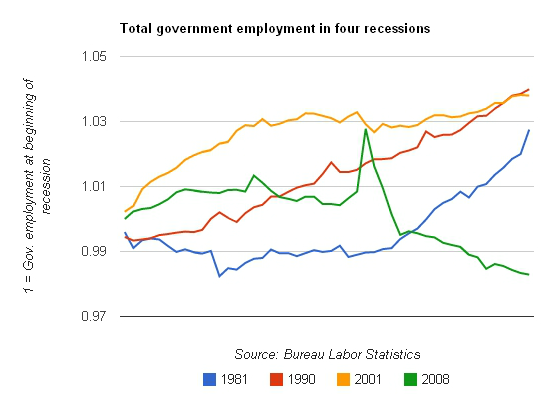

Public-sector austerity in one graph
On Friday, I ran some numbers on public-sector employment: Since Obama was elected, the public sector has lost about 600,000 jobs. If you put those jobs back, the unemployment rate would be 7.8 percent. [SNIP]
Today, Ben Polak, chairman of the economics department at Yale University, and Peter K. Schott, professor of economics at the Yale School of Management, widen the lens, with similar results: There is something historically different about this recession and its aftermath: in the past, local government employment has been almost recession-proof. This time it’s not. [SNIP] Go to like to read the rest of Ezra Klein’s article. Thank you.
A Flat Tax Payroll Deduction Might Save Social Security
DATA DRIVEN POINT OF VIEW: Don’t be fooled. Discussions about raising or lowering Federal Income Taxes has little to do with Social Security and Medicare, which are separately funded by payroll deductions. Is there a funding crisis for Social Security and Medicare? A long term problem, yes. A crisis, no. Can America continue to afford these programs given the number of baby boomer retirements? The answer is yes, of course we can. We are the wealthiest county on Earth. Nations with far less wealthier already provide their citizens with much more generous benefits. The reason we feel the funding punch is that the structure we’ve enacted to pay for federal insurance benefits is so regressive.
We could institute a flat tax for Social Security and Medicare. The table below shows what this might generate in premiums at the current 7.65% rate of payroll deductions. This plan would clearly generate more revenue than needed for current benefits. A flat payroll tax of significantly less than the current 7.65% would be all that is needed to fully fund Social Security and Medicare. It would reduce payroll taxes for the majority of Americans.
|
Payroll Taxes for Social Security and Medicare
|
||||
|
Total Income from Wages
|
Amount Currently Deducted
|
Contribution As a % of Income
|
Contribution if deductions were based on a flat tax
|
|
|
$1,000
|
$77
|
7.65%
|
$77
|
This Segment Represents 57 million households
|
|
$10,000
|
$765
|
7.65%
|
$765
|
|
|
$50,000
|
$3,825
|
7.65%
|
$3,825
|
|
|
$100,000
|
$7,650
|
7.65%
|
$7,650
|
|
|
$500,000
|
$8,423
|
1.68%
|
$38,250
|
|
|
$1,000,000
|
$8,423
|
0.84%
|
$76,500
|
There are at least 100,000 household in this segment
|
|
$10,000,000
|
$8,423
|
0.084%
|
$765,000
|
|
|
$50,000,000
|
$8,423
|
0.017%
|
$3,825,000
|
|
|
$100,000,000
|
$8,423
|
0.0084%
|
$7,650,000
|
|
|
$500,000,000
|
$8,423
|
0.0017%
|
$38,250,000
|
|
|
$1,000,000,000
|
$8,423
|
0.00084%
|
$76,500,000
|
|
|
$10,000,000,000
|
$8,423
|
0.000084%
|
$765,000,000
|
|
This table assumes that income from wages for the wealthy are at least $110,100, which is the income cap for 2012, and assumes they are not self-employed. Income from investments are not subject to payroll deductions. Employers pay an additional 7.65% in payroll taxes for their employees. The self employed also pay corresponding more in payroll taxes for their Social Security and Medicare benefits. Additional payroll deductions for unemployment and disability insurance may also apply in certain states and with certain individual.
These programs exist for everyone, and everyone should contribute according to their means. Those who are fortunate enough not to need the benefits still have a moral obligation to assure a minimal level of care to those less fortunate, and a social obligation to contributed to those who gave a lifetime of labor creating the fabulous wealth that the wealthy have accumulated.
Our Long-term Debt Will Be Fixed If Congress Does Nothing – But Don’t Count On that!
According to the Congressional Budget Office information (see below), it appears that if the “do-nothing” Congress actually does nothing the nation’s long term debt outlook would significantly improve. As it stands, temporary tax cuts are set to expire and automatic budget cuts already passed by Congress with bi-partisan support are set to take effect. As a result of laws already on the books our long-term debt problem is about to be fixed. But Congress will have none of this! Nor should they!
The 2012 Long-Term Budget Outlook: Infographic

The Real Lesson of the “Fast and Furious” Scandal
Thanks to the great reporting of Katherine Eban at Fortune magazine we now know that the “Fast and Furious” scandal was largely manufactured for political gain. The “Fast and Furious” operation by the bureau of Alcohol, Tobacco, Firearms and Explosives (the ATF) in Arizona was never designed to include the tactic of “gun walking”. Gun walking is the practice of intentionally not ceasing illegally purchased firearms in order to follow the subsequent chain of possession back to higher level criminals. It seems a few rogue ATF agents did engaged in an incident of this type on their own initiative, which does make it the AFT’s problem, but the specific guns the ATF is accused of allowing to walk across the border, one of which was used to kill a border guard named Brian Terry, could not be ceased by the ATF because the Arizona federal Prosecutors decided these weapons were legally purchased. Federal prosecutors in Arizona were broadly interpreting Arizona’s gun laws which are among the weakest gun laws in the nation.
The truth about the Fast and Furious scandal
June 27, 2012: 5:00 AM ET
The article begins:
FORTUNE — In the annals of impossible assignments, Dave Voth’s ranked high. In 2009 the federal Bureau of Alcohol, Tobacco, Firearms and Explosives promoted Voth to lead Phoenix Group VII, one of seven new ATF groups along the Southwest border tasked with stopping guns from being trafficked into Mexico’s vicious drug war.
PLEASE READ IT: http://features.blogs.fortune.cnn.com/2012/06/27/fast-and-furious-truth/
The Truth About the ATF Scandal Please…
The venerable New Jersey Star Ledger newspaper printed an editorial on June 30, 2012, in which it repeated as fact a purely partisan narrative known as the ATF’s “Fast and Furious” scandal. Here below is my full response:
As for the 2000 high powered weapons supposedly lost by the ATF, (as per Republican Congressman, Darrell Issa) virtually all of them were legally purchased according to Arizona’s federal prosecutors. This includes the gun later used to kill a U.S. border guard.
The hard truth is that Federal prosecutors broadly interpret Arizona’s gun laws, which are already the weakest in the nation. In Arizona, an unemployed 18 year old with no criminal record can walk into a gun shop, buy fourteen AK-47 assault rifles, certify they are for personal use, change his mind after walking out of the store and then legally sell them to anyone in the parking lot. It’s as if the gun laws in Arizona were designed for gun traffickers. Frustrated ATF agents believed the weapons in question were going to criminals but were over ruled. It is the system that allowed these guns to walk, not the AFT.
Meanwhile, 55,000 Mexican citizens have been killed in the last five years in the battle among drug cartels and Mexican police. It is estimate that 2000 weapons a day cross our Southern border into Mexico and there’s little the AFT can do about it.
I doubt Eric Holder criminally withheld documents from Congress, but the facts about this haven’t filtered out yet. The whole scandal appears to be a political witch hunt. What has become clear, however, is that the guns needed to support Mexican drug cartels are flooding over the border every day while tons of their illegal product floods back here to destroy more American lives.
Thanks to the great reporting of Katherine Eban at Fortune magazine
Note: Many newspapers around the country are probably relying on Congressman Issa’s partisan narrative when reporting on this story. His commentary has been around for months while the Eban report is just days old. Even so, it is revealing how much journalists must depend on the messages politicians give them. Enterprise journalism (or investigative journalism), is what we need to verify what politicians say. This type of journalism is labor intensive and expensive. Eban’s investigation took six months. Corporate media outlets are profit driven, not truth driven enterprises. Newspapers in particular are in financial trouble. Readership and advertising sales are down. I sometimes wonder if readership is down in part because newspapers no longer provide us with trusted, independently verified news?
A Billionaire to Regulate Billionaires at the SEC
A TALE OF TWO NORMS

NORM AS DIRECTOR:
SEC Names Norm Champ as Director of Division of Investment Management
2012-129
 Data Driven Viewpoints