Home » Society (Page 5)
Category Archives: Society
Over Population is Key to Understanding Our World
Over population is the elephant in the room than nobody talks about. Take most any crisis we face today, shrink it by 3 or 4 billion people and the problem goes away. Global population has doubled, and just about doubled again in my lifetime. It has fundamentally altered everything. It’s been estimated that there are as many people alive today as have ever lived before. Given our reproductive success as a species, it is easy to forget that population constrain is an unavoidable force of nature. Every species that ever was or ever will be is brought into natures balance. This WILL happen to humans with or without our planning. If we don’t take responsibility for a sustainable world the natural consequence could include human extinction. Natural consequences are seldom humane. Our intelligence has made us successful up till now, but if we don’t apply our ability to reason on this problem we won’t look so smart in the future. (selected reading below)
In the time it takes you to read this post there will be 2,000 more people in the world.
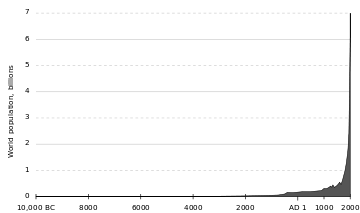
Graph of human population from 10,000 BC – 2,000 AD showing the unprecedented population growth since the 19th century
HERE IS A WORLD POPULATION CLOCK
Work to curb world overpopulation must begin now
Published July 11, 2012
http://www.theolympian.com/2012/07/11/2169964/work-to-curb-world-overpopulation.html
Tuesday morning, the world’s population stood at 7,025,367,636. Some believe that’s already a billion more than the planet can ultimately sustain, but the number is growing annually by 80 million people.
At that rate – about 9,100 new people per hour – the world population increases by roughly the size of Thurston County [Washington State] every day.
This morning, in London, on World Population Day, the Bill and Melinda Gates Foundation brought world leaders together to kick off a $4 billion fundraising campaign to provide contraceptives for 120 million women who do not have access to birth control, all of them in the poorest countries. [snip]
Overpopulation Problems; Lack of Resources
The World’s New Numbers
by Martin Walker
OVERPOPULATION: A KEY FACTOR IN SPECIES EXTINCTION
As the world’s population grows unsustainably, so do its unyielding demands for water, land, trees and fossil fuels — all of which come at a steep price for already endangered plants and animals. Most biologists agree we’re in the midst of the Earth’s sixth mass extinction event; species are disappearing about 1,000 times faster than is typical of the planet’s history. This time, though, it isn’t because of geologic or cosmic forces but unsustainable human population growth.
Today’s global human population is over 7 billion. Every day, the planet sees a net gain of roughly 250,000 people. If the pace continues, we’ll be on course to reach 8 billion by 2020 and 9 billion by 2050.

By any ecological measure, Homo sapiens sapiens has exceeded its sustainable population size. Just a single human waste product — greenhouse gas — has drastically altered the chemistry of the planet’s atmosphere and oceans, causing global warming and ocean acidification.
In the United States, which has the world’s third largest population after China and India, the fertility rate peaked in 2007 at its highest level since 1971 before dropping off slightly due to the recent economic recession. At 2.1 children per woman, the U.S. fertility rate remains the highest among developed nations, which average around 1.6. The current U.S. population exceeds 300 million and is projected to grow 50 percent by 2050.
The mission of the Center for Biological Diversity is to stop the planetary extinction crisis wiping out rare plants and animals around the world. Explosive, unsustainable human population growth is an essential root cause of this crisis.
We can reduce our own population to an ecologically sustainable level in a number of ways, including the empowerment of women, education of all people, universal access to birth control and a societal commitment to ensuring that all species are given a chance to live and thrive. All of these steps will decrease human poverty and overcrowding, raise our standard of living and sustain the lives of plants, animals and ecosystems everywhere.
Free Market Enterprise Is No Way to Distribute Social Services
Where do you turn when your aging mother can’t be by herself anymore, or you notice your baby seems a little delayed. Imagine that your teenager starts skipping school and staying out all night or imaging you are suddenly diagnosed with a serious illness or disabled in an accident? Where do you go for help?
Sooner or later we all knock on the door of our community’s social service network. What greets us may be far less than we expect. And sadly, the help available to us will depend a lot on where we live and how much money we make. The confusing patchwork of private, public and non-profit social service agencies through which we must navigate is the natural, unintended consequence of the free market model we’ve created to deliver social services.
We are all only temporarily able bodied. When don’t give much thought social services. We are content knowing that free market competition is efficiently keeping down the cost of publicly financed services for the needy.
It isn’t until we seek help ourselves that we encounter a labyrinth of agencies with confusing components and cutesy sounding acronyms for their name. Agencies often list the types of services they offer (counseling, for example) without listing the types of problems they serve (such as adolescent issues). Consumers are expected to know which services work best for their problems. Some agencies over promise results in their marketing or take on people with problems that would be bettered resolved elsewhere. Access to services are often restricted by bewildering eligibility requirements based on age, gender, geography, diagnosis, income, insurance provider, religion, ethnicity, funding source or hours of operation.
If your family has one or two very common problems, chances are you will find the help you need. But if your problems are uncommon or complex your search will not go smoothly, and if you also happen to be poor, live in an under served community or don’t have transportation, the prospects for getting effective help are slim.
This is character of our social service networks today. They are not based on matching service availability and capacity to the needs of local communities. They are loosely coordinated networks created by free market forces and competition between private or non-profit agencies scrambling for dollars.
For over thirty years we have been privatizing public social services in the belief that free markets are more efficient than government in providing the best services at the lowest cost. Little attention is given to the inescapable fact that market driven systems create uneven results by their very nature. This is true in commerce but especially true in public social welfare. Larger agencies are more politically connected and better positioned to compete for public dollars. Wealthier communities have a higher profit potential so they attract more and better competitors. Smaller agencies and program models that incorporate innovative ideas are less able to compete for government money.
Innovative approaches to helping people are usually funded in small trials by private foundations. Even when these trials prove successful, bringing them up to scale is almost impossible. Agency competition actually works against it because social service providers are competing on an artificial playing field.
Governments create the playing field on which agencies compete, but the government departments responsible for developing and funding social service contracts are often under staffed and ill equipped to monitor service outcomes. They also lack the personnel and special expertise it takes to design better programs. The time and effort involved in researching literature, writing contract proposals, putting contracts out for bid and guiding the implementation of new programs is enormous . Politicians don’t what to spend what it would cost to create real free market competition for high quality services.
To overcome the uneven distribution of services problem, governments develop specially targeted service contracts with extra financial incentives to serve specific areas. But these initiatives are expensive and tax revenues are declining. Targeted service contracts are usually limited in size and scope because of their higher costs.
We have come to the point where the quality and availability of essential social services, to treat an abused child for example, becomes an accident of birth. So often I have seen that a child can get this great service if she lives here but not if she happens to live a few towns away. Free markets are very efficient at distributing profits according to
Not surprisingly, the free market approach to social service delivery mirrors what we see today in our free market economy. Larger corporations have tremendous advantages over smaller, more local businesses. Most of the mom and pop store that once served local communities have been driven out of business. Chain stores that replace them tend to locate in more profitable communities and away from less profitable or economically blighted areas, further adding to the decline of poorer communities.
Another consequence of our particular brand of free market capitalism is the tendency of large corporations to optimize profits by catering to the average, hence largest segments of the population. For example, big retail clothing outlets carry a range of sizes that is narrower than the population as a whole. This forces some customers to shop in higher priced specialty stores and settle for less fashionable clothing. In another example, privatized bus and rail services tend to drop less profitable routes isolating those who can’t drive. This can have a disproportional impact the poor or elderly living in commercially less viable areas. In fact, the free market model is efficient, in part, because it discriminates between profitable and less profitable geographic markets or market segments.
What then makes the free market model the best approach for dispensing publicly funded social services, especially since the distribution of need for services is so often found in commercially unviable communities?
This is a question I hope to explore in future posts. I hope to elaborate on this discussion of our social service delivery model.
For now, however, please consider a minor example of how a alternative system might look. The example below may serve as a window into a different ways of thinking about social services.
Imagine the benefit of a seamless partnership between public health, education and community social services conveniently located in public buildings distributed throughout cities and local communities across America. Imagine if each of these public facilities provided modern classrooms, resources and teachers to educate our children during the day and provide remedial and secondary educational services to adults in the evening. These facilities would also provide after school and evening sport and recreational opportunities for the community. Imagine each of these facilities having community health clinics or screening centers staffed to meet the local public health needs of these children and families. Imagine each of these facilities serving as comprehensive social service intake and referral centers for families and the surrounding community . Each of these local facilities could be configured, staffed and funded to best meet the local needs of the immediate surroundings. A network of these local facilities would have among its goals the elimination of health, educational and social inequality and the provision of equal access to all public services.
This might seem like a grandiose plan, but much of the bricks and mortar infrastructure already exists to support it… our public schools. Public schools are located in the communities they serve and more accessible than most social service agencies serving the same community.
This concept above is a small start, yet it goes well beyond what is currently under construction in the field of Education today, for example. Some work is being to to develop what is being called “full-service community schools”. An example of this can be found on the Website of Steny Hoyer, a Congressman from Maryland and from the OaklandUnified School District, in California, which is attempting, with some success, to implement this model.
Full-Service Community Schools – Thinking Outside the Classroom
Why do so many schools have auditoriums? Why do they have athletic fields?
We take features like those for granted today, but there was a time when a school building with anything more than classrooms and chalkboards was considered wildly unorthodox. But, more than a hundred years ago, educators came to realize that schools can be more than simply places for instruction: they can be the center of their communities.
Indeed, classroom education is only one piece of the puzzle when it comes to ensuring that all children succeed. The notion of building a future of opportunities for our children through community partnerships that give them and their families the tools they need to grow and thrive is at the heart of the full-service community schools movement.
Full-service community schools work with local organizations and the private sector to coordinate a wide range of services for students and families. At a full-service community school you might find health clinics or dental care, mental health counseling, English lessons for parents, adult courses, nutrition education, or career advice. For high-need communities that require social services, there is no more welcoming — or efficient — place to house them than in a public school. Schools like these quickly find a place at the heart of their communities, staying open long after school hours and on weekends, giving neighbors a place to come together and participate in the education of their children.
Here in Maryland, we have seen the success of such a model in our state’s Judith P. Hoyer Early Child Care and FamilyEducation Centers, or “Judy Centers.” The 24 Judy Centers throughout Maryland promote school readiness through collaboration among community-based agencies and organizations located within each Center. State evaluations of theJudy Centers have shown increased access to high-quality programs and services for low-income and special needs children and that they improve school readiness and minimize the “achievement gap” at the start of first grade.
A decade of research on full-service community schools has consistently shown that they promote higher student achievement and literacy, stronger discipline, better attendance and parental participation, a reduction in dropouts, and increased access to preventive health care (a factor that is especially urgent as we face a possible flu epidemic).
With these benefits in mind, Congress is considering legislation I have introduced that could greatly expand the number of full-service community schools in America — one of the most important pieces of school legislation in recent years. It would provide grants for states and school districts to work with community organizations and businesses to create the kind of programs that have had so much success at schools across America. Strengthening services in schools also has the potential to save our country money on everything from prison systems to emergency room visits.
Oakland Unified School District:
A Full-Service Community School in Oakland serves the whole child; it invites the community in and extends its boundaries into the community in order to accelerate academic achievement; it shares responsibility for the student, family and community success.
Despite Flaws, We May Be The Model For Pluralistic Societies
The story which follows supports a theory of mine that the UnitedState, with its highly diverse population, and despite all our ethnic and racial bias, may still be the most social advanced nation with respect to the development of a pluralistic society. Pluralistic societies, to the extent of ours here in America, are a relatively recent development. Our founding fathers were thefirst to build a nation based on principles and ideals instead of geographic population and culture. This was, and is, a gift to human progress.
European nationality remains primarily based on geography and the resulting cultural diversity that historical isolation once allowed. What would happen, for example, if migration patterns resulted in the majority of the Germans being from various other cultures? While we have a long way to go in becoming a truly pluralistic society, we have a two-hundred year head start over most other countries. Unfortunately, there are those here who would undo this progress but the long arch of history is not on their side.
Greece: Halt Mass Migrant Round-Ups
Discriminatory Police Sweeps Violate Rights
AUGUST 8, 2012
(London) – The Greek authorities’ ongoing sweeps targeting suspected migrants based on little more than their physical appearance violate international standards, Human Rights Watch said today. Since August 4, 2012, more than 6,000 foreigners presumed to be undocumented migrants have been taken into police stations for questioning, and more than 1,500 arrested for illegal entry and residence with a view to deportation to their countries of origin.
“Greece has the right to enforce its immigration laws, and after a fair process, to deport people with no legal basis to stay in the country”, said Benjamin Ward, deputy director of the Europe and Central Asia division at Human Rights Watch. “But it doesn’t have the right to treat people like criminals or to presume irregular immigration status just because of their race or ethnicity.”
Greek police must have specific cause to stop and question people beyond the appearance of their national origin. Mass expulsions are strictly prohibited under international law. Greece is also legally bound not to return refugees to persecution or anyone to risk of torture. Yet Greece has failed to demonstrate its capacity even to receive asylum claims, let alone to process and decide them fairly, Human Rights Watch said.
Human Rights Watch and others have also documented inhuman and degrading conditions in Greek migrant detention facilities. While enforcing its immigration laws, Greece needs to be scrupulous in respecting the basic human rights of migrants. Greece should not discriminate based on race or ethnicity and should not subject migrants to arbitrary detention, inhuman and degrading treatment or to summary removal without due process of law. Greece should also provide effective remedies to those in need of protection.
With its deep economic crisis, and after years of mismanaged migration and asylum policies, anti-migrant sentiment has grown in Greece. A far-right party entered parliament for the first time in 2012 elections. A recent Human Rights Watch report showed that xenophobic violence in Greece has reached alarming proportions, with gangs regularly attacking migrants and asylum seekers. The attackers are rarely arrested, and police inaction is the rule.
“Greek police have a duty to protect all foreigners from violence, just as they do Greek citizens”, Ward said. “These sweeps are a dangerous distraction from the real policing challenges the country faces.”
U.S. Drops to 12th Place on Global Prosperity and Well Being Index
How prosperous is the United States compared with other nations? The latest Prosperity Index is out, and the news for America is disappointing. The U.S. fell to 12th place in the world, just behind Luxembourg and Ireland. Partisan and ideologically driven arguments should to be set aside for the moment as we analyze and assess this data. We should take this finding as a challenge to be solved by appealing to our strengths as a nation. In the coming months I will be exploring various aspects effecting our national prosperity. I invite the readers of this blog to check back periodically to see what I uncover.
The 2012 Legatum Global Prosperity Index of Wealth and Well Being
The just released Global Prosperity Index finds the United States has fallen to 12th place in the world. This is the first time the US has not been in the top 10 group. The Index is based on the Dubai-based Legatum Institute’s assessment of prosperity based on both material wealth and personal wellbeing in 142 different countries, in eight categories ranging from the economy and entrepreneurship to health and personal freedom. The top 25 nations ranking is as follows:
Prosperity Index
1 – Norway
2 – Denmark
3 – Sweden
4 – Australia
5 – New Zealand
6 – Canada
7 – Finland
8 – Netherlands
9 – Switzerland
10 – Ireland
11 – Luxembourg
12 – U.S.
13 – UK
14 – Germany
15 – Iceland
16 – Austria
17 – Belgium
18 – Hong Kong
19 – Singapore
20 – Taiwan
21 – France
22 – Japan
23 – Spain
24 – Slovenia
25 – Malta
There are eight categores by which national prosperity is judged. The United States scored as follows on these eight categories:
Ranking Catigory
20 Economy
12 Entrepreneurship /Opportunity
10 Governance
5 Education
2 Health
27 Safety/Security
14 Personal Freedom
10 Social Capital
Male Contraception Could Mute Abortion Debate
Bio-technology may one day mute the abortion debate by curtailing the number of unintended pregnancies. The possibility of developing an effective male contraceptive just improved.
Scientists from Monash University, the University of Newcastle, John Curtin School of Medical Research and Garvan Institute of Medical Research, in Australia; and the University of Cambridge, in the UK have advanced research that could lead to a male contraceptive. They discovered a genetic mutation in a protein (RABL2) that shortens a sperm cell’s tail and limits its ability to swim. According to an article published October 8, 2012 in Genetics (Medical Xpress), “In laboratory tests, the team found that a mutation in RABL2 resulted in sperm tails that were 17 per cent shorter than normal. Dysfunctional RABL2 also negatively affected sperm production, resulting in a 50 per cent decrease. “
http://medicalxpress.com/news/2012-10-closer-male-contraceptive-pill.html
According to the report, RABL2 also works with other molecules known as intraflagellar transport proteins that carry genetic cargo along the sperm tail. Dysfunctional RABL2 results in lower sperm counts as well as sperm structure that reduces a its potency as well as its motility. With these insights it may be possible in the future to develop a pill that inhibits this protein. The prospect is not straight forward, however, because lower concentrations of RABL2 is also found in other organs. The trick would be to find a way to inhibit it only in the testes.
DATA DRIVEN VIEWPOINT:
The development of a male contraception should be a welcome, even an urgent goal for pro-life advocates. A male contraceptive pill would greatly reduce the number of abortions in the United States and bypass most religious based objections to post-fertilization contraceptives methods currently available for woman.
As it stands now, people have been fruitful and have multiplied to the point where human population is creating enormous stress on the planet’s ecosystems. There are more people alive today than have already died in the past. And population growth is still rising exponentially. It is a mathematical certainty that we either take control of our population growth or nature will do it for us in ways that could lead to our extinction. Any advances in contraception and increased ability of families to control reproduction is welcome news.
Paul Ryan’s Mentor: Ayn Rand, the Mother of Modern Conservatives
On April 30, 2012, The Atlas Society published a piece called “Paul Ryan And Ayn Rand’s Ideas: In The Hot Seat Again.”
In it they talked about the close association then vice presidential candidate, Rep. Paul Ryan, had drawn between Ayn Rand and his own political philosophy. Publicity surrounding his views were prompted by a National Review article entitled, “Ryan Shrugged” which characterize as an “urban legend Ryan’s alleged connections to Rand’s Objectivist philosophy. While Rep. Ryan may never have expressly indicated he embraces her Objectivist philosopy, he is clearly a fan of Ayn Rand‘s ideas and requires his staff to read Atlas Shrugged. (See National Review’s “Ryan Isn’t a Randian” for more along these lines.)
How closely Paul Ryan and other conservative associate themselves with Ayn Rand’s Objectivism is important because it shines a light on the heart and soul of their political objectives. Ayn Rand, a staunch believer in individualism and foe of collectivism in any form, believed altruism and any form of self-sacrifice was evil. She meant this literally, and any institutions based on such collectivist notions were also evil. This included churches and all major religions. Ayn Rand was obviously an atheist. This is an inconvenient truth for Ryan and many evangelical Christians who have adopted Rand’s ideology with respect to the behavior of corporations and the formulation of government business policies. Rand’s Objectivism philosophy has become, ex-post-facto, the underpinning for today’s very aggressive brand of capitalism. In fact, the incompatibility of Rand’s value systems applied to business behavior and Christian values applied to human behavior is the great paradox of our time. Objectivism and Religion antithetical belief systems. (To hear a little more about Ayn Rand in her own words, listen to her interviewed on the Phil Donahue Show back in 1979.)
In the article the Atlas Society released an audio recording of a 2005 speech mand by Paul Ryan at the organizations “Celebration of Ayn Rand” event. That audio file is posted here below along with the following excerpts [highlights are mine].
Congressman Paul Ryan on Ayn Rand
(1:45) I just want to speak to you a little bit about Ayn Rand and what she meant to me in my life and [in] the fight we’re engaged here in Congress. I grew up on Ayn Rand, that’s what I tell people. You know everybody does their soul-searching, and trying to find out who they are and what they believe, and you learn about yourself.
(2:01) I grew up reading Ayn Rand and it taught me quite a bit about who I am and what my value systems are, and what my beliefs are. It’s inspired me so much that it’s required reading in my office for all my interns and my staff. We start with Atlas Shrugged. People tell me I need to start with The Fountainhead then go to Atlas Shrugged [laughter]. There’s a big debate about that. We go to Fountainhead, but then we move on, and we require Mises and Hayek as well.
(2:23) But the reason I got involved in public service, by and large, if I had to credit one thinker, one person, it would be Ayn Rand. And the fight we are in here, make no mistake about it, is a fight of individualism versus collectivism.
(2:38) In almost every fight we are involved in here, on Capitol Hill, whether it’s an amendment vote that I’ll take later on this afternoon, or a big piece of policy we’re putting through our Ways and Means Committee, it is a fight that usually comes down to one conflict: individualism vs. collectivism.
(2:54) And so when you take a look at where we are today, ah, some would say we’re on offense, some would say we’re on defense, I’d say it’s a little bit of both. And when you look at the twentieth-century experiment with collectivism—that Ayn Rand, more than anybody else, did such a good job of articulating the pitfalls of statism and collectivism—you can’t find another thinker or writer who did a better job of describing and laying out the moral case for capitalism than Ayn Rand.
(3: 21) It’s so important that we go back to our roots to look at Ayn Rand’s vision, her writings, to see what our girding, under-grounding [sic] principles are. I always go back to, you know, Francisco d’Anconia’s speech (at Bill Taggart’s wedding) on money when I think about monetary policy. And then I go to the 64-page John Galt speech, you know, on the radio at the end, and go back to a lot of other things that she did, to try and make sure that I can check my premises so that I know that what I’m believing and doing and advancing are square with the key principles of individualism… [To better understand Ryan’s references here go to David Weigel’s commentary in Slate from August 13, 2012 ]
(6:53) Is this an easy fight? Absolutely not…But if we’re going to actually win this we need to make sure that we’re solid on premises, that our principles are well-defended, and if we want to go and articulately defend these principles and what they mean to our society, what they mean for the trends that we set internationally, we have to go back to Ayn Rand. Because there is no better place to find the moral case for capitalism and individualism than through Ayn Rand’s writings and works.
TO LISTEN TO AUDIO, PLEASE CLICK ON THE ORIGINAL ATLAS SOCIETY LINK ABOVE
U.S. Global Business Competitiveness Slipping
The World Economic Forum published a study on global business competitiveness that ranks 144 nations according to indicators in 12 categories. We American’s sometimes inflate our greatness among nations. With respect to our Militarily this is justified. The United States represent nearly half of the worlds total military capability. But on measures of national well being, ecology, human rights, health care, press freedom and many other critical areas we often fall short in comparison to other advanced nations.
Given how highly our politics regards U.S. business interests, you might assume our global business competitiveness makes us number one in the world. Keep in mind as you read on that many of the specific measures that make businesses competitive are not in the best interest of ordinary citizens. Business interests and social interests are sometime opposed.
The business competitiveness study categories and where the United States ranks:
CATIGORY RANK (Out of 144)
| 1. Institutions | 42 |
| 2. Infrastructure | 14 |
| 3. Macroeconomic Environment | 111 |
| 4. Health and Primary Education | 34 |
| 5. Higher Education and Training | 8 |
| 6. Goods Market Efficiency | 23 |
| 7. Labor Market Efficiency | 6 |
| 8. Financial Market Development | 16 |
| 9. Technological Readiness | 11 |
| 10. Market Size | 1 |
| 11. Business Sophistication | 10 |
| 12. Innovation | 6 |
Overall, the United States is very competitive, ranking 7th out of 144 nations. This is a decline from last year, however, when we were 5th out of 142 countries. Major reasons for the overall low marks can be found in our Macroeconomic situation, primarily our government budge imbalance and huge national debt on which we were ranked 140th and 136th respectively . Our gross national savings is also very low, with a rank of 114th in the world. Still, confidence in America’s credit rating remains high, 89.4%, or 11th among the nations.
Looking at our strengths and weaknesses, in the Institutions category our top ranking was 5th in investor protections. Our next highest rankings were in efficiency of corporate boards (23rd), intellectual property protection and ethical behavior of firms (both ranked 29th). Our lowest ranking was on the business cost of terrorism (124th). Next lowest rankings were in the business cost of crime and violence, and the business cost of organized crime (86th and 87th).
We did better in Infrastructure. We ranked 1st in available airline seats and 15th in telephone land lines. Interestingly, mobile phone subscriptions were our lowest indicator (72nd) followed by the quality of our electric supply (33rd in the world). Our transportation infrastructure didn’t fair much better (30th).
In the category of Health and Primary Education we had no malaria impact on businesses (1st) but the prevalence and business impact of HIV was high ranking the US 92nd and 90th in the world. Also surprising was our low ranking on primary school enrollments (58th), infant mortality (41st) and the quality of our primary education (38th).
In Higher Education and Training we are doing well in post-secondary education (2nd) and the availability of research and training opportunities (9th). We ranked 47th in secondary school enrollment and the quality of our math and science education.
In Goods and Market Efficiency we rank 9 and 10 in market dominance and buyer sophistication. Our worst ranking is on the business tax rate to profit ration (103rd).
In the area of Labor Efficiency we apparently have the lowest labor redundancy costs in the world (1st) and our hiring and firing practices are also great for business (8th). The labor redundancy variable estimates the cost of advance notice requirements, severance payments, and penalties due when terminating a redundant worker. We also ranked 5th in the brain drain measure and 8th in the efficiency of our hiring and firing practices. Our low rankings here were in the women to men ratio in the work force (we ranked 44th) and our cooperation in labor-employer relations (42nd) , perhaps no surprise give our ease and thrift in firing people).
In the Financial Market Development category we are very competitive in the availability of venture capital (10th) but weak on the strength of our banking institutions (80th). Regarding the regulation of security and exchange, we also ranked low (39th) although it is unclear if this means we are over or under regulated.
In the area of Technological Readiness we ranked 8th in the number of internet subscribers yet 20th in the percentage of individuals using the internet. We rank lowest, (43rd) on foreign direct investment and technology transfer.
Market Size, we remain number one in domestic market size (we buy more things) and number two in foreign market size.
In the category of Business Sophistication we are third in the extent of marketing and ranked in the low teens on other measures, such as production process (13th) and local supplier quality/quantity (14th).
When it comes to Innovation, The United States is still doing very well. We are ranked in the single digits on most measures, including University-industry collaboration in R&D (3rd), Availability of scientists and engineers (5th), Quality of scientific research institutions (6th), Capacity for innovation and Availability of scientists and engineers (both ranked 7th). Our lowest ranking in this area was in government procurement of advanced tech products (15th).
Read more at: http://reports.weforum.org/global-competitiveness-report-2012-2013/
High School Graduation Rates A National Disgrace
Educational achievement can be viewed as a long range predictor of a nations economic health and well being. In advanced economies, a great deal depends on scientific and technical advantages.
A recent report from the World Economic Forum published a study on global business competitiveness that ranks 144 nations according to indicators in 12 categories. While the United State ranked 7th in the world over all, our ranking in primary and secondary education measures were alarming. The united states ranked 58th on primary school enrollments and 38th on the quality of our primary education. We ranked 47th in secondary school enrollment and 47th on the quality of math and science education. (See report summary here )
Now the U.S. Department of Education has released data detailing state four-year high school graduation rates in 2010-11 – the first year for which all states used a common, rigorous measure. The report states:
“The varying methods formerly used by states to report graduation rates made comparisons between states unreliable, while the new, common metric can be used by states, districts and schools to promote greater accountability and to develop strategies that will reduce dropout rates and increase graduation rates in schools nationwide.
The new, uniform rate calculation is not comparable in absolute terms to previously reported rates. Therefore, while 26 states reported lower graduation rates and 24 states reported unchanged or increased rates under the new metric, these changes should not be viewed as measures of progress but rather as a more accurate snapshot. “
See States Four Year Graduation Rates here: http://www2.ed.gov/documents/press-releases/state-2010-11-graduation-rate-data.pdf In reading the summary below please keep in mind that no data was available from Idaho, Kentucky, Oklahoma or Puerto Rico and some other states had data missing.
Summary of Finding
The highest graduation rate achieved by any state is in Iowa, which as an 88% high school graduation rate. Wisconsin and Vermont were right behind Iowa with an 87% graduation rate. The lowest high school graduation rate is just 59% in the District of Colombia. Among the sovereign states the lowest graduation rates were in Nevada (62%), New Mexico (63%), Georgia (67%), Alaska and Oregon (both at 68%). All together, 13 states have high school graduation rates at or below 75%.
When it comes to race and ethnicity, the graduation rates for Latino children in Maine and Hawaii are slightly better then for White students. Beyond these two examples, in every other state the rates are lower for both Black and Latino students, and significantly so in some states. In Minnesota and Nevada Black student have a graduation rate below 50%. The disparity in Minnesota is stark. White students in Minnesota graduate at a rate of 84% while the Latino graduation rate is 51% and only 49% of Black students graduate. These numbers and other dramatic disparities among the states are a national disgrace.
Even more startling is the low graduation rates and huge rate disparity for children with disabilities. Graduation rates for these children range from a high of 77% in Texas, 75% in Arkansas and 73% in both Kansas and New Jersey to a low of 23% in Mississippi and Nevada. Only 33 states have graduation rates above 50% among children with disabilities. Children with disabilities are not more severely handicapped in places like Louisiana (29%) than Pennsylvania (71%).
Children with limited English proficiency also graduate at lower rates in most states, but especially in Nevada (29%) and Arizona (25%). Students with limited English proficiency actually have a better graduation rate in West Virginia (79%) than do White children for whom English is their primary language (77%). In states as diverse as Arkansas and Maine limited English proficiency is hardly a barrier at all. Nineteen states have high school graduation rates of less than 50% for children for whom English is not their primary language.
I would appear that childhood disabilities and limited English proficiency are not that closely correlated with economic disadvantage. There are no states in which the graduation rate for economically disadvantaged children falls below 50%. In Arizona, for example, economically disadvantaged students have a 73% graduation rate and students with disabilities have a 67% rate of graduation while, as mentioned, students for whom need help learning English have a very low graduation rate (25%). In the case of Mississippi economically disadvantaged students graduate at a rate of 69% while only 23% of disabled children graduate high school.
So what’s going on here? From the broad strokes of this report it would seem that poor educational outcomes are less a result of funding or the demographics of being economically poor and more a matter of selective neglect for some student populations. I this judgment is too harsh. However, no matter how you look at this data, United States appears heading for national decline if we remain unable to turn around these educational outcomes.
Life Without Parole Sentences for Juveniles
While the US Supreme Court held in 2010 that youth offenders under age 18 convicted of non-homicide crimes could not be sentenced to life without the possibility of parole, about 2,600 youth offenders continue to serve such a sentence for homicide-related crimes. – Human Rights Watch, 2012 [Read it here http://bit.ly/AiMRCj Excerpts Below.]
In one study of youth arrested for murder in 25 states where there was available data, African Americans were found to be sentenced to juvenile life without parole at a rate that is 1.59 times higher than white youth.
The Asian American Legal Defense and Education Fund (AALDEF) has joined the NAACP Legal Defense Fund, LatinoJustice PRLDEF, the Charles Hamilton Houston Institute for Race and Justice, and Leadership Conference on Race and Human Rights in filing an amicus brief in opposing the imposition of life sentences without parole on juvenile offenders in the Miller v. Alabama andJackson v. Hobbs cases (Miller-Jackson) currently before the U.S. Supreme Court. [ Read it here: http://bit.ly/xPZlOO ]
The amicus brief contends that life without parole sentences for fourteen year-old offenders violate the Constitutional prohibition against cruel and unusual punishment, and the historic role of racial stereotyping in imposing these sentences on children further undermines their validity.
Historically, the imposition of life without parole sentences is rooted in stereotyping. For much of the 20th century, courts widely held that children were less culpable than adults and therefore not subject to such severe penalties. But in the 1980s and 90s, the media, academics, and politicians increasingly characterized teen crime in racially coded terms. For example, a 2000 study of news broadcasts in six major U.S. cities found that 62% of the stories involving Latino youth were about murder or attempted murder, even though data from 1998 indicated that minority youth accounted for only 25% of all juvenile crime arrests. This false conflation between race, youth, and criminal behavior — the infamous “Central Park Jogger” case being the most notorious example — led to harsh sentences for children previously only reserved for adults.
Consistent with its beginnings, the life without parole sentence continues to be imposed on children of color at disproportionate rates. According to a 2008 Amnesty International and Human Rights Watch report, African American youth nationwide serve life without parole sentences “at a rate that is ten times higher than white youth.” Thus, the continuing influence of race on the sentencing of youth to life without parole renders it unconstitutional. AALDEF contends that the Supreme Court should categorically exempt youth from this extreme and final sentence.
Nos. 10-9646 & 10-9647
IN THE
Supreme Court of the United States
EVAN MILLER, Petitioner,
v.
ALABAMA, Respondent.
KUNTRELL JACKSON, Petitioner,
v.
RAY HOBBS, Director,
Arkansas Department of Correction, Respondent.
On Writ of Certiorari to the
Alabama Court of Criminal Appeals
and the Supreme Court of Arkansas
BRIEF OF AMICI CURIAE
NAACP LEGAL DEFENSE & EDUCATIONAL FUND,
INC., CHARLES HAMILTON HOUSTON INSTITUTE
FOR RACE AND JUSTICE, LATINOJUSTICE
PRLDEF, ASIAN AMERICAN LEGAL DEFENSE AND
EDUCATION FUND AND LEADERSHIP
CONFERENCE ON CIVIL AND HUMAN RIGHTS
IN SUPPORT OF PETITIONERS
SUMMARY OF ARGUMENT
The question presented by these cases is whether the imposition of a life without parole sentence on a fourteen-year-old child convicted of a homicide offense violates the Eighth and Fourteenth Amendments’ prohibition against cruel and unusual punishments. As detailed by the submissions of the Petitioners and their amici curiae, the answer is “yes.” As this amicus brief explains, the improper
influence of race impairs the culpability analyses of children subject to life without parole sentences, which is further evidence of the unconstitutionality of this sentencing practice. Although a proper evaluation of culpability is fundamental under the Eighth and Fourteenth Amendments, history shows that racial stereotypes propelled the implementation of the laws that led to juvenile life without parole sentences, and research establishes that children of color are sentenced to life without parole at markedly disproportionate rates. This Court
declared, in Graham v. Florida, 560 U.S. ___, 130 S. Ct. 2011 (2010), that youth are less culpable than adults and, therefore, less deserving of life without parole sentences. Yet, it is clear that race critically and inappropriately influences the assessment of blameworthiness in the context of juvenile life without parole sentencing. Given this constitutional infirmity, as well as the severity and finality
http://bit.ly/yuh15a Human Rights Watch files an amicus brief.
Human Rights Watch also joined 25 other institutions in filing an amicus brief before the US Supreme Court in the upcoming cases of Miller v. Alabama and Jackson v. Arkansas. Both involve offenders who were sentenced to life without the possibility of parole for crimes they committed when they were 14 years old. The United States is the only country in the world that sentences youth to life without the possibility of parole for offenses they committed before the age of 18. Universally accepted standards, including several treaties to which the US is a party, condemn such sentencing of youth. We argue that international practice, opinion, and treaty obligations support holding all life without parole sentences for juveniles unconstitutional.
One Way State Policies Impacts Children’s Lives
Investing in Public Programs Matters: How State Policies Impact Children’s Lives
Read more here: http://bit.ly/zbNSSY
Public Investments in Children Matter.

The STATE CWI draws from the most comprehensive set of data used to form a state index of child well-being. With these data, the STATE CWI ranks children’s well-being in seven different domains for each state and compares them across states. In addition to state rankings, this report includes new findings about the strength of relationships between state policies and selected economic and demographic factors indicative of child well-being.
Read more:
William O’Hare
The Annie E. Casey Foundation
Mark Mather and Genevieve Dupuis
Population Reference Bureau
January 2012
Child Well-Being Index (CWI)
The FCD Child Well-Being Index (CWI) is a national, research-based composite measure updated annually that describes how young people in the United States have fared since 1975. The NATIONAL CWI, released publicly for the first time in 2004, is the nation’s most comprehensive measure of trends in the quality of life of children and youth. It combines national data from 28 indicators across seven domains into a single number that reflects overall child well-being. The seven quality-of-life domains are Family Economic Well-Being, Health, Safe/Risky Behavior, Educational Attainment, Community Engagement, Social Relationships, and Emotional/Spiritual Well-Being.
 Data Driven Viewpoints