Home » Uncategorized (Page 10)
Category Archives: Uncategorized
Another Dark Day Passing
I am sick, and angry and so sad all at once. The news of the shootings at Sandy Hook school in Newtown, Connecticut, is deeply disturbing. Twenty little children murdered. My heart breaks for the parents whose children won’t be there for Christmas, for the families of the faculty who died in service to their community and to every person who must bear the burden of what they witnessed in Newtown today. This moment is reserved for those most devastated by the tragedy. The rest of us can only imagine joining with them in their grief and profound loss.
But when these days of mourning are over, and a time for sober reflection emerges, don’t let our insane national gun control dialogue crowd out all the other important areas to which our attention must turn: Our failing mental health systems; cyber violence and violence in our entertainment media; child abuse and neglect; bullying; aggressive models for problem solving and the unrestrained hostility in our very public discourse. There is, unfortunately, always a smoking gun in mass shootings but there is never a single direction to look for answers. If we can muster the patience, the persistence and the discipline to look both broadly and deeply into our propensity for violence we may come away with a better understanding of how to change. Let this be the legacy of the children we lost today in Newtown.
Steel Guitar Inventor Joseph Kekuku and His Obscure Grave
Joseph Kekuku (1874 – 1932)
I recently visited Kekuku’s grave. It is hard to find even when you know where to look for it.
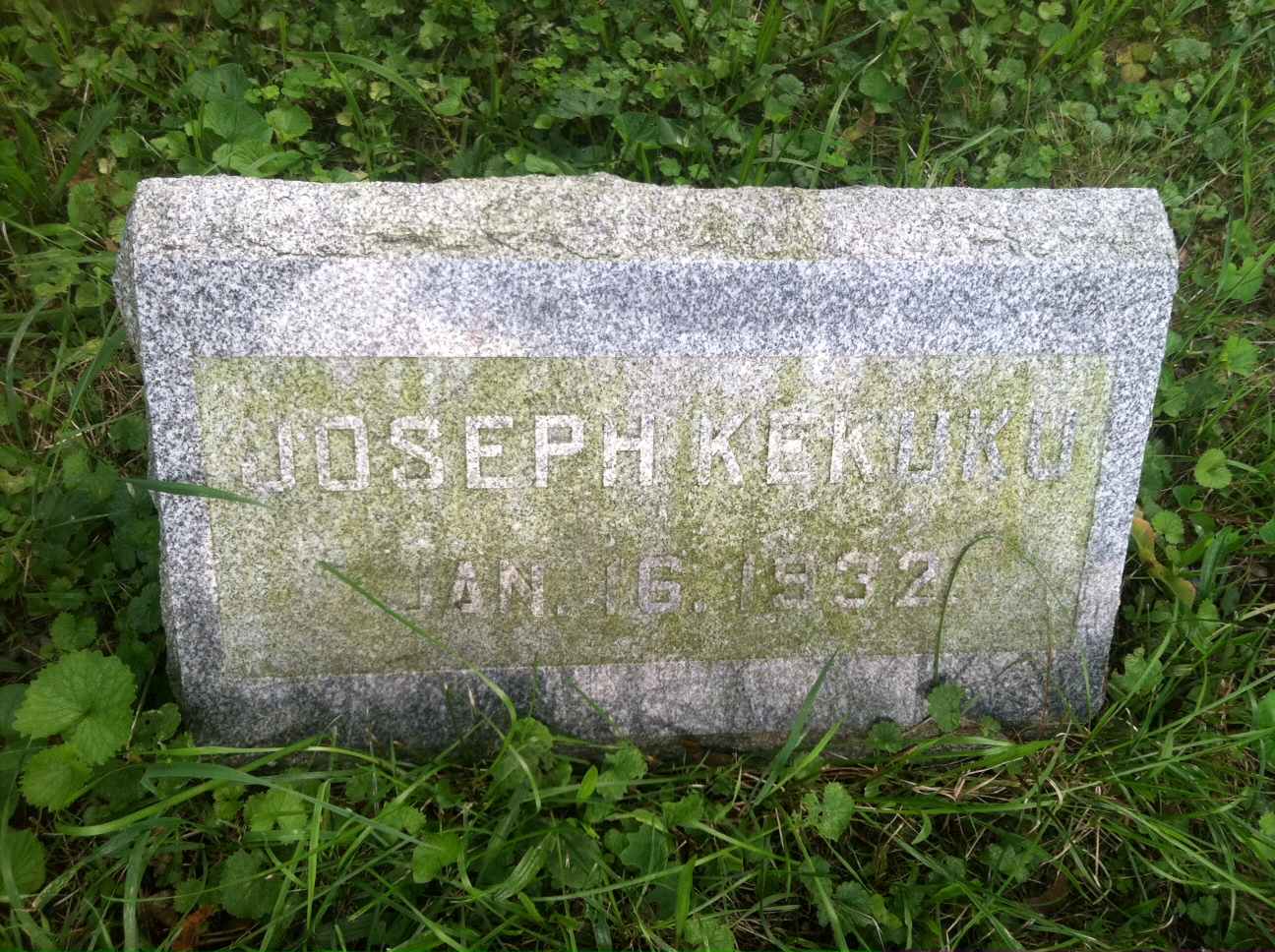
It would nice if people who appreciate his contribution to modern music would come together and design a more appropriate grave marker. I was expecting to see a small sculpture of a steel guitar or something. Share your comments below if you have any thoughts about this.
Biography
From Wikipedia
Kekuku was born in Lāʻie, a small village on the windward side of Oʻahu, Hawaii. As a boy, he would experiment with guitar technique, sliding ordinary household objects across the strings to see what sounds could be produced. When Joseph was 15, he and his cousin, Sam Nainoa left for a boarding school in Honolulu, about 40 miles south of Laie. In 1889 while attending the Kamahameha School for Boys, Kekuku accidentally discovered the pleasing sound of the steel guitar. By the time he was an adult, he had developed a unique style of playing. He traveled extensively, teaching and performing throughout the USA and Europe.
According to C.S. DelAno, publisher of the “Hawaiian Music In Los Angeles” whose “Hawaiian Love Song” was the first original composition to be written for the Hawaiian Steel Guitar,
“Joseph told me that he was walking along a road in Honolulu 42 years ago, holding an old Spanish guitar when he say a rusty bolt on the ground. As he picked it up, the bolt accidentally vibrated one of the strings and produced a new tone that was rather pleasing. After practicing for a time with the metal bolt, Joe experimented with the back of a pocket knife, then with the back of a steel comb and still later on with a highly polished steel (bar) very similar to the sort that is used today.”
In 1904 at the age of 30, Joseph left Hawaii and in his 58-years of life, would never return to his native islands. Instead, he brought his native islands, through music, to the rest of the world. He started in the United States by performing in vaudeville theaters from coast to coast. His group was “Kekuku’s Hawaiian Quintet” which was sponsored by a management group called “The Affiliated.”
In 1919 at the age of 45, Kekuku left the U.S. for an eight year tour of Europe traveling with “The Bird of Paradise” show. During this time, Kekuku played before Kings and Queens in many different countries. “The Bird of Paradise” show had been on Broadway with brilliant Hawaiian scenery, dazzling costumes, plus authentic Hawaiian music. The show traveled in Europe for eight years and was a total sellout. European hearts were captured by the sweet teasing sounds of the steel guitar. NO OTHER INSTRUMENT HISTORY BECAME THE DARLING OF SO MANY COUNTRIES SO QUICKLY. (Lorene Ruymar) “The Bird of Paradise” show was so popular that it became a film in 1932 and again in 1951. [snip]
In the 1930s the steel guitar went electric. Electrification attracted other musical forms such as western, big band, jazz and country. The electrified steel guitar made its greatest breakthrough into country music. Little Roy Wiggins was the first widely known electric steel guitar player to back a major Nashville artist, in his case Eddie Arnold. Another influence was the rise in the use of the pedal steel guitar, where the player could produce a correct change in harmony by pushing a pedal or kneeing a lever.
Kekuku returned to the United States and, at the age of 53, settled in Chicago and ran a popular and successful music school. Around 1930, he left Chicago and visited Dover, New Jersey. Some think he came to Dover as part of a traveling musical troupe that appeared at the Baker Theater. Hawaiian groups on these vaudeville tours usually consisted of 5 or 6 musicians with the steel guitarist seated in the center. Why Kekuku settled in Dover is not known. A possible reason is wanting to be near the rolling hills of Dover, the bustling downtown district in the valley, the shows at the Baker Theater, and the trains that ran to New York City. Another possible reason is his wife Adeline was tired of traveling and wanted to settle down there. In any event, in 1932 Joseph Kekuku was living in Dover, New Jersey with his wife at 88 Prospect Street and giving Hawaiian guitar lessons. Around town, he was ofter referred to as “the Hawaiian.”
Death
On January 16, 1932 at the age of 58, Joseph Kekuku died in Morristown, Dover, New Jersey of a cerebral hemorrhage.[1] His obituary appeared in the Dover Advance on January 18, 1932 and read:
“Funeral services will be held tomorrow at 1:00 o’clock for Joseph Kekuku, fifty-eight years old from the home of Mrs. Mary Stone on Prospect Street. Rev. Hedding B. Leach will officiate and interment will be in the Orchard Street Cemetery. Mr. Kekuku is survived by his wife. He died after a lingering illness at Morristown on Saturday. Mr. Kekuku, an Hawaiian, resided with Mrs. Stone last summer and gave lessons on the steel guitar which he claimed to have originated.”
Kekuku is buried in the Orchard Street Cemetery. A small marker at the Orchard Street Cemetery reads: JOSEPH KEKUKU JAN. 16, 1932 marking his final resting place.
[edit]Inducted into Steel Guitar Hall of Fame
In 1993, Joseph Kekuku was inducted into the Steel Guitar Hall of Fame with full honors as the inventor of the Hawaiian Steel Guitar. The Dover Area Historical Society salutes this genius musician, this artist, this teacher, this ambassador of Hawaii and the Aloha spirit around the world. His passion brought him far from his birthplace of Laie, Hawaii to his final resting place in Dover, New Jersey.
Projections of Power – How Elections are Called by Our Media
DATA DRIVEN VIEWPOINT: Our election results are called based on statistical projections made by corporate media behind closed doors. These are the same media corporations that benefit so lavishly from all that campaign spending. So the question becomes, what is the rationale for highly vulnerable electronic voting machines to rapidly count votes when elections are called based on projections and exit polling by the NEP? And why is it so important to get such quick result in the first place? Finally, if something did go wrong,this extra layer would make it so much more difficult to unravel what went wrong. Recall the confusion caused in 2000 when Gore was projected to win. The Bush camp when nuts, got the medial to take it back and then call him the winner weeks before anyone knew the final result. And when you think about it, how could Bush have been declared the projected winner when the actual vote coun was so close.
Bev Harris covers these issues and she grants permission to re-post providing it is attributed and credited to her Website, blackboxvoting.org
AMERICA’S CLAIRVOYANT ELECTION SYSTEM
by Bev Harris, BlackBoxVoting.org
11/7/2012
http://www.blackboxvoting.org/
Perhaps one of the oddest moments of all during last night’s live election coverage was what happened to Karl Rove on Fox Network News.
With Florida still too close to call and hundreds of thousands of votes still out in Ohio (including a large hunk of votes in Romney strongholds), and with a spread of about 100,000 votes separating the candidates in Ohio, Fox called Ohio for Obama. Karl Rove arranged to come on the Fox network to voice his rebuttal.
Now, whatever you think of Rove, I think most of us agree that he’s a numbers guy. His numbers didn’t support the calling of the state of Ohio at that point in time. When he explained his reasoning, the Fox anchor quickly shut him down. “It’s a science” he was told.
Based not on actual votes, but on projections from a single private entity, the National Election Pool (NEP), we were all told what the election results were going to be. When Rove pulled out his notes and calculations, he was basically told “Shut up, this is a science.”
But is that what your vote really is? A science project, to be viewed only by experts inside a nesting set of black boxes, completely out of public view?
If we are to have real self-governance, we need to be able to authenticate each essential step in our own elections — without need for special expertise to explain to us what the result is. What more centralized, privatized form of declaring a result is there than to commission the NEP to provide a single set of statistics to ALL of the TV networks for a declaration of results without human eyes ever looking at a single ballot.
The media called the election in Tennessee just 11 minutes after the polls closed and by the way, exit polls had already been cancelled in Tennessee because, it was explained, everyone already knew who the winner was going to be so why bother with the expense. Even the voting machines, opaque and controlled by whatever their programmers put into them, had not yet issued results printouts. Is this the new, NEW method for pretending at democracy?
Washington State, where I live, is a forced absentee state, where 100% of the votes are now absentee ballots, which must be postmarked on Election Day. I placed my ballot in the post office at 2 pm. There are no exit polls, because there are no polling places. Apparently a few phone calls now substitute for actual exit polling (to people with land lines? That’s an increasingly elderly demographic). Perhaps 40% of all ballots in Washington have not even been counted yet, but we’ve been told the results.
In California, typically 25% of the votes are counted after Election Day, yet results have been announced. That’s a million uncounted ballots in Los Angeles alone. We have no clue what is on those ballots but we’ve been told not to worry about it. The stats guys have issued their verdict.
Forget voting machines, programmed by insiders to do whatever they do. Let’s just skip counting the votes altogether and use statistics.
Creepy little way to run an election, if you ask me.
From Wikipedia: The National Election Pool (NEP) is a consortium of American news organizations formed in 2003 to provide “information on Election Night about the vote count, election analysis and election projections.” See NEP’s FAQ. Member companies consist of ABC News, the Associated Press, CBS News, CNN, Fox News and NBC News. The organization relies on the Associated Press to perform vote tabulations and contracted with Edison Media Research and Mitofsky International to “make projections and provide exit pollanalysis.” [see below]
The precursor was Voter News Service, which was disbanded in 2003, after controversies over the 2000 and 2002 election results. The NEP plan is largely the suggestion of CNN, which used Edison/Mitofsky as consultants in the past. Mitofsky headed the original pool that preceded VNS.
The organizers of the pool insist that the purpose of their quick collection of exit poll data is not to determine if an election is flawed, but rather to project winners of races. Despite past problems, they note that none of their members has incorrectly called a winner since the current system was put in place. [1] However, to avoid the premature leaking of data, collection is now done in a “Quarantine Room” at an undisclosed location in New York. All participants are stripped of outside communications devices until it’s time for information to be released officially.
Warren Mitofsky (September 17, 1934 – September 1, 2006) was an American political pollster.
Mitofsky graduated in 1957 from Guilford College and was executive director of the CBS News election and survey unit from 1967 to 1990. He also previously served as an executive producer of CBS election night broadcasts.
Prior to CBS, Mitofsky worked with the Census Bureau where he designed a number of surveys. Along with Joseph Waksberg, Mitofsky is credited with developing an efficient method of sampling telephone numbers using random digit dialing, which has since been widely adopted as a sampling method. In 1999, the American Association for Public Opinion Research presented him with its lifetime achievement award for his “continuing concern for survey quality”.
Mitofsky is credited with having invented the exit poll.[1]
In November 2004, Mitofsky was interviewed by PBS NewsHour regarding what went wrong with the accuracy of his exit polls for the 2004 U.S. presidential election. Early poll results were leaked which showed John Kerry leading George W. Bush, conflicting with the final official outcome. Mitofsky said he suspected that the difference arose because “the Kerry voters were more anxious to participate in our exit polls than the Bush voters.” He refused, consistently, to release precinct-level polling data from Ohio to researchers who maintained that the election results were fraudulent, and his own exit polls were a more accurate picture of the vote.
He died on September 1, 2006 in New York City of an aortic aneurysm, aged 71.[2]
 Data Driven Viewpoints