Declaring War on the Poor

by Brian T. Lynch, MSW

Thom Tillis is now Senator elect from North Carolina, having beaten Democratic incumbent Kay Hagan in the 2014 election. During his campaign Tillis berated the poor and suggested that those people who can’t help being poor, like the truly disabled, should rise up and opposed welfare for the unworthy poor. What he actually said was:

“What we have to do is find a way to divide and conquer the people who are on assistance,” 

North Carolina has 1.1 million poor. That’s 13.1% of its population. If these folks voted it would be hard to imagine Tillis getting elected, but Hagan and the Democrats have abandoned the poor and working class in this country as well. Now the poor are under attacks like this:

“We have to show respect for that woman who has cerebral palsy and had no choice, in her condition, that needs help and that we should help. And we need to get those folks to look down at these people who choose to get into a condition that makes them dependent on the government and say at some point, ‘You’re on your own. We may end up taking care of those babies, but we’re not going to take care of you.’ And we’ve got to start having that serious discussion.” – Thom Tillis

Watch for the U.S. Senate to put Tillis on the Health, Education, Labor and Pensions Committee to replace Kay Hagan. He is destine to become the chair of the Children and Families Sub-committee with his attitudes. His appointment would amount to a declaration of war on the poor.

So how should sensible people respond to divisive attacks like this on the poor and vulnerable? Should we begin making similar distinctions between the worthy and unworthy rich? Should we affirm those who earned their great wealth and provide social benefit but rescind all advantages given to those who use their inherited wealth to squeeze the people and their government for still more?

How we respond to these questions will define who we are as a nation.

How Free is “Free Will”

by Brian T. Lynch

This is purely my opinion, but my understanding of “Free Will” is very narrow compared to most people I talk to about it. I see it as something that emerges gradually along a continuum from actions that are totally coercive to purely rational and independent. It isn’t an all or nothing phenomenon, as some see it. I exclude all impulsive actions taken due to internal urges from my definition since urges aren’t rational and follow from completely different pathways in the brain. Also, actions that spring from emotions may or may not involve free will in my view. It is here that the gradual blossoming of free will is most evident. 

When ever we act to satisfy urges or emotions we really cannot distinguish “free will” from the actions taken since acting on a urge feels identical to acting by choice.. That is why people don’t even know they are addicted to something until they discover they can’t simply choose to stop. Addiction in insidious that way. No one can say for sure that they smoke by choice after that first cigarette because even six months later the brain can trigger powerful urges for another cigarette.

The same holds true, by degree, with our emotions. We can’t know for certain if we are acting on free will when we acquiesce to our feelings since emotions can also overpower free will. We even say we are “acting on our emotions” to explain certain behaviors, but it still feels exactly like a choice, even if we can’t help it. So inwardly speaking, we can only no for sure that we are acting on free will when our actions are contrary to both our urges and our feelings. It is only when we place them in check that we can know for sure we are acting on our own free will.

That said, what about free will in circumstances when our only available options for action are proscribed by others, or by circumstances out of our control? If we have no choice but to act, do we have free will? If we have only bad choices, are we exercising free will by making that bad choice? Was Socrates exercising free will when he choose to drink hemlock rather than face a public execution? It so, and I believe he was exercising free will, then a limited form of free will must exist even under extreme forms of coercion.

How we define “free will” has enormous social and political implications because it thereby defines how responsible individuals are for their actions. It is here we see the continuum of emerging free will run its course. Some folks believe everyone is 100% responsible for their actions. They might then blame the poor for being poor, or the sick for being sick (live style choices) and would probably not accept an insanity defense for crimes committed by the insane. Speaking of justice, we see the role “free will” plays in our action played being calculated in criminal sentencing hearings when mitigating and aggravating circumstances are used to determine appropriate punishment. We punish people for criminal intent but not acquit them, or lighten their punishment if they were not in control of their actions.

These are just examples. In fact, we use these sort of calculations everyday with each other or our children in judging their actions and in modulating our responses. So the idea that free will is an all or nothing phenomenon just isn’t born out in our every day experience.

Anyway, here is an interesting article on the subject.

It has become fashionable to say that people have no free will. Many scientists cannot imagine how the idea of free will could be reconciled with the laws of physics and chemistry. Brain researchers say that the brain is just a bunch of nerve cells…

SLATE.COM

Why Democrats Keep Losing!

by Brian T. Lynch, MSW

May I rant? It helps me to think out loud. Maybe you will find it helpful too. (or just ignore this if you like.)

voting


Democrats are loosing in state after state and in federal elections because they are acting too white and wealthy for their base, the REAL latent base of the party. And this base is NOT its liberal donors. Dem donors are nice folks, but they can’t compete with the GOP donor machines. (Nor should they try)

According to OpenSecrets.org, from the prior election, two-thirds of corporate donations go to the GOP and one-third to Dem’s. That’s more than enough money to distract Democratic candidates.  But that’s not the whole story.

We already have a party of wealthy white guys, so we don’t need another party of wealthy (relative term here, not pejorative) white gals or guys to oppose them. As badly as the GOP is exploiting and marginalizing woman (treating them like subordinates), woman’s issues are not winning over woman like it should, not even female Democrats. But that’s not the whole story either.

We need a Democratic party that gets intimately in touch with the needs of the ordinary people who haven’t been voting lately, people who, from their distal vantage, can’t tell the two parties apart. Their issues are literally bread and butter, not theoretical or ideological economics. They live in a deflationary universe where wages are flat and a dollar keeps shrinking. Their daily sweat has been sanitized and turned into a market commodity. There is no profit left in labor for them. They know their children will have no inheritance because everything they own can be sold at a flee market.

The middle class that we usually picture in our mind is not the middle income folks of today. Popular culture’s view, reinforced by network TV’s portrayals of middle-class lifestyles, matches people making more than $100,000 a year, twice the median wage. Which politicians for federal office speak openly and bravely for this half of our hard working citizens who make less than $50,000 per year? You can’t reach them by talk of job creation! Most of them have more jobs than they can handle.

If we think of the lower half of wage earners as being made up of those who are working and those looking for work, then 7% unemployed minus the 50% who earn less than a middle wage leaves 43% of the wage earners who are not being represented by either party. Of this group, those who call themselves Democrats aren’t showing up to vote. Why should they? What will change when no one seems to notice them?

Republican in this same low income group do show up to vote, but that’s because they are cynically manipulated by the wealthy wing of the GOP. They are voting out of fear, anger and pain. The wealthy wing of the GOP hears their pain even as it twist the knife.

Democrats in public office, or running for office, don’t want to ruffle the feathers of the powerful minority groups (Wall Street, CEO’s, Billionaires, etc.) even though these folks aren’t voting for them.  Money is tight. I get that.

Let me give you just two examples from two New Jersey congressional races that were below the national radar, The incumbent Republican, Rodney Frelinghuysen, raise 7 times more money than his Democratic challenger, Mark Dunec in the 11th District. Incumbent Republican Leonard Lance raised 8 times more than his Democratic challenger, Janice Kovach in the 7th District. All this money did not come from the 43% of hard working American’s who still need some form of government subsidy to survive.

And what help did these Democratic candidates get from their party elders? Very little! A decision was made to write off these districts. The slick election strategy that carefully targets resources to the most competitive races writes off the needs of millions of people who have every right to be represented. The big get out the vote strategy touted by the party fizzled because they didn’t have an explosive message to motivate the 43%ers.

People who live below the median wage level have one thing in common with the richest billionaires… their vote is just as powerful. One person! One vote! It isn’t how corporations operate; It’s how democracies operate. And until Democrats start collecting those uncast vote, instead of appeasing the rich, Democrats will continue to loose.

It is time to stop playing the Republican’s game.


Here is a helpful article by Robert Reich that says in fewer word what I am trying to say above.

http://m.dailykos.com/stories/1342950


Anyway, I’m done with my rant. Thanks for listening, even if you didn’t make it this far. All the best in the future.

_______________________________

Image Credit: http://news.yourolivebranch.org/2011/05/24/iec-declares-election-free-and-fair/

Should Living Wage Minimums be Based on Individuals or Families?

by Brian T. Lynch, MSW

FDR

 
“No business which depends for existence on paying less than living wages to its workers has any right to continue in this country… By living wages, I mean more than a bare subsistence level — I mean the wages of a decent living.” (1933, Statement on National Industrial Recovery Act – Franklin Delano Roosevelt)
 

Question:  In looking at the Living Wage calculator, I see that $10.83 for a single adult in Morris County, New Jersey  where I live. This seems fair to me for a single person, but when you add one child to that scenario the rate jumps to $22.12 per hour. This raises a serious question.  Does the Living Wage Movement suggest that wages should be adjusted according to need? [ http://livingwage.mit.edu/ ]

Answer:  That’s a great question. I am not a spokesman for, or advocate of, the living wage movement as an organization. I do believe that living wages should be the minimum wage in this country.  Minimum living wages should be what we pay summer college help or student interns, not full-time employees. It might also be appropriate for part-time seasonal help. It shouldn’t be what we pay permanently hired employees.

To answer your question, I researched what a living wage is in the 130 cities that have living wage laws. It turns out that their wage base is for a single employee, not including any dependents. A living wage in Manchester CT equals $15.54/hour (the highest) while it is $8.50 in Orlando FL (the lowest).  It would appear that the Living Wage Movement is looking to index a minimum living wage minimum to local economies based on one adult with no dependents.

That said, the minimum wage in 1986 was $10.86/hour  as opposed to its current level of $7.25/hour.  If it had been indexed to inflation in 1986 the current minimum wage today would be $23.59/hour today. That clearly was intended to provide for a worker with a family. The current median family size is 2.54 persons per household. That inflation adjusted wage equals about $47,000 per year while the current median family wage is a little over $51,000 per year (and still declining, I might add).

Here’s the thing, we have only been talking about wage adjustments to keep pace with inflation. We have not been talking about raising wages to reward workers for our growing productivity. We have not been talking about sharing the wealth that workers help create so everyone keeps pace with America’s growing economy. Cost of living adjustment are important, but they shouldn’t be confused with a productivity, or merit raise.

America is $1.7 trillion richer today than it was in 1976. Our economy has doubled, yet the share of all that new wealth created by American workers in this same period of time is insignificant.

In the 1960’s my father was an appliance repairman at Sears. His salary was enough that my mother could stay home to raise my sister and me. Her role as mother to the next generation of citizens was valued. Today, a typical family of four making about $51,000  does so because both parents work. And they are only able to make ends meet because of easy access to credit to shift their financial burdens onto their future earnings.

When I speak about a living wage I am thinking about getting back to a point where one breadwinner can hold one full-time job and still raise a small family without needing government assistance to do it. That’s what we had, and that should be our goal as a country.

Minimum Wage is a Moral Question

by Brian T. Lynch, MSW

The White House put out a brief video on why we should raise the minimum wage to $10.10/hour. It is OK as far it goes, but it is still a little disappointing to me.

Click here to see the video. [ https://www.youtube.com/watch?v=PqtLQgkcUFM ]

Even the White House is looking at minimum wage law though the modern day pro-business bias that has infected all of civil government. Even though raising bottom wages creates an economic stimulus that would boost spending, increase demand for goods and services and create more jobs, this isn’t the most important aspect. The main reason to raise minimum wages is because it’s simply the right thing to do.

The question of minimum wage is actually a moral question. There is no good rationale for paying a full-time employee less than a self-sufficient wage. What is almost half of a human beings waking moments worth? What is the minimum compensation they should receive for devoting that time to enrich their employers? Why should it be less than what is required to survive with human dignity?

From a social perspective, should profitable businesses be held in high esteem as models of efficiency for paying wages so low that full-time employees require taxpayer subsidy to keep from becoming homeless or having their children taken away from them? Should we have to subsidize the labor force of wealthy corporations like Walmart? Should the federal income taxes of those who make more than minimum wage have to be used to supplement the other employees who takes out the trash at night or mow the lawn? Why should any healthy corporation be allowed to boost their profits at public expense through subsidized labor?

If small businesses or start-up company need government subsidies or tax breaks to help pay their help, let these business owners apply for government assistance rather than make their employees feel inadequate by having to beg for government assistance. No man or woman who works hard all day long should have to apply for housing assistance or SNAP or KidCare or childcare assistance or HEAP or any other government subsidy. Let the business owners apply for government aid to help pay employees the self-sufficient wages all full-time workers should have. Let the means testing process for government subsidy programs fall to the employers. Let’s get it off the backs of the working poor and eliminate the social stigma they don’t deserve. Let the minimum cost of self-sufficient labor wages be part of the cost of doing business in America.

Profits for CEO’s and share holders should not come before self-sufficient wages for laborers. Exploiting workers and taxpayers to boost profits for investors and chief executives is immoral.

What Do We Know About Police Homicides?

I’ve started the following petition:

“Barack Obama and Harry Reid and John Boehner: Pass a law mandating that law enforcement must file a report with the FBI every time a police shooting results in the death of a citizen.”   I am asking for your help to get this petition off the ground.

Will you take 30 seconds to sign it right now? Here’s the link:

http://www.change.org/p/barack-obama-and-harry-reid-and-john-boehner-pass-a-law-mandating-that-law-enforcement-must-file-a-report-with-the-fbi-every-time-a-police-shooting-results-in-the-death-of-a-citizen

Here’s why it’s important:

Do you know how many people are shot and killed by law enforcement every year? No? Well neither does anybody else. Records aren’t collected for what is called police homicides, which includes justifiable shootings.

There are 17,000 law enforcement agencies in the United States, including local municipal police, but no national database to track police killings of civilians. The FBI maintains a partial data based of reports submit on a voluntary basis. Only 750 law enforcement agencies, just 44% of all agencies, volunteer to submit police shooting data. What the FBI  collects and reports are only those cases in which police homicides were considered justified by the departments reporting them.  There is no auditing or review process either. And some law enforcement agencies, such as the US Border Patrol, don’t even have to report people they shoot and kill to their command.

When government law enforcement officers kill civilians it is our right to know about it. We are all ultimately responsible for the actions of our government. The first logical step is to require that a record be kept and available for public inspection.

So, what does the current, ver very limited information on police homicides show right now?

There are about 400 justified police homicides per year. Every week in this country there are two incidents like the one in Ferguson, Missouri, involving a white police officer shooting a black citizen. About half of all police homicides involve black citizens, and among the population of folks 21 years old or younger, the police homicide rate for blacks is 18%, twice the rate for white citizens (8.7%).

Again, these numbers are based on voluntary self-report from less than half of all law enforcement agencies nation wide.  It seems evident from what we know and don’t know that collecting better, more complete information about police homicides is important.

You can sign my petition by clicking here.

Thanks!
Brain Lynch

Buying Back the U.S. Senate

by Brian T. Lynch, MSW

Dark money from anonymous donors is pouring into the 2014 Senate races. According to Jon Terbush at The Week magazine, midterm election spending this year will “blow away” prior campaign spending records.”Spending by outside groups in particular is on pace to reach an unprecedented level this cycle,” he wrote. “To this point in 2010, outside groups had spent $10.4 million… to date, such groups have spent more than three times as much on the 2014 races.”He offered this graph which show the 2014 spending to date:

There is no doubt that big donations are flooding into politics since the Citizen’s United decision by the Supreme Court. Another factor is the proliferation of highly political 501 C non-profit organizations. More than ever these organization take advantage of IRS policy to fund issue advertizing for their partisan candidates. All this money is narrowly concentrated. It comes from a few billionaires or from a relatively small number of special interest groups. Senators become obligated to their wealthy donors while the majority of citizens are not being well served. Much disaffection between citizens and their government has resulted from special interest politics, and this often suits corporate interests.
The biggest price tags for US Senate seats this year are in Georgia and North Carolina. Spending between these races is expected to be nearly $50 million dollars, most of which will come from large donations. How on earth can average citizens compete with such big donors for the attention and fidelity of their Senate representatives? There is growing certainty that our Republic no longer represents the interests of most ordinary citizens.Here’s part of the problem. Big numbers are very hard to comprehend. Our brains aren’t wired to grasp numbers in the millions or billions. So if we want to understand how expensive our elections really are, we have to break down the cost into manageable units.

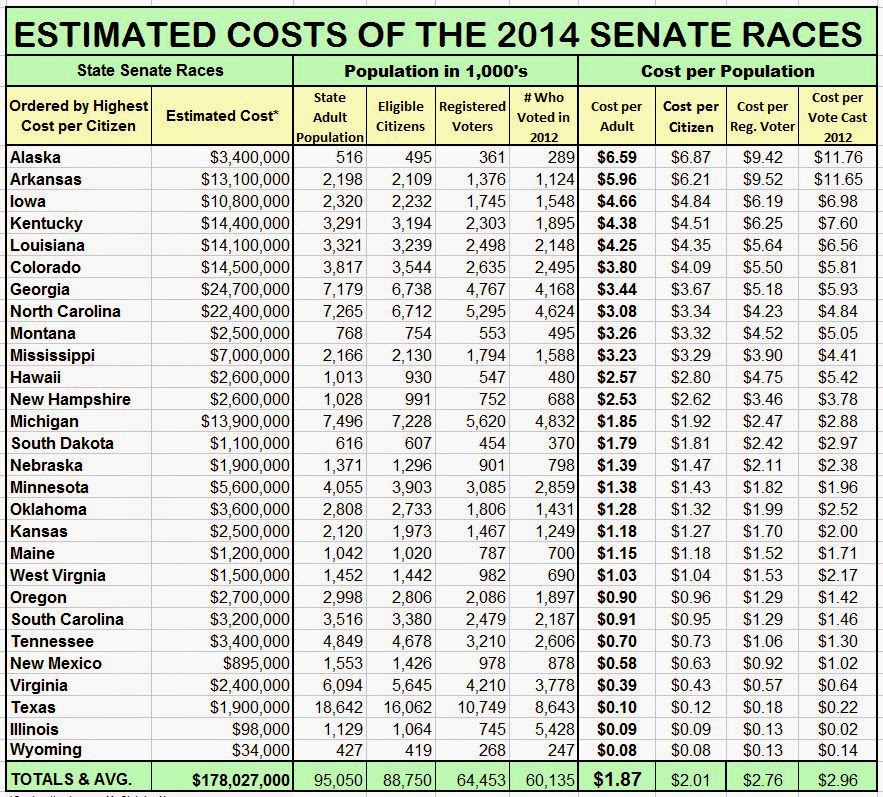
Using Senate campaign cost estimates from the McClatchy news organization, and some census data, the following table breaks down Senate election costs by population segments. For example, the Michigan race is expected to cost $13.9 million this year, a lot of money, yet it breaks down to $1.85 for every adult living in the state. This is very close to the national average of $1.87 per adult for this Senate elections cycle. The really expensive Senate elections this year, on a per adult basis, are actually in Alaska and Arkansas where spending will be nearly $12 for every vote that is likely to be cast. Consider also that Senate elections take place every six years. That works out to just $2 per year per likely voter in the most expensive Senate seat, or about $1.10 for each Alaskan adult.

*Estimates are from the McClatchy News Service as published in the New Jersey Star Ledger.Here then are some numbers that most people can comprehend. The average cost to an individual for this very expensive Senate election works out to just 31¢ per year per Senator. This is all it would cost you to buy back your vote.Elections cost money. To get the money interests out of politics people have to put money into it. We can’t let billionaires and special interest group buy the Congress at such bargain prices. It is time to step to the plate and publicly finance our Republic.

Yes we need to undo Citizen’s United and make clear that corporations are not people. We need to do a lot of things, but nothing will restore our voice in government better than fronting the cost of election campaigns. When politicians need both our money and our vote we will have their full attention. Even a few dollars a month would go a long way to fund our democracy.  It would do more to help the poor and support the middle class than almost anything else we could buy. We could even discount campaign finance contributions for everyone who registers to vote.

As essential as voting is to fulfilling our civic duty, funding our Republic and being knowledgeable and engaged in public issues are just as critical.

When Ben Franklin was asked what kind of government we have as he left the Constitutional Convention of 1787 he famously remarked, “A Republic, if you can keep it.” Now we know what he meant. It’s time to take back our Republic from special interest groups and quirky billionaires. This time let’s invest our time, talents and money to keep it in the hands of ordinary people where it belongs.

Evolution of Modern Christianity

by Brian T. Lynch, MSW

After 2000 years of Christianity, the idea that the Bible is incapable of being wrong first developed among Protestants about 100 years ago. http://j.mp/1oCQrA0  But it is a mistake to view each and every detail of the Bible as inerrant. Anyone who holds this belief can’t possibly be correct since the Bible is so self-contradictory.

Do you want some examples? Try taking this New Testament biblical quiz:

[ http://exchristian.net/3/ ].

It is a very humbling experience.

The Bible may be the inspired word of God, but it certainly was not written in a day. It was drafted over more than a thousand years. The New Testament was likewise drafted over the course of nearly 200 years, starting about 50 years after Jesus’ death. It was written by mostly anonymous authors in various locations, none of whom were eye witnesses to the events in Jesus’ life.

If you wanted to read the New Testament in the order it was written, you would have to start with the letters of Paul, probably beginning with Thessalonians. The remarkable aspects of these earliest writings of Paul is that he never quotes Jesus nor provides any biographical information about him. This couldn’t have been because the words of Jesus were well documented, since these were literally the first documents written.

The first Gospel of the New Testament was the book of Mark, written some 20 years after Paul’s letters. This was the first draft of the life, times and sayings of Jesus. Some scholars believe that Mark served as a template for the later works. Written 70 plus years after Jesus’ death, the author of this Gospel is unknown. It has the fewest biographical details about Jesus and the least amount of red ink (direct Jesus quotes). This account begins with John the Baptist at the start of Jesus’ ministry. It tells us that his family thought he was out of his mind while others thought he was possessed by the devil. It ends with his crucifixion, resurrection and being “taken up into heaven”. In addition to having fewer details than subsequent accounts, it also has certain details that are missing in later Gospels. For example, Mark very specifically states that the cross of Jesus was carried by another person.

“A certain man from Cyrene, Simon, the father of Alexander and Rufus, was passing by on his way in from the country, and they forced him to carry the cross.”

In the other Gospels, Jesus carried his own cross, falling down several times under the burden, etc. The point here being that details are fluid and sometimes contradictory, as would be expected given the generations over which the New Testaments were written.

The Gospel of Matthew is believed to have been written sometime between 80 and 90 years after Jesus’ death. It was later named after Matthew, who was certainly not alive to write this text. And then, surprise, the Book of Revelation and the Gospel of John followed, probably in that order, but who knows exactly? The last of the four Gospel’s was the book of Luke. It may have been written as late as 120 years after Jesus died.

The last book written in the New Testament is 2 Peter, believed to have been written between 150 and 200 CE.

Of course there were very many other scriptures and texts written during the first and second century about Jesus and the early Christian church. The task of sorting all this out to come up with a single version of the New Testament began in earnest in the 4th Century, concluding around the middle of the 7th Century. However, even today there remains differences in what constitutes the Holy Bible. For example, the Old Testament Book of Wisdom is included in the Catholic bibles but not the Protestant bibles. Most Christian fundamentalists today rely on the Protestant version for their sources. They do not accept the Book of Wisdom, for example. Add to this the fact that every different translations leads to different interpretations.

I believe it is fair to say the New Testament was written by many people over a number of generations and refined into the several versions we have today over the course of many centuries. It was not created in a day. It evolved, just as the Christian understanding of its means, and the Christian experience have evolved over time. The Catholic Church today certainly doesn’t act on many of the beliefs it held in the 13th or 14th Centuries. Over the millennium many different sects and permutations of Christianity formed and dissolved. Each group has pulled from different details, translations or interpretations to create unique constructs, and each in turn have been challenged or even attacked by other Christian groups doing the same. In this way, what it means to be Christian has evolved, and it will continue to do so in the future.

There is plenty of room for doubt when interpreting bible passages. In fact, there is plenty of room to doubt the legitimacy of the whole Christian faith if you are inclined to do so. The existence of God, after all, cannot be proven or disproven. This is what distinguishes faith and knowledge.

But the leap from faith to a fundamentalist dogma that the Bible is the inerrant word of God is another matter. Religious faith need not require the rejection of reason nor intellect. Belief in what is, or can be known, and faith in what we cannot know, are not mutually exclusive until we cross the line into religious fanaticism. Religious fanatics reject empirical facts that contradict any of their religious claims. The rejection of empirical reality is, in fact, what defines fanatic beliefs. In this regard all religious fanatics are alike. They require a fidelity to tenants of faith that directly contradict the natural world of the Creator God they worship.

In the long arch of history, those who reject the evolution of Christian faith, those who try to deconstruct our present knowledge or force conformity to an unsustainable Christian understanding will ultimate fail. The only question is what damage will they do along the way. Who will suffer and for how long before the latest versions of religious fanaticism become extinct.

The Profit Driven Rise of Domestic Armies

by Brian T. Lynch, MSW

Our founders never wanted a standing army, much less combat troops patrolling our towns and villages.  The role and methods of solders is much different than the role and methods of local police, and that is the way we wanted it from the beginning. But now, without public debate or voter input, the culture and the very nature of law enforcement is being changed.  The changes began with little notice well before 9/11 but accelerated after that terrible day, bring together both military equipment and military police training in the name of “homeland security.” I’ve written about the military equipment part of this change in May, 2012, but didn’t know much about how local police were being trained. That part of the story begins with the rise of PMCS.

PMSCs is the acronym for private military and security companies. These are  mercenaries incorporated. They provide private solders to protect government or business interests in unstable parts of the globe. They have multi-billion dollar contracts with the US and other world governments and they represent a huge growth industry since the start of the Afghanistan and Iraq wars. As these conflicts wind down, these PMSC corporations have searched for new markets and places to do business. One of those new markets has been local and state domestic police training here in the United States.

(Credit: Reuters/Steve Nesius)

BLACKWATER, a large private solders-for-hire corporation, is one of the leading companies currently training many of our domestic police officers. They teach them with military style training and train them on how to use military style weapons provided to local police departments at no cost through the gov’t 1033 program. While the rationale for the 1033 program was stated to fight the war on drugs when it first began in 1997, the amount of brand new military equipment given away to local police departments has grown every year since.  The mere possession of this equipment is enough to alter the culture of local police departments, but coupled with military training on its use clearly militarizes law enforcement. The development of this police training is well documented in an article in Salon (below).

Here is a brief excerpt from the Salon article explaining the difference between “Serve and Protect” training and military training:

The difference between a police officer trained to “keep the peace” and a soldier was quite easy to identify. A policeman was legally required to protect and to serve the citizens of the state, to assume innocence unless there was a reasonable suspicion of illegal activity, and to use weapons against a citizen only as a last resort. A soldier was trained to identify enemies and if necessary to kill them while protecting any non-enemies in the vicinity. “I stand ready to deploy, engage, and destroy the enemies of the United States of America in close combat” was their creed. And although most policemen trained by a private military company would remain dedicated to their oaths to serve and protect the public, there was the possibility of the exception.

This is an article that everyone should read and discuss.  Is this development to be our future or our past?  the answer is up to us all.

http://www.salon.com/2014/08/30/militarized_police_are_everywhere_when_police_officers_are_armed_and_trained_like_soldiers_its_not_surprising_that_they_act_like_soldiers/

A Moderate GOP Congressman’s Slide to the Right

Leonard Lance is a Republican running for his third term as New Jersey Congressman from the 7th Congressional District. This is among the wealthiest Congressional Districts in the country. Lance was elected because he was considered a moderate, but over time the whole GOP has pulled hard to the right. Here is the voting record for this “moderate” Republican just over the past month on some key legislation. This isn’t is complete voting record for the past month but it shows how he voted on the most contested pieces of legislation.

HR 4935 – Child Tax Credit Improvement Act of 2014

Passage of this bill has both pros and cons.

Pros: This law would index the current $1,000/child tax credit to inflation. This would automatically increase the amount of this tax credit each year going forward. This is a good thing.

Cons: 1. This law would raise income eligible for a Child Tax Credit to families making between $110,000 to $140,000 per year. This income group is in the top 5% of wage earners and they clearly do not need this tax break more than, say, a child in need of a federally funding lunch at school. We don’t need to give more tax breaks to the already well off.

2. At the same time that it raises income eligibility for wealthier Americans this law does not extend enhanced benefits to poor families that is scheduled to expire in 2018. Expiration of that extended benefit will cost poor families over $1,000 per year.  We have got to stop making life ever more difficult for the poor.

3. Under current federal law employers are required to obtain federal taxpayer ID numbers for undocumented aliens who work for them and to collect both payroll and income taxes for these employees (Many people are unaware that at least 2.3 million undocumented aliens pay their fair share of income and payroll taxes each year). The bill requires that recipients of the tax credit have Social Security numbers. This bill blocks unauthorized immigrants who work and pay their taxes from collecting Child Tax Credits on their Income Tax returns. As it stands, most of these immigrants will never receive any Social Security benefits either, despite paying into the system their whole life. They help float the whole system for the rest of us citizens. Now we are going to tax them at a higher rater than we tax citizens. This is another attack on unauthorized residents, particularly those who have been here for decades and contribute so much to this country.

Leonard Lance voted YES for this bill.

H Amendment 1040 – Prohibits Implementation of Certain Climate Assessments

Leonard Lance voted YES for this bill.

Passage of this bill blocks already appropriated funding needed to prepare several of the federal governments annual climate assessment reports including:

· The Intergovernmental Panel on Climate Change’s Fifth Assessment Report;

· The United States Global Climate Research Program National Climate Assessment; or

· The United Nation’s Agenda 21 sustainable development plan.

Leonard Lance voted YES for this bill to block funding for these assessments.

H Amendment 1012 – Prohibits Federal Agencies from Contracting with Businesses Chartered in Bermuda or in the Cayman Islands

This bill Prohibits Federal Agencies from entering into contracts with businesses that are chartered in Bermuda or in the Cayman Islands in order to avoid paying US taxes.

Leonard Lance voted NO which means federal agencies cannot reject contract bids from companies that evade US taxes.

H Amendment 1098 – Prohibits District of Columbia from Implementing Certain Firearm Laws

Passage of this law would effectively prevent the District of Columbia (Washington, DC) from enforcing any of the districts gun control legislation, apparently allowing guns to be openly carried in the district.

Leonard Lance voted YES for this bill. (Isn’t it time to give DC a right to vote in Congress?)

H Res 676 – Providing for Authority to Initiate Litigation for Actions by the President or Other Executive Branch Officials Inconsistent with Their Duties Under the Constitution of the United States

This bill Provided the Authority to Initiate Litigation for Actions by the President or Other Executive Branch Officials Inconsistent with Their Duties Under the Constitution of the United States. A vote to pass a resolution that authorizes the Speaker of the House of Representatives to initiate a civil action on behalf of the House of Representatives against the President of the United States for certain purposes.

Leonard Lance voted YES for this bill. He wants to sue President Obama for trying to govern the country while Congress is unable to pass any meaningful legislation on the most urgent issues of the day.