“The Post”, A Tribute to the Fourth Estate
by Brian T. Lynch, MSW
The Post. What a fantastic movie on so many levels!
I saw it recently with my family and, except for someone who kept falling asleep and snoring behind us, we really enjoyed this truly inspiring movie. The actual events surrounding the Pentagon Papers and the Vietnam conflicts here at home all flooded back to mind (yes, I am that old). But the movie brought in more detail and information than I ever knew. It filled the theater with suspense despite knowing the ultimate outcome. It reminded me again of just how vulnerable our First Amendment rights are, and how easy it is for an administration of government to take them away.
The U.S. Constitution doesn’t actually grant us our rights, it is just a slip of paper. Rather, it challenges us to physically inhabit those rights for ourselves. It lays the framework for an active civic process. Each generation must secure their rights anew under our Constitutional framework.
It was twice said in the movie that the right to publish the news is secured by publishing it, not by arguing about it. Our rights can wither in debate but can only strengthen when exercised. That is a lesson we must pass along to every generation.
Two present day examples of this principle come to mind. NFL players kneeling during the National Anthem is an actual exercise of our First Amendment rights, while the ensuing debate did little to strengthen our right to protest. A second example comes from a local news story of a lawyer who was stopped in her car by a police officer. The officer asked her if she knew why he had stopped her. She said she refused to answer the question, but otherwise cooperated and gave him her documents. The officer was so upset that she wouldn’t answer his question that he arrested her for not following a “legal” command. As he put her in the back of his police car he read her that familiar Miranda warning, which says in part, “You have a right to remain silent…” She remained under arrest for hours before being released. She later won a modest settlement in a suit brought against the Department for her unlawful arrest. The story generated a lot of debate while her actions helped secure our actual rights.
But back to the movie. I also came away with a profound appreciation for the incredible heroine depicted so well by Meryl Streep.
Katharine Graham was a socialite and heiress to the Washington Post, which was a local newspaper at that time. Her father founded the paper and left her husband in charge. Then her husband died suddenly leaving all of this crushing responsibility for the newspaper on her.
Ms. Graham was ill prepared for her role as publisher in most aspects. But she had an incredibly noble character and somehow managed to summon enormous strength to do the right thing under threats of disaster. She was a woman alone in a man’s world, yet she rose to meet the challenges. Her courage saved the Post and helped save the First Amendment for a generation to come. Her decision to publish the stolen, top secret Pentagon Papers exposed decades of government lies about Vietnam and helped bring that war to an end. The Supreme Court’s decision to uphold the freedom of the press in publishing that information set the stage for journalism’s victory in holding the Nixon administration accountable to the rule of law following the Watergate break in.
Contrast that with how the government is acting in the Edward Snowden matter today, for example, consider the public good Snowden has done in exposing illegal, unconstitutional government activities. His decision to selectively reveal classified information to the press has lead to strong government reforms designed to protect our privacy rights, yet he is considered a criminal, just as Daniel Ellsberg was a generation ago.
At a time when our current President openly lies to us, disparages the free press, calls it “fake news” and encourages citizens to distrust not only legitimate journalism but many trusted government institutions, this story about Publisher Katharine Graham, her Editor-in-Chief, Ben Bradley and the Washington Post is a timely tale of caution and inspiration for us all.
Race, Social Divisions Sap Our Strength, but We Shall Overcome!
by Brian T. Lynch, MSW
I liked this humorous bit (below) because it highlights the fact that racism is used to maintain the growing income and wealth gap enjoyed by the wealthy. If poor whites and poor minorities joined in common cause it would spell trouble for wealthy elite. They would be forced to share more of their wealth.
Dr. ML King came to understand this before he was murdered. He was never a greater threat to the established order than when he began his work to unite the races in a fight against poverty and the wealthy elite who structure societies to favor themselves.
View Here: https://www.facebook.com/OfficialChopShop702/videos/936060313225131/

There is only one source of social power in human society, and that is the power of coordinated actions. Whether you are building a house, a business, a movement or a government, it is the coordinated actions of people that get things done.
The converse is true when powerful interests want to block the competing interests of others. They block others by disrupting the ability to organize. They disrupt the ability of others to coordinate their actions. They diminish us by subversion, by creating or exploiting divisions among us, by creating distractions or confusion, by disparaging or arresting our protest leaders, by isolating us, by restricting our access to resources or by force of arms if necessary.
Forming social divisions is part of our human nature, but so is forming alliances and overcoming differences for mutual benefit. If the ability to work together was not greater than our tendency to “take care of our own,” we would still be a society of hunter gatherers, if not an already extinct species. Powerful people use their power to stay in power. They thwart our attempts to organize, to unionize, to communicate, to affiliate, to overcome our differences and even to vote in this republic.
And now a new layer has been added. Hostile foreign powers have infiltrated our government at the highest levels. They are using their military to conduct mass media propaganda attacks against us, attacks designed to disunite us as a nation. Their goal is to establish a global kleptocracy with unlimited powers to extract our wealth and control our behavior.
Against these coordinated attacks on America and our power of self-determination we must come together, unite in common cause and overcome the differences between us that they magnifying and exploit. It’s time to unite against all odds and move in unison against the forces that are pulling us apart.
Here, on Martin Luther King Day, are a few quotes and his last address before being assassinated.
“God never intended for one group of people to live in superfluous inordinate wealth, while others live in abject deadening poverty.”
“A second evil which plagues the modern world is that of poverty. Like a monstrous octopus, it projects its nagging, prehensile tentacles in lands and villages all over the world. Almost two-thirds of the peoples of the world go to bed hungry at night. They are undernourished, ill-housed, and shabbily clad. Many of them have no houses or beds to sleep in. Their only beds are the sidewalks of the cities and the dusty roads of the villages. Most of these poverty-stricken children of God have never seen a physician or a dentist.”
“The rich nations must use their vast resources of wealth to develop the underdeveloped, school the unschooled, and feed the unfed. Ultimately a great nation is a compassionate nation. No individual or nation can be great if it does not have a concern for ‘the least of these.’”
Most people think about Dr. King’s “I have a dream” speech today, but I want to leave this topic with another of his speeches: ” The last major speech Dr. King delivered, four days before his assassination, was on poverty at the National Cathedral, Washington, D.C., on March 31, 1968.”
Dr. Martin Luther King, Jr. on Poverty
The full text of Dr. King´s sermon entitled “Remaining Awake Through a Great Revolution” containing the quotes below can be read here:
http://www.stanford.edu/group/King/publications/sermons/680331.000_Remaining_Awake.html
“There is another thing closely related to racism that I would like to mention as another challenge. We are challenged to rid our nation and the world of poverty. Like a monstrous octopus, poverty spreads its nagging, prehensile tentacles into hamlets and villages all over our world. Two-thirds of the people of the world go to bed hungry tonight. They are ill-housed; they are ill-nourished; they are shabbily clad. I’ve seen it in Latin America; I’ve seen it in Africa; I’ve seen this poverty in Asia.
I remember some years ago Mrs. King and I journeyed to that great country known as India. And I never will forget the experience. It was a marvelous experience to meet and talk with the great leaders of India, to meet and talk with and to speak to thousands and thousands of people all over that vast country. These experiences will remain dear to me as long as the cords of memory shall lengthen.
But I say to you this morning, my friends, there were those depressing moments. How can one avoid being depressed when he sees with his own eyes evidences of millions of people going to bed hungry at night? How can one avoid being depressed when he sees with his own eyes God’s children sleeping on the sidewalks at night? In Bombay more than a million people sleep on the sidewalks every night. In Calcutta more than six hundred thousand sleep on the sidewalks every night. They have no beds to sleep in; they have no houses to go in. How can one avoid being depressed when he discovers that out of India’s population of more than five hundred million people, some four hundred and eighty million make an annual income of less than ninety dollars a year. And most of them have never seen a doctor or a dentist.
As I noticed these things, something within me cried out, “Can we in America stand idly by and not be concerned?” And an answer came: “Oh no!” Because the destiny of the United States is tied up with the destiny of India and every other nation. And I started thinking of the fact that we spend in America millions of dollars a day to store surplus food, and I said to myself, “I know where we can store that food free of charge-in the wrinkled stomachs of millions of God’s children all over the world who go to bed hungry at night.” And maybe we spend far too much of our national budget establishing military bases around the world rather than bases of genuine concern and understanding.
Not only do we see poverty abroad, I would remind you that in our own nation there are about forty million people who are poverty-stricken. I have seen them here and there. I have seen them in the ghettos of the North; I have seen them in the rural areas of the South; I have seen them in Appalachia. I have just been in the process of touring many areas of our country and I must confess that in some situations I have literally found myself crying.
I was in Marks, Mississippi, the other day, which is in Whitman County, the poorest county in the United States. I tell you, I saw hundreds of little black boys and black girls walking the streets with no shoes to wear. I saw their mothers and fathers trying to carry on a little Head Start program, but they had no money. The federal government hadn’t funded them, but they were trying to carry on. They raised a little money here and there; trying to get a little food to feed the children; trying to teach them a little something.
And I saw mothers and fathers who said to me not only were they unemployed, they didn’t get any kind of income-no old-age pension, no welfare check, no anything. I said, “How do you live?” And they say, “Well, we go around, go around to the neighbors and ask them for a little something. When the berry season comes, we pick berries. When the rabbit season comes, we hunt and catch a few rabbits. And that’s about it.”
And I was in Newark and Harlem just this week. And I walked into the homes of welfare mothers. I saw them in conditions-no, not with wall-to-wall carpet, but wall-to-wall rats and roaches. I stood in an apartment and this welfare mother said to me, “The landlord will not repair this place. I’ve been here two years and he hasn’t made a single repair.” She pointed out the walls with all the ceiling falling through. She showed me the holes where the rats came in. She said night after night we have to stay awake to keep the rats and roaches from getting to the children. I said, “How much do you pay for this apartment?” She said, “a hundred and twenty-five dollars.” I looked, and I thought, and said to myself, “It isn’t worth sixty dollars.” Poor people are forced to pay more for less. Living in conditions day in and day out where the whole area is constantly drained without being replenished. It becomes a kind of domestic colony. And the tragedy is, so often these forty million people are invisible because America is so affluent, so rich. Because our expressways carry us from the ghetto, we don’t see the poor.
Jesus told a parable one day, and he reminded us that a man went to hell because he didn’t see the poor. His name was Dives. He was a rich man. And there was a man by the name of Lazarus who was a poor man, but not only was he poor, he was sick. Sores were all over his body, and he was so weak that he could hardly move. But he managed to get to the gate of Dives every day, wanting just to have the crumbs that would fall from his table. And Dives did nothing about it. And the parable ends saying, “Dives went to hell, and there were a fixed gulf now between Lazarus and Dives.”
There is nothing in that parable that said Dives went to hell because he was rich. Jesus never made a universal indictment against all wealth. It is true that one day a rich young ruler came to him, and he advised him to sell all, but in that instance Jesus was prescribing individual surgery and not setting forth a universal diagnosis. And if you will look at that parable with all of its symbolism, you will remember that a conversation took place between heaven and hell, and on the other end of that long-distance call between heaven and hell was Abraham in heaven talking to Dives in hell.
Now Abraham was a very rich man. If you go back to the Old Testament, you see that he was the richest man of his day, so it was not a rich man in hell talking with a poor man in heaven; it was a little millionaire in hell talking with a multimillionaire in heaven. Dives didn’t go to hell because he was rich; Dives didn’t realize that his wealth was his opportunity. It was his opportunity to bridge the gulf that separated him from his brother Lazarus. Dives went to hell because he was passed by Lazarus every day and he never really saw him. He went to hell because he allowed his brother to become invisible. Dives went to hell because he maximized the minimum and minimized the maximum. Indeed, Dives went to hell because he sought to be a conscientious objector in the war against poverty.
And this can happen to America, the richest nation in the world-and nothing’s wrong with that-this is America’s opportunity to help bridge the gulf between the haves and the have-nots. The question is whether America will do it. There is nothing new about poverty. What is new is that we now have the techniques and the resources to get rid of poverty. The real question is whether we have the will.
In a few weeks some of us are coming to Washington to see if the will is still alive or if it is alive in this nation. We are coming to Washington in a Poor People’s Campaign. Yes, we are going to bring the tired, the poor, the huddled masses. We are going to bring those who have known long years of hurt and neglect. We are going to bring those who have come to feel that life is a long and desolate corridor with no exit signs. We are going to bring children and adults and old people, people who have never seen a doctor or a dentist in their lives.
We are not coming to engage in any histrionic gesture. We are not coming to tear up Washington. We are coming to demand that the government address itself to the problem of poverty. We read one day, “We hold these truths to be self-evident, that all men are created equal, that they are endowed by their Creator with certain inalienable Rights, that among these are Life, Liberty, and the pursuit of Happiness.” But if a man doesn’t have a job or an income, he has neither life nor liberty nor the possibility for the pursuit of happiness. He merely exists.
We are coming to ask America to be true to the huge promissory note that it signed years ago. And we are coming to engage in dramatic nonviolent action, to call attention to the gulf between promise and fulfillment; to make the invisible visible.
Why do we do it this way? We do it this way because it is our experience that the nation doesn’t move around questions of genuine equality for the poor and for black people until it is confronted massively, dramatically in terms of direct action.
Great documents are here to tell us something should be done. We met here some years ago in the White House conference on civil rights. And we came out with the same recommendations that we will be demanding in our campaign here, but nothing has been done. The President’s commission on technology, automation and economic progress recommended these things some time ago. Nothing has been done. Even the urban coalition of mayors of most of the cities of our country and the leading businessmen have said these things should be done. Nothing has been done. The Kerner Commission came out with its report just a few days ago and then made specific recommendations. Nothing has been done.
And I submit that nothing will be done until people of goodwill put their bodies and their souls in motion. And it will be the kind of soul force brought into being as a result of this confrontation that I believe will make the difference.
Yes, it will be a Poor People’s Campaign. This is the question facing America. Ultimately a great nation is a compassionate nation. America has not met its obligations and its responsibilities to the poor.
One day we will have to stand before the God of history and we will talk in terms of things we’ve done. Yes, we will be able to say we built gargantuan bridges to span the seas, we built gigantic buildings to kiss the skies. Yes, we made our submarines to penetrate oceanic depths. We brought into being many other things with our scientific and technological power.
It seems that I can hear the God of history saying, “That was not enough! But I was hungry, and ye fed me not. I was naked, and ye clothed me not. I was devoid of a decent sanitary house to live in, and ye provided no shelter for me. And consequently, you cannot enter the kingdom of greatness. If ye do it unto the least of these, my brethren, ye do it unto me.” That’s the question facing America today.
I want to say one other challenge that we face is simply that we must find an alternative to war and bloodshed. Anyone who feels, and there are still a lot of people who feel that way, that war can solve the social problems facing mankind is sleeping through a great revolution. President Kennedy said on one occasion, “Mankind must put an end to war or war will put an end to mankind.” The world must hear this. I pray God that America will hear this before it is too late, because today we’re fighting a war.
I am convinced that it is one of the most unjust wars that has ever been fought in the history of the world. Our involvement in the war in Vietnam has torn up the Geneva Accord. It has strengthened the military-industrial complex; it has strengthened the forces of reaction in our nation. It has put us against the self-determination of a vast majority of the Vietnamese people, and put us in the position of protecting a corrupt regime that is stacked against the poor.
It has played havoc with our domestic destinies. This day we are spending five hundred thousand dollars to kill every Vietcong soldier. Every time we kill one we spend about five hundred thousand dollars while we spend only fifty-three dollars a year for every person characterized as poverty-stricken in the so-called poverty program, which is not even a good skirmish against poverty.”
The Promise Makers of Wall Street
by Brian T. Lynch, MSW
Not long ago a dollar was backed by the promise that it could be exchanged for gold or silver. To back up that promise the US gold reserve was established at Fort Knox in Tennessee, for example. The confidence of our people, and of the rest of the world, in our currency was far less certain than it is today. The gold standard was perhaps a necessary step towards establishing the good faith of the US Government.
Look at a dollar bill and you will see that it is a Federal Reserve Note. Before the creation of the Federal Reserve Bank, many banks issued their own currency, or “bank notes”. The worthiness of those bank notes wasn’t consistent. The Federal Reserve Bank standardized and stabilized our national currency. It’s important to remember that the word “note” is another word for an I.O.U. A bank note is a promise that a coin or a paper document can be exchanged for a stated amount of tangible value.
The important point for this discussion is that all currency is a form of debt. A U.S. Dollar is a government backed loan. Our trust in its worthiness has become an intrinsic faith in our government’s ability to guarantee its face value. (Which is why the Congressional Freedom Coalition’s talk of not raising the national debt ceiling is so dangerous.)
I recently saw “Junk” on Broadway. It is a play partially based on the story of Wall Street financier Michael Milken. It is a cautionary tale of money and corruption. Milken’s new approach to finance made him a billion dollars over just four years in the 1980’s. He was like a god on Wall Street and all the normal rules didn’t seem to apply to him, until he got caught breaking the laws he ignored.
More than that, Junk is the story of the paradigm shift Milken pioneered in how modern bankers and business leaders have come to understand wealth and power. It is a view of wealth that can be summed up by the slogan, “debt is an asset”. Specifically, any financial instrument that reliably conveys the promise of value to another person or entity can be used as a form of currency. Government regulated Federal Reserve Notes are no longer central to the exchange of wealth. Nor is any physical collateral or real estate necessary. It seems almost any promise of payment for money owed is sufficient to make financial transactions on Wall Street. These creative financial instruments often have cleaver name and deceptive structures. They are increasingly complex and difficult to understand or regulate. But they all have one thing in common, they are all based on debt. They all create wealth on a promise.
In Milken’s case, he began with generating cash by selling very high risk, but high yield bonds and then using those bonds as collateral to finance corporate takeovers. These “junk bonds” (as they are still called) were used like currency to finance “leveraged buyouts” of other businesses. Whole divisions within companies purchased in these buyouts often had to be chopped up and sold off to pay back these high interest bonds.
The charges brought against Milken were ordinary financial crimes, such as insider trading. But his creative financing lead to a whole new banking culture that upended how business was conducted around the world. It has lead to an economic environment where new methods for wealth extraction competes against more conventional methods of wealth creation on a global scale.
The growing methods and culture of wealth extraction transfers wealth but doesn’t create new wealth. It doesn’t grow or manufacture anything. It only creates more opportunities for the wealthy to grow richer while disadvantaging mid-sized businesses and manufacturers. It is one of the drivers leading us into the next gilded age, but it hard to see just where it is taking us. It is harder still to know what we can do make our economy work for everyone again.
Uranium One Hype a Big “Nothing Burger”
by Brian T. Lynch, MSW
President Trump and some Republicans in Congress want the Department of Justice to investigate Trumps political opponent, Hillary Clinton. Specifically they want a Special Counsel appointed to investigate her ties to the sale of US uranium to Russia. Attorney General Jeff Sessions squirmed under pressure to act from a GOP congressmen at a hearing on November 14, 2017.
A President calling for criminal investigations of his political opponents is abhorrent in any modern democracy. In this particular case a second Special Counsel investigation would also give Trump political leverage to further obstruct the efforts of Robert Mueller’s investigation of Trump’s ties to Russia. But I suspect the biggest reason Jeff Sessions squirmed when pressed to appoint a Special Counsel was because there is simply no basis to investigate anything connecting Hillary to Uranium One sales. Here are the essential facts in a timeline format.
2005 – Bill Clinton and Frank Giustra, a Canadian mining financier with an interest in the UrAsia Mining Company, visit Kazakhstan. Kazakhstan is an independent country that was once under the control of the former Soviet Union. Not long after the Guistra visit, UrAsia Mining receives a lucrative mining contract in Kazakhstan.
2006 – Frank Giustra donates $31.3 million to the Clinton Foundation.
2007 – UrAsia Mining Company merges with South Africa Mining Company to become the Uranium One Company. Frank Giustra sells his financial interests in the company.
2008-2010 – During this period several active investors with an interest in Uranium One Company and a former investor (Giustra ) donate more than $8 million to the Clinton Foundation. Donation from just the active investors totaled just over $4 million. The Clinton Foundation omitted these active donors’ names in a US Government filing document, later admitting that information was omitted by mistake.
2009 – Hillary Clinton becomes Secretary of State. Later that same year, Rosetom, a Russian mining company, begins buying a stake in Uranium One.
2009-2013 – During this time Rosetom completes three separate transactions to gain a controlling interest in Uranium One. Announcement of plans to take over Uranium One invokes the need for the Uranium One sale to be approved by the Committee on Foreign Investment in the United States (CFIUS). (Note: This sale of Uranium One only involved product mined in the US and sold only to private nuclear power generation companies within the US. CFIUS is an advisory committee. Only the President of the United States can stop the sale of this company to a foreign business entity.)
2010 – The CFIUS committee, comprised of the Secretary of the US Treasury Department and department heads at the Justice Department, Homeland Security, Consumer Affairs, the Defense Department, The State Department, the Energy Department, The office of US Trade Representatives and the Science and Technology Policy group, approve the sale a controlling interest in the Uranium One Company to the Rosetom company. At the time of the approval, the State Department’s CFIUS representative was the Assistant Secretary of State, Jose Fernando (not Hillary Clinton). Had any one of these agency heads objected to the sale the matter would have gone to the President to decide. The purchase of a controlling interest in Uranium One by Rosetom did not involve or allow the export of uranium to Russia.
2017 – President Donald Trump and Republican members of Congress call for a criminal Investigation of Hillary Clinton’s connections to this uranium sale that took place seven years prior.
That’s it. If there was a quid pro quo arrangement between Hillary Clinton and Uranium One or Rosetom it isn’t apparent from the facts, as least not to me. There are other facts that advocates of a Hillary prosecution toss into the mix (speakers fees, etc.), but they have little apparent relationship to the essential accusation the Republicans are making. If Hillary Clinton could no, and did not, contribute anything of value to the parties involved in the sale of financial interests in Uranium One, then there was no quid pro quo, no bribery to investigate.
Even FoxNews’ Sheppard Smith called out his own company and the President on this one. https://youtu.be/f8wuFDs7xSA

Let’s Talk!
by Brian T. Lynch, MSW
I don’t mean to offend anyone who enjoys sports, but professional sports have become a primary distraction keeping us from our due diligence to be well informed and actively engaged in the level of civil discourse our democracy requires.(This doesn’t apply to everyone who likes sports). So when folks are upset that politics is infringing on sports, they affirm the role of sport as a means to avoid uncomfortable conversations.
Most Americans have developed a superficial relationship to politics (Including many in the media who cover it like a sport). Politics as sport is all process and insider intrigue. It is devoid of real substance or depth behind the reported facts. We lose sight of the real world consequences that bad policy decisions have on our lives.
Current events are forcing us to confront politics as we haven’t done in years. It’s a good development, but it will take time to get use to talking about politics with our neighbors again. It will take time to gather the essential facts we should have, facts that have been missing or withheld from us for years. And it will test our patience and tolerance as we begin to bridge the gaps that have come to divided us. So let’s hang in there and keep talking.
A War of Perceptions
We are at war, but it isn’t a kinetic war where things explode. It’s a perceptual war that uses our advanced social medium platforms and weaponized psycho-social messaging against us.
It is a war that undermines our trust and faith in self-government and our civil institutions. It is a war that divides, polarized, confuses and eventually turns us against our neighbors. It eats away at the values, morals and principles that unit people. It fills us with mistrust, greed, envy and hate.
When we are disunited and weak, when we are unable to govern ourselves and events spiral out of control, we will welcome the social order that the wealthy and powerful tyrants of our day want to impose.
I know this sounds bleak and a little crazy, even to me, but we have entered into an age were the powerful elites who own or control the means of mass communications can modify and manipulate mass perceptions if we let them.
We must love humanity, trust in our shared values, heal our divisions, restore civility, take back control of our public discourse and rebalance public actions to better serve the greater good for all.
Oct. 7, 2016 – The Day We Learned and Forget Russia Was Attacking Us
by Brian T. Lynch, MSW
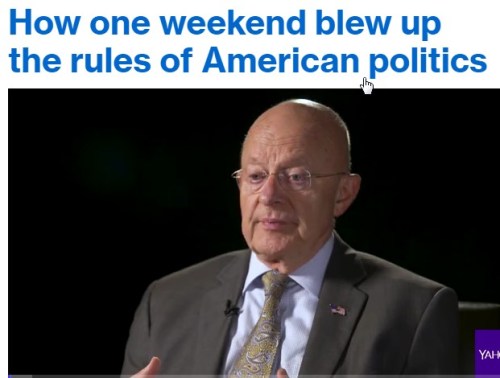
James Clapper of the CIA and U.S. intelligence agencies announce that Russia is taking active measures to interfere with our Presidential elections.
https://www.yahoo.com/news/64-hours-october-one-weekend-blew-rules-american-politics-2-162827162.html
It was Friday, October 7, 2016. There was a rapid series of news dump that day that changed to course of our Presidential Election and our country.
If corporate (for profit) news outlets based reporting on the gravity of events rather than a stories public appeal, the top news story on this one day during the campaign would have been that US intelligence agencies announced that Russia was actively messing with our election. Media manipulations by powerful people behind the scenes took place in the hours that followed the announcement, burying the biggest news story in a decade. Who was behind the release of that shocking Access Hollywood tape that stole our attention?
The video doesn’t say. It could have been Hillary friendly sources, neutral sources or even Russian cyber-ops. It doesn’t matter. The corporate media released the tapes and then fed the blaze of interest that followed.
Then, an hour later, the first of the Podesta emails were released These emails that had been stolen by Russian based hackers and the content was used to strategically selected emails for release that maximize damage to the Hillary campaign. The Podesta email release blunted the impact of the Access Hollywood tapes. Both stories dominated the news for days. The two stories combined completely eclipsed the Russia story. And so the biggest story in a decade, That our democracy was currently under attack by Russia, got buried and erased from our collective conscious until after the election.
The Hypocrisy Risk for Social Conservatives
by Brian T. Lynch, MSW
Whenever hypocrisy strikes a Republican politician, the immediate argument on the right is that Democratic politicians are not morally superior to Republicans. This is may be true, but it is also misleading. The most recent GOP hypocrisy scandal is an example.
Representative Tim Murphy of Pennsylvania became the latest GOP social conservative to manifest hypocrisy. Murphy is married, has an adult child, is a staunch right-to-life proponent and a member of the Congressional House Pro-Life Caucus. This January he voted for the latest Pro-Life bill that passed in Congress. He proudly highlighted his support for the bill in a press release that reads in part:
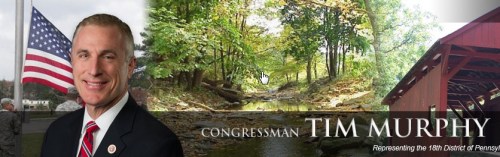
“Passage of H.R. 7 in the wake of the President’s executive action yesterday gives me great hope that moving forward, we will once again be a nation committed to honoring life from the moment of conception onward and ensuring American taxpayer dollars are never spent to end a life before it even begins.” [Murphy, January 24, 2017]
The scandal is that he had just suggested to a woman who became pregnant as a result of their extra-marital affair that she should have an abortion. The woman, Shannon Edwards, was offended by the hypocrisy of Murphy’s public and private attitudes on abortion and told him so in a text message:
“And you have zero issue posting your pro-life stance all over the place when you had no issue asking me to abort our unborn child just last week when we thought that was one of the options.” [Edwards, January 2017]
Ms. Edward’s texts went public and Tim Murphy has since announced he will not run for re-election next year. The very polarized social media debates are well underway.
From this brief account the hypocrisy is clear and the consequences are sad for those involved, especially his wife and child. Frustration on the right is also understandable as this keeps happening on the GOP side. It may seem like the media are selectively reporting on GOP moral gaffs, hence comes the counter-argument that Democratic politicians are just as likely to engage in immoral behaviors, but circumstances make this misleading.
On the Republican side, family values focuses on moral issues, such as this case in point. On the Democratic side family values focuses more on policy issues, such as universal health care, fair wages, school lunch programs, etc. It is less likely politicians will fall victim to hypocrisy if the family values they promote are policy related rather than morality based.
As long as Republicans exploit social conservative issues and insist on legislating morality, the GOP will continue to provide glaring examples that we all fall short of living perfect lives. Conceding that Democrats are just as likely to engage in immorality may be true, but it doesn’t change the fact that they are still less likely to sound like hypocrites when they do.
Should I Stand or Should I Kneel?
by Brian T. Lynch, MSW

Are the NFL players who kneeled in protest at the National Anthem to be reviled, or were they being courageous?
Did they insult our nation, or is their freedom to action what our flag stands for?
Were the protesting players disrespectful or patriotic?
These questions vexed the nation in recent days. People argued and took sides. Tempers sometimes flared. Angry posts or tweets were exchanged. And somewhere in a Russian troll farm cyber warriors were smiling.
This National Anthem flap is a perfect example of how we are being manipulated by higher powers in the media sphere every day. Some of the bad actors are foreign, such as the Russia operatives at the Internet Research Agency in St. Petersburg, with its army of automated bots, who took to Twitter once again to polarize our public discourse over the NFL protest flap.
The truth is that Russia has been doing this type of thing for years; Using social media platforms on the internet to post extreme and inflammatory messages on opposite sides of every issue. This is just one of Russia’s many methods to sow discord and to splinter our national unity. Their goal: Polarize our politics, widen our political fault lines, pit us against one another and make America ungovernable. Russia is targeting other democracies this way in Europe as well.
But Russia isn’t the only player fomenting disunity and despair. They may even be minor players next to some of our own “stateless” oligarchs who benefit from governmental paralysis at every level. These billionaires don’t want to pay any taxes, support the public commons or be told what they can and can’t do. They are among a oligarchs from around the world who control more wealth and power than most countries. They see self-governing entities as obstacles to be overcome in pursuit of wealth, or as competition in their exercise of power, and some have been messing with our politics and social perceptions for years.
To borrow from a prior article:
… there is strong evidence that the rogue interests of certain Western billionaires and Russian oligarchs have converged. Breaking down the economic barriers that keep wealth and power in check under civilian controlled democracies, and the goal of undermining the strength and unity of Western democracies (strengthening Vladimir Putin’s global influence) are essential aligned.
This is the bigger picture. It is a picture so large it’s hard to take in and even harder to accept as true. Yet here we are, confronted by a clear case where a foreign power used Twitter to influence the personal conversations we are having with each other.
Mainstream media also has its part to play in this NFL protest story and countless others like it. It is the “for-profit” news outlets that select what we will be talking about tomorrow. NFL players protesting during the National Anthem is a real money topic. It attracts a much wider audience compared to another story about race relations. It’s important to remember here that we are the commodity the broadcast media delivers to advertisers. What they choose not to cover, we don’t talk much about. A simple internet search for “NFL protests” proves this point. Lost in the hoopla about the flag is any discussion of why there is a protest.
So what was the protest about?:
1. Police in this country kill too many civilians.
2. If your skin is black, you are twice as likely to be one of those killed.
NFL players were trying to bring attention to these issues, one superimposed on the other. On average, police kill about two people per day. For perspective, in all of Great Britain police kill about two people per year. If the rate of police homicides were that low in the US there wouldn’t be enough of them to reveal any sort of pattern. But a pattern does exist, and African-Americans are too often the victims.
These same racial patterns come up time and again in the American justice system because we have a pervasive and persistent problem with race. Whether we are looking at statistics about arrests, convictions, incarcerations, police stops, etc., the same pattern is superimposed on the data. Racial disparity, by far, is the more stubborn of the two problems listed above. We do need to address it. The other part of the problem, the high number of police killings, is a more solvable problem. We can all agree that the fewer number of civilians killed the better. That might mean better police training, better vetting of applicants and changes in police tactics or philosophy.
But here’s the thing. When we try to have that discussion, the social media platforms light up with extreme, emotionally charged messaging that polarizes our public discourse. Conversations quickly become adversarial. Efforts to separate one issue from another to make problem solving easier are sabotaged. Fake news stories begin popping up to further cloud the issues and crazy websites emerge to sustain the divisions thus created. These are often organized disinformation campaigns to reinforce political disunity. They can be so successful that we sometimes can’t even agree on the same set of facts. We get locked into an ideological battle and don’t how we got there. We can’t see the nefarious forces at work behind the scenes.
To understand how this is happening we have to consider the massive social media platforms though which we can broadly and anonymously communicate with millions of strangers. Never before have we had a cyber presence where everything we write or reveal about ourselves exists forever and is available to anyone. The whole internet is a gigantic, ever growing database that can be searched and analyzed. It’s a mercurial universe of ones and zeros. Yet, to an ever greater degree, our world view is molded by our social media experiences. Even as we become more enmeshed in the cyber world, this new medium is increasing falling under the influence of powerful people with weaponized information technologies and the motivation to alter our perceptions, our behavior and our culture. Our vulnerability to manipulation by bad actors has never been greater.
We need to educate ourselves about this new virtual world in which we find ourselves. We have lost control over our public discourse and need to win it back. We have to learn how to recognize when we are be targeted with propaganda messaging and how to resist falling victim to it. We mustn’t let our authentic narratives become hijacked by those who would alter our perceptions to serve their own ends? If democracy is to survive, if America is to survive, we have to overcome our differences and fight back against those who want to see our people’s Republic fail.
Why Russia Hacked Voter Registration Databases – Micro-targeted Messaging
by Brian T. Lynch, MSW
What if Presidential candidates could identify the exact swing districts, to the precinct, that they need to win state elections? Imagine how concentrated their campaigns efforts and resources would be, including the ad buys and how those ads are tailored to the voters in those districts.
Welcome to the modern political campaign. The ability to do exactly this grows greatly every election cycle. Highly detailed voting information has not only allowed candidates to geographically concentrate their resources, it has given unscrupulous party operatives a map to devise voter suppression strategies, vote tampering schemes and gerrymandered districts that give their party structural advantages.
This much is well known by the savvy readers here, even if it remains under appreciated by the many voter. Less well understood are the new information technology weapons that were employed in the last election.
Into the” big data” world of our modern political campaigns came a whole set of newly developed propaganda technologies that can exploit a campaigns massive knowledge base. Explaining how just one of these new, information technology weapons work, one called micro-targeting, we can see how the dots are connected in the Russia election scandal now unfolding.
Here is a step by step plan to use modern information technologies to micro-target individual voters in swing districts to manipulate their vote.
Step 1. CREATE BIO-PSYCHO-SOCIAL PROFILES ON POTENTIAL VOTERS: All the publicly shared Facebook and Twitter information voluntarily provided by individual users has unwittingly created the most massive database ever imagined. Marketing companies can use this database to target ads to those most likely to buy certain products. But in politics, companies like Cambridge Analytica can use this data to creates highly accurate bio-psycho-social profiles (BPS profile) on millions of American adults, and use that information to manipulate voting behavior. The ability to create these very accurate, highly predictive individual profiles using a meta-analysis techniques is well established. Researchers have estimated that just 150 “likes” on Facebook, along with self-reported biographical information, can produce a BPS profile for individuals that better predicts their behavior than what their own spouse could predict. These profiles can even predict which words or phrases will elicit specific emotional reactions in a person. Of this profiling data, Paul-Olivier Dehaye, a Swiss mathematician, said, “People just don’t understand the power of this data and how it can be used against them.”
For those who don’t know, Cambridge Analytica is a election data analysis company founded by Robert Mercer, an American billionaire with some very radical ideas. The company was lead by Breitbart’s Steve Bannon until he joined the Trump administration. Cambridge Analytica was contracted by the Trump campaign to utilize the company’s extensive voter profiles to help get Donald Trump elected in 2016.
Information that Facebook or Twitter does not uniformly obtain is the current voter registration status of users or their voting history. This type of information is only kept in state or county voter registration databases spread throughout the country. For a political campaign to get this type of information they would need to hack into many state and county databases, and do it in a way that doesn’t easily trace back to the campaign.
Step 2. HACK SPECIFIC VOTER REGISTRATION FILES: Micro-targeting voters is a huge undertaking requiring a massive amount of computing. It also requires connecting an individual’s BPS profile with their current voter registration status and voting history. Micro-targeting voters cannot happen without this information. There is currently no national source for voter registration information, but one has been proposed by Donald Trump’s Presidential Advisory Commission of Election Integrity.
Not having a national voter registration system is probably a good thing. A hack of a single database would be far more damaging, and is less likely to be detected. Hacking dozens or hundreds of smaller databases increases the odds of getting caught. Hacks of voter registration files should therefore be limited in number, and the hacks must therefore be targeted at just the right swing districts where micro-targeting has the best odds of changing voting behaviors. The people with the best idea of which voting districts to hack are those within the campaign. The same internal polling numbers used to direct ad buys are the same numbers needed to direct voter registration hacks.
One way to assure that hacking activity can’t easily be traced back to a candidate’s campaign is to covertly employ third parties to conduct the hacks and supply the stolen information to the data analysis companies. If micro-targeting of voters took place during the 2016 elections, as a growing body of evidence suggests, then there has to be a connection between the micro-targeting and the Russian hacks of voter registration files that took place in 22 states. Some information sharing between the campaign and third party hackers would be required to assure that the information to be obtained is useful.
It is still highly speculative, but not unreasonable, to investigate the connections between the Trump campaign and Russian hacking of the voter registration databases. It is also reasonable to investigate whether any of the stolen information ended up in the databases of companies such as Cambridge Analytica.
Step 3. IDENTIFY INDIVIDUALS IN SWING DISTRICT WHOS VOTING BEHAVIOR CAN BE INFLUENCED BY MICRO-TARGETED MESSAGING: Once a voter’s registration information and voting history is matched up with his or her BPS profile, it is a relatively straight forward step to distinguish implacable voters from casual or inconsistent voters. BPS profile characteristic can be used to identify a voters political leanings and the issues they might care about. Another characteristic that micro-targeting requires is that the target must be engaged in social media.
Step 4. BOMBARD TARGETED VOTERS ON THEIR SOCIAL MEDIA WITH SPECIALLY DESIGNED MESSAGES: In the final phase of the operation the object is to create an alternative social media landscape for the targeted voter by bombarding them with fake news stories, tweet storms and biased commentary designed to alter their perceptions of the political environment. These messages are tailored to elicit specific emotional reactions in the subjects. The messages are delivered by a virtual army of trolls (Russia has internet troll farms) and automated bots using fake Facebook or Twitter accounts. If the targeted voter ever shared any doubts about Hillary Clinton on social media, for example, the content of their micro-targeted messages might be designed to amplify those doubts and raise new ones. The purpose is to lessen the likelihood of that voter voting for Hillary. If a person ever “liked” a story about building the border wall, targeted messages might contain outrageous immigration stories to heighten fear and loathing toward immigrants, and to strengthen the voters motivation to vote for Donald Trump. By BPS profiling and micro-targeting people, it is the targeted voters who get manipulated, not the voting machines or the voting process itself.
RESULTS: The psychological and emotional impact of targeted propaganda messaging on individual voters will motivate some to go to the polls and vote for a candidate when they might have otherwise stayed home. Or the messaging may dispirit some voters and cause them to stay home when they would have otherwise cast their ballot. Researchers tell us that people manipulated by these technologies generally don’t realize they are being manipulated. Because of the massive computing power available to these election data companies, and the unprecedented social media databases, identifying and targeting voters susceptible to targeted propaganda messaging is capable of directing these attacks on many thousands of voters just before an election. Flipping whole election through this process may be possible. Did micro-targeting flip the 2016 Presidential election to Donald Trump’s win? No one knows yet, in part because it is so difficult to prove.
It is my belief that the state voter registration hacks were not done to disenfranchise voters at the polls, but to supplement data needed in order to identify and to micro-target low malleable voters with propaganda messaging. I also suspect targeting information was provided to the Russian hackers who broke into the state voter registration files. I don’t know if these are crimes. I certainly hope they are, and I hope the Justice Department Probe is pursuing this line of investigation.
 Data Driven Viewpoints