Home » 2013 (Page 2)
Yearly Archives: 2013
NSA, The More We Know The More We Fear – For a Reason
The recent opinion piece (below) by Amy Zegart and Marshall Erwin of the conservative Hoover Institution suggests the NSA spy agency’s real problems are caused by our not knowing how well they protect us from terrorists. They think the NSA should focus on this rather than correcting our “misperceptions” about how they use our email and telephone data. They wrote that, “…there is no evidence the NSA is engaged in any illegal domestic snooping,” even though such evidence requires transparency and everything the NSA does is secret.
Setting aside recent proof that NSA employees do sometimes breach security protocols, we know the NSA maintains a database of electronic “envelope” information from all our calls and emails. From this information they create their meta-data analysis that reveals how closely each of us is linked to anyone else. But the NSA also has yet to deny that they are storing the content of our emails, and possibly our phone calls, in huge data storage facilities such as the recently built Utah Data Center, officially called the Intelligence Community Comprehensive National Cybersecurity Initiative Data Center. The NSA may not be previewing all this content data, but saved records can be accessed and reviewed in the future if they choose to look. By any stretch of meaning, saving private electronic content by government, even if it is never opened, is still an unreasonable government seizure prohibited by the Fourth Amendment.
So, is it reasonable for government to seize all our private emails or phone conversations providing they don’t peek? If so, then what’s to stop state or local law enforcement from doing the same. And what’s to stop the NSA from making secret allegations, obtaining secret FISA court access to stored communications or even altering those files to persecute citizens perceived as a threat? Our founding fathers would not have consented to this and neither should we. Protecting us from terrorist threats doesn’t justify suspending Fourth Amendment rights protecting us from tyranny at home.
The NSA’s image problem
To know the spy agency is not necessarily to love it.
By Amy Zegart and Marshall Erwin
November 1, 2013
In the wake of Edward Snowden‘s ongoing revelations about U.S. surveillance programs, the National Security Agency is facing the worst crisis in its 60-year history. Today, too many Americans mistakenly believe the NSA is listening to their phone calls and reading their emails. But misperception is only part of the agency’s problem. In an Oct. 5-7 YouGov national poll we commissioned, we also found the more that Americans understand the NSA’s activities, the less they support the agency. [snip]
Our poll results found the part about the public’s ignorance was true. But we did not find that ignorance bred greater distrust of the agency. [snip]
For example, Americans who accurately understood the NSA’s telephone metadata program were no more favorable toward the agency than those who mistakenly thought metadata involved snooping on the content of calls. [snip]
NSA Director Gen. Keith Alexander [has said]: “And so what’s hyped up in a lot of the reporting is that we’re listening to your phone calls. We’re reading your emails. That’s just not true.” [snip]
The NSA needs to win this debate on the merits. What we need to know is whether the agency’s telephone and Internet surveillance programs are wise and effective.
Though legal scholars will continue to debate endlessly just what “relevance” or “targeting” means, the message from these disclosures for the rest of us is this: There is no evidence that the NSA is engaged in any illegal domestic snooping operations.
For national security, the more important question now is whether these programs are good counter-terrorism policy. We have lost sight of that.
[read more at http://www.latimes.com/opinion/commentary/la-oe-zegart-nsa-effectiveness-20131101,0,1883353.story#axzz2jMeD4paf ]
Razor Blade Prices Growing Faster Than Whiskers
What is up with the price of razor blades?

There are few cheap plastic items as horribly expensive as razor blades.
It’s insane! Gentleman, where is your outrage? If these prices keep rising the length of women’s skirts and dresses will have to fall. It’s time for consumers to ask some pointed questions of companies like Gillette and Schick?
By some estimates the simple act of shaving our face can cost as much as a dollar per shave. I have been shopping for Gillette Mach 3 blades but can’t bring myself to cough up $24 bucks for eight cartridges. I went shopping again today and was shocked when I saw the unit price for them is $291 per hundred. The 4 blade Fusion cartridges are $180 more per hundred, or $469.75/ hundred.
I started looking around on the internet and discovered that the prices of these stupid plastic razors has been soaring everywhere, even in the United Kingdom. By one account on a British Website the cost of razor blades has climbed by 99% three years to as much as £3.49 (or $5.59 US) per cartridge. According to that article in costs Gillette less than 10p (about 16 cents) to make. (see below)
If you listen to business analysts or industry spokes persons it is either brand loyalty or the high cost of shaving research and marketing expences that is driving up the cost. I don’t believe it. I suspect something akin to price fixing is behind it all. I think it is time for someone to investigate the shaving industry to see why the costs are skyrocketing.
The great razor rip off: Prices of blades soar by up to 99% in just three years
By SEAN POULTER
PUBLISHED: 18:26 EST, 27 April 2012
Read more: http://www.dailymail.co.uk/news/article-2136440/The-great-razor-rip-Prices-blades-soar-99-just-years.html#ixzz2kJ3Yy3wM
Follow us: @MailOnline on Twitter | DailyMail on Facebook
The price of razor blade cartridges has surged by as much as 99 per cent in just three years – driving many men to adopt designer stubble. The cartridges cost less than 10p to make, but shoppers are being charged as much as £3.49 each. The biggest player, Gillette, has imposed a stealth price rise by cutting the number of replacement cartridges in its Mach3 Turbo packs from five to four. [snip]
Allure Man Asks: Why Are Razor Blades So Damn Expensive?
If you, like me, can remember a time before razor blades were kept behind the drugstore counter along with the cigarettes and other controlled substances, then you probably also share my amazement at just how much they cost. A four-pack of Gillette Fusion Power razor cartridges retails for $19.49 at Walgreens. That’s, what, $4.87 for a week’s worth of shaves? Outrageous!
I put this question to Jeff Raider, a cofounder of Harry’s, a new online retailer that offers shaving supplies similar in quality to the major brands but at half the price: How did razor blades become fetish objects? All of the good ones, he says, are made from similar high-grade steel, which is then precision-milled to produce a blade that’s thick at the bottom, where it’s anchored to the plastic cartridge that clips onto your razor, yet thin as a single hair at the top, where it mows down morning stubble. “The steel is a very expensive product, but the real magic of a fine razor blade is how it’s ground,” says Raider.[snip]
Good Question: Why Are Razor Blades So Expensive?
October 21, 2013
http://minnesota.cbslocal.com/2013/10/21/good-question-why-are-razor-blades-so-expensive-2/
MINNEAPOLIS (WCCO) — It can cost us anywhere between $20 and $30 dollars just to shave the hair from our faces or legs. Sometimes, the price of the razor blades is more expensive than the razors themselves.
So, why are razor blades so expensive? Good Question. [snip] Erin Lash is a senior equity analyst at Morningstar, anindependent investment research firm. She covers Gillette (owned by Proctor & Gamble), one of the the two dominant players in the razor market. Schick (owned by Energizer Holdings, Inc.) is the other company.
Lash says part of the reason razor blades are so expensive is because consumers are loyal to the brand.
“Once you buy a particular razor, there’s no substitution for the razor blade,” she said. “Companies have a great ability to charge up for the blade once you’re locked into the actual product,” she said.[snip
Why Are Razors So Darn Expensive?
Because shaving is a science.
So let’s do the math. In the photo above, a women’s package of razors costs $18.79 for five cartridges. If each cartridge lasts about a week, that comes out to about 54 cents a shave. Seems pricey, but what exactly goes into making a razor? Those stainless steel blades that you see are only a small part of the final product. [snip]
A Word About My Free Rooftop Solar
by Brian T. Lynch, MSW
Let me tell you about my free rooftop solar energy system which I recently had installed.

I’ve wanted solar energy for a long time, mostly because my wife and I are concerned about the global warming. We didn’t convert years ago because of the high cost and slow rate of return on the initial investment. We live in Northern New Jersey which has considerably less sunlight than, say, Arizona. When I first looked into it, solar panels were far less efficient than they are today so the cost/benefit for us couldn’t be justified.
Now we are retired and improved solar panels have really lowered investment recovery times, but we may want to downsize or relocate in the next few years. We don’t want a solar energy project that won’t be paid off before we sell.
The solution for us was one of the new solar energy lease program that installs and maintains the entire system for free over a period of years. The solar panels send power directly to the power grid in an arrangement with the utility companies know as “net metering”. The solar electricity generated is deducted by the utility company from the power that I use. When we generate more power than we use the utility company gives us a credit. On months when we use more power than we generate we apply the accumulated credits and pay for any difference.
There is a catch, of course. The company who owns the system on our roof also owns the electricity it generates. We pay them for the solar electricity that we use, power which the original utility company no longer supplies. In effect, the solar energy company becomes our energy provider. For the use of our roof the solar company sells us this electricity at a discounted rate. In our case we paid nothing for the system, we will pay nothing for its maintenance over the next 20 years and we will save on our electricity bill each month. Our solar electric rate is structured to increase the amount we will save each year over time relative to our current provider. We were told that over twenty years we should save about eighteen-thousand dollars by switching to solar through this lease program.
The real beneficiary in all this is the environment. Over the course of one month we prevent over a quarter ton of carbon from entering the atmosphere. That’s three tons a year or sixty tons over the next twenty years. Through conservation measures our electric use is already half what a typical homeowner uses, so most people would save even more on carbon emissions. If everyone on our block had rooftop solar the atmosphere would be spared well over 3,000 tons of carbon a year.
How did we pick a solar energy company? I would like to say we shopped and compared, but it didn’t happen that way. I stopped to talk with a person offering information on rooftop solar at a kiosk in Home Depot. This lead me to invite a sales representative from Rooftop Diagnostic to come to our home. The representative explained how the lease option worked and confirmed that our house was a candidate for a solar based on our homes orientation and the amount of sunlight it gets. Rooftop Diagnostics only designs, installs and maintains the system for a company called Enphase Energy and neither of these two companies are affiliated with Home Depot.
Under a net metering arrangement homeowners are not allowed to produce more power than they use. This means that rooftop solar installations can’t be designed to produce more than 100% of the homeowners average annual energy use. The initial electricity rate the solar company charges is somewhat negotiable, but it should be at or slightly below what the utility company charges now. Under our Enphase Energy contract our initial electric rate will increase by 3.5% per year, which they say is half of the historic rate increase for our current energy provider. That might sound like a lot, but the inflation rate over the past 10 years is 2.3%, so inflation alone accounts for most of the increase. In our specific case, our energy charge would start at about $36.00 per month and it will end up about $67.00 per month in twenty years. The power utilities also charges a delivery service charge each month based on energy use. Since about 96% of our electricity will come from the electricity generated on our roof, our delivery service charge will be 96% less per month as well. Also, while our current electric rates vary seasonally, our solar energy rates remain the same each month.
After I first met with the solar representative, I searched the internet for more information to comparison shop, but didn’t find what I was looking for. I wanted a database listing companies that provide solar leasing options but there are none at present. A lot of companies on the internet offer solar instillations but important details are lacking. Unfortunately, internet information about solar electric companies is not as organized as is information about the sham alternative energy retailers that “compete” to sell you lower electric rates. These companies are wholesale purchasers of electricity who offer crazy gimmicks and low introductory rates to get you to buy power from them. It is a dog and pony show masquerading as a competitive energy market, but the only real competition the utility companies face is from the nascent “distributed energy” alternatives such as rooftop solar and wind power systems. Even though these true alternative energy sources are a tiny fraction of the energy market, the big utility companies are already organizing to protect their business model and market shares. If you think you might be interested in a rooftop solar system, to buy or lease, it would be wise to act soon because the current financial incentives will disappear if the energy industry has its way.
[PS: If you live in New Jersey and already have a rooftop system from Rooftop Diagnostics, they will pay you a referral fee for any new customers you refer to them. Other companies might offer similar incentives,so if you are thinking about getting a system, check with friends and family members who might benefit from this incentive program. To be clear, I am not soliciting referrals and I have no pecuniary motivation in writing this post.]
Snippets: Toxic Stress and New Ways to Combat the Impact of Child Abuse and Neglect
What follows is a snip-it of an excellent article from the Opinionator section of the New York Times by David Bornstein. Within the article are hyperlinks to excellent source material on childhood toxic stress, its impact on children and new methods to prevent harm or treat children who are exposed to toxic stress. I have taken snippets of each of these hyperlinks to create an annotated index to the sources from Mr. Bornstein’s article. I hope that this will encourage further reading and understanding on this topic. Having spend 31 years as a social worker in child protective services it has been my experience that chronic and repetitive stress on children is both pervasive and incredibly damaging. It takes new protective service workers years of experience to recognize toxic stress and fully appreciate how damaging it truly is. The whole field of protective services is more oriented towards responding to physical abuse and acute safety risks than it is to chronic neglect or repetitive lower level trauma. – Brian T. Lynch, MSW
Protecting Children From Toxic Stress
New York Times – October 30, 2013
Imagine if scientists discovered a toxic substance that increased the risks of cancer, diabetes and heart, lung and liver disease for millions of people. Something that also increased one’s risks for smoking, drug abuse, suicide, teen pregnancy, sexually transmitted disease, domestic violence and depression — and simultaneously reduced the chances of succeeding in school, performing well on a job and maintaining stable relationships? It would be comparable to hazards like lead paint, tobacco smoke and mercury. We would do everything in our power to contain it and keep it far away from children. Right?
Well, there is such a thing, but it’s not a substance. It’s been called “toxic stress.” For more than a decade, researchers have understood that frequent or continual stress on young children who lack adequate protection and support from adults, is strongly associated with increases in the risks of lifelong health and social problems, including all those listed above.
[read more: http://opinionator.blogs.nytimes.com/2013/10/30/protecting-children-from-toxic-stress/?_r=0 ]
Toxic stress response: Occurs when a child experiences strong, frequent, and/or prolonged adversity—such as physical or emotional abuse, chronic neglect, caregiver substance abuse or mental illness, exposure to violence, and/or the accumulated burdens of family economic hardship—without adequate adult support. This kind of prolonged activation of the stress response systems can disrupt the development of brain architecture and other organ systems, and increase the risk for stress-related disease and cognitive impairment, well into the adult years.
When toxic stress response occurs continually, or is triggered by multiple sources, it can have a cumulative toll on an individual’s physical and mental health—for a lifetime. The more adverse experiences in childhood, the greater the likelihood of developmental delays and later health problems, including heart disease, diabetes, substance abuse, and depression. Research also indicates that supportive, responsive relationships with caring adults as early in life as possible can prevent or reverse the damaging effects of toxic stress response.
[read more: http://developingchild.harvard.edu/topics/science_of_early_childhood/toxic_stress_response/ ]
Centers For Disease Control and Prevention
http://www.cdc.gov/ace/index.htm
Survey shows 1 in 5 Iowans have 3 or more adverse childhood experiences
October 14, 2013By Jane Ellen Stevensin
Iowa’s 2012 ACE survey found that 55 percent of Iowans have at least one adverse childhood experience, while one in five of the state’s residents have an ACE score of 3 or higher.
In the Iowa study, there was more emotional abuse than physical and sexual abuse, while adult substance abuse was higher than other household dysfunctions.
This survey echoed the original CDC ACE Study in that as the number of types of adverse childhood experiences increase, the risk of chronic health problems — such as diabetes, depression, heart disease and cancer — increases. So does violence, becoming a victim of violence, and missing work days.
[read more: http://acestoohigh.com/2013/10/14/survey-shows-1-in-5-iowans-have-3-or-more-adverse-childhood-experiences/ ]
From the American Academy of Pediatrics
Technical Report
The Lifelong Effects of Early Childhood Adversity and Toxic Stress
- 1. Benjamin S. Siegel, MD,
- 2. Mary I. Dobbins, MD,
- 3. Marian F. Earls, MD,
- 4. Andrew S. Garner, MD, PhD,
- 5. Laura McGuinn, MD,
- 6. John Pascoe, MD, MPH, and
- 7. David L. Wood, MD
ABSTRACT
Advances in fields of inquiry as diverse as neuroscience, molecular biology, genomics, developmental psychology, epidemiology, sociology, and economics are catalyzing an important paradigm shift in our understanding of health and disease across the lifespan. This converging, multidisciplinary science of human development has profound implications for our ability to enhance the life prospects of children and to strengthen the social and economic fabric of society. Drawing on these multiple streams of investigation, this report presents an ecobiodevelopmental framework that illustrates how early experiences and environmental influences can leave a lasting signature on the genetic predispositions that affect emerging brain architecture and long-term health. The report also examines extensive evidence of the disruptive impacts of toxic stress, offering intriguing insights into causal mechanisms that link early adversity to later impairments in learning, behavior, and both physical and mental well-being. The implications of this framework for the practice of medicine, in general, and pediatrics, specifically, are potentially transformational. They suggest that many adult diseases should be viewed as developmental disorders that begin early in life and that persistent health disparities associated with poverty, discrimination, or maltreatment could be reduced by the alleviation of toxic stress in childhood. [snip]
[read more: http://pediatrics.aappublications.org/content/129/1/e232.full ]
WORKING PAPER #3
Excessive Stress Disrupts the Architecture of the Developing Brain
New research suggests that exceptionally stressful experiences early in life may have long-term consequences for a child’s learning, behavior, and both physical and mental health. Some types of “positive stress” in a child’s life—overcoming the challenges and frustrations of learning a new, difficult task, for instance—can be beneficial. Severe, uncontrollable, chronic adversity—what this report defines as “toxic stress”—on the other hand, can produce detrimental effects on developing brain architecture as well as on the chemical and physiological systems that help an individual adapt to stressful events. This has implications for many policy issues, including family and medical leave, child care quality and availability, mental health services, and family support programs. This report from the National Scientific Council on the Developing Child explains how significant adversity early in life can alter—in a lasting way—a child’s capacity to learn and to adapt to stressful situations, how sensitive and responsive caregiving can buffer the effects of such stress, and how policies could be shaped to minimize the disruptive impacts of toxic stress on young children.
Suggested citation: National Scientific Council on the Developing Child (2005). Excessive Stress Disrupts the Architecture of the Developing Brain: Working Paper No. 3. Retrieved from http://www.developingchild.harvard.edu
Strengthening Adult Capacities to Improve Child Outcomes: A New Strategy for Reducing Integenerational Poverty
Jack P. Shonkoff, Harvard University – Posted April 22, 2012
[snip]
It’s clear that high-quality early childhood programs can make a measurable difference for children in poverty, but we must do more. Advances in neuroscience, molecular biology, and the behavioral sciences provide the evidence needed to build on best practices and to forge new ideas that can address the factors that contribute to intergenerational poverty. One promising path is to focus on fostering the skills in adults that allow them to be both better parents and better employees.
Science tells us that children who experience significant adversity without the buffering protection of supportive adults can suffer serious lifelong consequences. Such “toxic stress” in the early years can disrupt developing brain architecture and other maturing biological systems in a way that leads to poor outcomes in learning, behavior, and health. [snip] …[T]he goal is to prevent or mitigate the consequences of toxic stress by buffering young children from abuse or neglect, exposure to violence, parental mental illness or substance abuse, and other serious threats to their well-being.
Success in this area requires adults and communities to provide sufficient protection and supports that will help young children develop strong, adaptive capacities. Since many caregivers with limited education and low income have underdeveloped adaptive skills of their own, interventions that focus on adult capacity-building offer promising opportunities for greater impacts on children.
One area of development that appears to be particularly ripe for innovation is the domain of executive functioning. These skills include the ability to focus and sustain attention, set goals and make plans, follow rules, solve problems, monitor actions, delay gratification, and control impulses.[snip]
[ See more at: http://www.spotlightonpoverty.org/ExclusiveCommentary.aspx?id=7a0f1142-f33b-40b8-82eb-73306f86fb74#sthash.4XsuGXPI.dpuf ]
Stress reactivity and attachment security.
Gunnar MR, Brodersen L, Nachmias M, Buss K, Rigatuso J.
Source
Institute of Child Development, University of Minnesota, Minneapolis 55455, USA.
Abstract
Seventy-three 18-month-olds were tested in the Ainsworth Strange Situation. These children were a subset of 83 infants tested at 2, 4, 6, and 15 months during their well-baby examinations with inoculations. Salivary cortisol, behavioral distress, and maternal responsiveness measures obtained during these clinic visits were examined in relation to attachment classifications. In addition, parental report measures of the children’s social fearfulness in the 2nd year of life were used to classify the children into high-fearful versus average- to low-fearful groups. In the 2nd year, the combination of high fearfulness and insecure versus secure attachment was associated with higher cortisol responses to both the clinic exam-inoculation situation and the Strange Situation. Thus, attachment security moderates the physiological consequences of fearful, inhibited temperament. Regarding the 2-, 4-, and 6-month data, later attachment security was related to greater maternal responsiveness and lower cortisol baselines. Neither cortisol nor behavioral reactivity to the inoculations predicted later attachment classifications. There was some suggestion, however, that at their 2-month checkup, infants who would later be classified as insecurely attached exhibited larger dissociations between the magnitude of their behavioral and hormonal response to the inoculations. Greater differences between internal (hormonal) and external (crying) responses were also negatively correlated with maternal responsiveness and positively correlated with pretest cortisol levels during these early months of life.
[read more: http://www.ncbi.nlm.nih.gov/pubmed/8666128 ]
Child FIRST
HIGHLIGHTS
- Intervention: A home visitation program for low-income families with young children at high risk of emotional, behavioral, or developmental problems, or child maltreatment.
- Evaluation Methods: A well-conducted randomized controlled trial.
- Key Findings: At the three-year follow-up, a 33% reduction in families’ involvement with child protective services (CPS) for possible child maltreatment. At the one-year follow-up, 40-70% reductions in serious levels of (i) child conduct and language development problems, and (ii) mothers’ psychological distress.
- Other: A study limitation is that its sample was geographically concentrated in Bridgeport, Connecticut. Replication of these findings in a second trial, in another setting, would be desirable to confirm the initial results and establish that they generalize to other settings where the intervention might be implemented.
Download a printable version of this evidence summary (pdf, 4 pages)
Effects of Child FIRST one year after random assignment:
Compared to the control group, children in the Child FIRST group were –
- 68% less likely to have clinically-concerning language development problems, as measured by a trained assessor (10.5% of Child FIRST children had such problems versus 33.3% of control group children).
- 42% less likely to have clinically-concerning externalizing behaviors, such as aggression or impulsiveness, as reported by their mothers (17.0% of Child FIRST children versus 29.1% of control group children).
Compared to the control group, mothers in the Child FIRST group were –
- 64% less likely to have clinically-concerning levels of psychological distress, based on self-reports (14.0% of Child FIRST mothers versus 39.0% of the control group mothers).
- The study did not find statistically-significant effects on (i) the percent of children with clinically-concerning internalizing behaviors (e.g., depression or anxiety); (ii) the percent of children with clinically-concerning dysregulation (e.g., sleep or eating problems); (iii) the percent of mothers with clinically-concerning parenting stress; or (iv) the percent of mothers with clinically-concerning depression.3
[read more: http://toptierevidence.org/programs-reviewed/child-first ]
Research Finds a High Rate of Expulsions in Preschool
By TAMAR LEWIN
New York Times – Published: May 17, 2005
So what if typical 3-year-olds are just out of diapers, still take a daily nap and can’t tie their shoes? They are plenty old enough to be expelled, the first national study of expulsion rates in prekindergarten programs has found.
In fact, preschool children are three times as likely to be expelled as children in kindergarten through 12th grade, according to the new study, by researchers from the Yale Child Study Center.
[read more: http://www.nytimes.com/2005/05/17/education/17expel.html?_r=0 ]
Preschool and child care expulsion and suspension: Rates and predictors in one state.
Gilliam, Walter S.; Shahar, Golan
Infants & Young Children, Vol 19(3), Jul-Sep 2006, 228-245. doi: 10.1097/00001163-200607000-00007
ABSTRACT : Rates and predictors of preschool expulsion and suspension were examined in a randomly selected sample of Massachusetts preschool teachers (N = 119). During a 12-month period, 39% of teachers reported expelling at least one child, and 15% reported suspending. The preschool expulsion rate was 27.42 per 1000 enrollees, more than 34 times the Massachusetts K-12 rate and more than 13 times the national K-12 rate. Suspension rates for preschoolers were less than that for K-12. Larger classes, higher proportion of 3-year-olds in the class, and elevated teacher job stress predicted increased likelihood of expulsion. [snip]
[read more: http://psycnet.apa.org/psycinfo/2009-04570-007 ]
Traumatic and stressful events in early childhood: Can treatment help those at highest risk?
Chandra Ghosh Ippen, William W. Harris, Patricia Van Horn, Alicia F. Lieberman
ABSTRACT: This study involves a reanalysis of data from a randomized controlled trial to examine whether child–parent psychotherapy (CPP), an empirically based treatment focusing on the parent–child relationship as the vehicle for child improvement, is efficacious for children who experienced multiple traumatic and stressful life events (TSEs)
[read more: http://www.sciencedirect.com/science/article/pii/S0145213411001499 ]
Listening to a Baby’s Brain: Changing the Pediatric Checkup to Reduce Toxic Stress
Listening to a baby’s heartbeat. Examining a toddler’s ears. Testing a preschooler for exposure to lead. These critical screenings have long been the hallmarks of early childhood checkups. Now, leading pediatricians are recommending major changes to the checkups of the future. The American Academy of Pediatrics (AAP) wants primary care doctors to screen their youngest patients for social and emotional difficulties that could be early signs of toxic stress. Read more >>
[read more: http://developingchild.harvard.edu/resources/stories_from_the_field/tackling_toxic_stress/ ]
From the American Academy of Pediatrics
Policy Statement
Early Childhood Adversity, Toxic Stress, and the Role of the Pediatrician: Translating Developmental Science Into Lifelong Health
Andrew S. Garner, MD, PhD, Jack P. Shonkoff, MD, Benjamin S. Siegel, MD, Mary I. Dobbins, MD, Marian F. Earls, MD, Andrew S. Garner, MD, PhD, Laura McGuinn, MD, John Pascoe, MD, MPH, David L. Wood, MD
ABSTRACT : [snip] To this end, AAP endorses a developing leadership role for the entire pediatric community—one that mobilizes the scientific expertise of both basic and clinical researchers, the family-centered care of the pediatric medical home, and the public influence of AAP and its state chapters—to catalyze fundamental change in early childhood policy and services. AAP is committed to leveraging science to inform the development of innovative strategies to reduce the precipitants of toxic stress in young children and to mitigate their negative effects on the course of development and health across the life span.
[read more: http://pediatrics.aappublications.org/content/129/1/e224.full.html ]
Top of Form
aces connection
HEALTHY, HAPPY KIDS GROW UP TO CREATE A HEALTHY, HAPPY WORLD.
This is a community of practice network. We use trauma-informed practices to prevent ACEs & further trauma, and to increase resilience.
[read more: http://acesconnection.com/ ]
ABOUT DAVID BORNSTEIN:
David Bornstein is the author of “How to Change the World,” which has been published in 20 languages, and “The Price of a Dream: The Story of the Grameen Bank,” and is co-author of “Social Entrepreneurship: What Everyone Needs to Know.” He is a co-founder of theSolutions Journalism Network, which supports rigorous reporting about responses to social problems.
Global Cooling and a Climate Denialist Who Forgot Who Once Solved the Acid Rain Problem
The following is from an email to a friend who denies global warming as having a man made cause. He dropped of a 1975 Newsweek article on Global Cooling:
Read the article. Interesting. Thanks. Looked it up some and found this on Wikipedia, that great source of information for Rand Paul speeches:
Global cooling was a conjecture during the 1970s of imminent cooling of the Earth‘s surface and atmosphere culminating in a period of extensive glaciation. This hypothesis had little support in the scientific community, but gained temporary popular attention due to a combination of a slight downward trend of temperatures from the 1940s to the early 1970s and press reports that did not accurately reflect the full scope of the scientific climate literature, i.e., a larger and faster-growing body of literature projecting future warming due to greenhouse gas emissions. The current scientific opinion on climate change is that the Earth has not durably cooled, but undergoneglobal warming throughout the 20th century.[1]

Also, found the graph of global warming and cooling cycles for the past 425,000 years covering 5 glacial periods. The data stops at 1990 on this chart:

http://www.planetseed.com/relatedarticle/temperature-change-history
And between 1990 and the present the rate of temperature rise has exceeded the highest peeks from the past 425,000 years to about +4 degrees celcius. You will also notice that we really should be entering into a global cooling period based on the pattern you see above. Here is the current trend:

So to say the temps have been rising since the last ice age is as true as it is irrelavant. We should be heading into the next ice age, not shooting up to tempretures that haven’t been seen for a million years.
I also reminded my friend that Acid Rain was once a much bigger problem. Everyone accepted back then that it was a man made problem caused by sulfer released from coal and oil fired electric plants. A sequestration plan and cap and trade system was passed, which was a Republican plan opposed by many Democrats. But it worked and acid rain is not the critical problem it was back then. So here we are facing an even bigger man made problem and the opposition is from the party that solved acid rain with a cap and trade method that worked. go figure.
Carbon, Climate and a Mirror to Our Future
by Brian T. Lynch, MSW
If you asked most forward thinking Americans to name a disruptive challenge we face today, global warming would be high on the list. Climate changing levels of carbon dioxide have been released into the air and the impacts on weather, on raising ocean levels and melting glacier are underway. The most socially responsible among us are already reducing their carbon footprint by recycling, buying more efficient cars, better insulating their homes, buying Energy Star appliances, using florescent or LED lighting. More and more people are also taking advantage of incentive programs to install rooftop solar or wind power generation systems.
The impact from these early pioneers of change is still quite small relative to the problem, but it is significant. So significant, in fact, that the industries which release carbon dioxide to produce the energy we buy are feeling threatened. After all, every time you replace an incandescent light bulb with an LED bulb you reduce their revenue.
Our power generation and distribution companies can adapt by getting into the LED lighting business for example, or they can maladapt by killing government regulations and initiatives to reduce carbon emissions. It appears they have chosen to do both. Some energy companies are investing in wind, solar or other renewable energy technologies while others are busy hatching plans to manipulate the democratic process in order to scuttle government incentives and regulations that threaten their bottom line.
When the power generation utilities think about the disruptive challenges we face as a nation they quite literally see a mirror image of what the rest of us see. The threats they see include “demand side management” (DSM) which refers to consumer energy conservation measures, and “distributed energy resources” (DER) meaning residential power generation such as rooftop solar systems. This is explained in an national industry report released this past January by the Edison Electric Institute. Entitled, “Disruptive Challenges, Financial Implications and Strategic Responses to a Changing Retail Electric Business,” the report describes how disruptive consumer conservation and residential energy generation can be to their business. To help electric utility executives better understand the disruptive forces of socially responsible citizens it offers this useful flow chart: [http://tinyurl.com/m5py4rg]
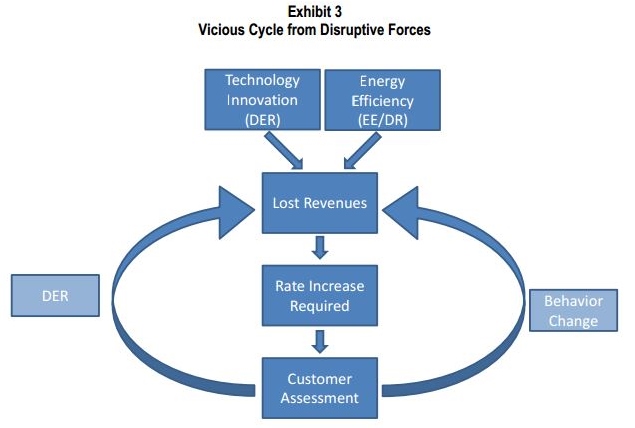
Edison Electric Institute, Washington, D.C. – www.eei.org
Another study conducted for PacifCorp was released in March of 2013 by The Cadmus Group, Inc., another D.C. based firm. This industry study looks at the potential impact of consumer conservation on corporate energy sales over the next 20 years in states served by the Pacific Power and Rocky Mountain Power Companies. The Cadmus Group defined DSM this way:
Demand-side management involves reducing electricity use through activities or programs that promote electric energy efficiency or conservation, or more efficient management of electric energy loads. These efforts may:
- Promote high efficiency building practices
- Promote the purchase of energy-efficient ENERGY STAR® products
- Encourage the transition from incandescent lighting to more efficient compact fluorescent lighting
- Encourage customers to shift non-critical usage of electricity from high-use periods to after 7 p.m. or before 11 a.m.
- Consist of programs providing limited utility control of customer equipment such as air conditioners
- Promote energy awareness and education
This report suggests that energy conservation efforts and residential power generation over the next twenty years will reduce these energy company sales by up to 15%. About 76% of this reduction will come from residential customers, mostly from conservation measures. Numbers like these are causing energy companies everywhere to start defending their business model. The Arizona Public Service Company, for example, recently funded non-profit agencies to start what looks like a grass roots attempt to turn public opinion against both rooftop solar and the states’ publically elected Arizona Corporation Commission, which has final authority over utility rates. Rooftop solar initiatives are a prime target for utility companies both because of its rapid growth and the direct way these installations impact utility company profits. The reason why conservation efforts and residential power generation may be scary to utility companies from a business perspective becomes clear when you look at the bigger picture.
The history of U.S. energy use is one of annually increasing demand. Population growth and consumer purchases of more energy reliant products guarantee increased electric demand well into the future. It remains a growing market, but the rate of growth is slowing. This has been true since the 1950’s. According to the U.S. Energy Information Administration, “The growth of electricity demand (including retail sales and direct use) has slowed in each decade since the 1950s, from a 9.8-percent annual rate of growth from 1949 to 1959 to only 0.7 percent per year in the first decade of the 21st century.” The following chart shows how the increase in electric demand is declining in this country.

US. Energy Information Agency http://tinyurl.com/nnz9rgg
Meanwhile coal continues to be the biggest fuel source for power plants. The use of coal accounts for about 42% of the electricity we generate. Coal is expected to remain predominate though 2040, although its share of the energy generation mix will fall to around 35% of the total as natural gas and renewable energy soruces grow. This means that for the foreseeable future carbon emissions and growing electricity demand will still be with us if nothing changes. Of course nothing ever stays the same. The real question is whether the energy utilities, reacting to market forces, will dominate the direction we take in producing carbon based energy or whether pressure to save the planet will rise to a point where we can achieve meaningful reductions in green house gas emissions.
Bogus Claim: Obama Uses IRS to Buy Votes
There appears that a phony new scandal is taking shape on some conservative corners of the internet. It may or may not gain traction, but it is worth a peek. David DeVine, on the Website entitled TheWestern Free Press, and others, are accusing President Obama of using the IRS to create “de facto amnesty” for illegal aliens. It has to do with an aspect of federal tax law that has been ignored for years.

Here is the actual claim:
ITIN amnesty scam empowers Obama IRS to buy votes
“Outraged that illegal aliens claimed child-tax-credits, but no outrage that current tax law allows them to report income and pay taxes without threat of deportation?”
Apparently some on the right have finally discovered that many resident aliens actually do have IRS identification numbers that allow them to file and pay their federal income taxes and receive some tax benefits.
For years now rightwing conservatives have complained that undocumented aliens (by which they usually mean all non-citizens of color) don’t pay taxes and are a burden to taxpayers. This has never been entirely true, of course. Even setting income taxes and payroll deductions aside, all resident aliens pay sales taxes, property taxes (sometime indirectly by paying rent), gas taxes, cigarette taxes, tolls, fees , etc. But the biggest misconception has been that most resident aliens don’t pay income taxes. Many, perhaps most resident aliens do pay income taxes. Even my liberal friends have had a hard time believing this.
For more than forty-years the IRS has issued a nine-digit Individual Taxpayer Identification Number ( IRS application form W-7) to resident aliens who are not eligible to apply for Social Security. These identification numbers may be issued to resident aliens who earn income in the U.S. and either have a “Green Card” eligibility or meet the “Substantial Presentence” eligibility test. In fact, the instructions on the W-7 states, “A foreign individual living in the United States who does not have permission to work from the USCIS, and is thus ineligible for a SSN, may still be required to file a U.S. tax return”, and therefore obtain an Individual Taxpayer Identification Number (ITIN). So regardless of how a foreign citizen came to be here, if they earn money while here they are required to file income taxes. For example, a foreign citizen who came here in January and earned money and is still here in December must file income taxes and apply for the ITIN by attaching the application to their return.
Depending on their status and circumstance they may also be eligible to receive federal tax rebates and some other benefits under the tax law for themselves or their dependents. This includes the Child Tax Credit when a dependent child is a citizen or meets criteria in the IRS code. What resident aliens cannot collect is the Earned Income Tax Credit. It says so right on the ITIM application.
These IRS issued ITIN’s have be around at least since the 1960’s but some on the right what to use this rediscovered revelation to accuse President Obama of buying votes by making the IRS issues Child Tax Credits to “illegals.” This claim ignores the fact that all resident aliens are ineligible to vote. Some conservatives also want to pin on Obama their outrage that undocumented aliens are even allowed to report income without the threat of deportation. They would prefer, I suppose, that undocumented aliens be exempt from paying income tax, or else forced to hide their income out of fear of instant deportation.
Immigration enforcement is not the job of the IRS. It is their job to collect taxes on all residents who earn income regardless of whether they are citizens. It will be interesting to see if this issue gains traction or finds its way into round 2 of the immigration reform debate on the horizion.
A Passionate Call for an Alternative to Poliltics
What follows is the very essence of passion and disphoric expression by the next generation towards today’s intractable political systems that serve the interests of the rich and powerful. Russel Brand’s passion and rejection of establishment processes to bring about change mirror the essence of the Occupy movement. The outragiously disparate distribution of wealth and power has so distorted and hoplessly incumbered politics and democracy that he and many young people today are repulsed by it all. They struggle for an alternative that doesn’t yet exist and may never exist. The rant is perhaps a glimps into the hearts and minds of the coming generation. Through the social media an emotional consensus is building which has no clear expression or pathway to change.
Actor Russell Brand reduces BBC newsman to stunned silence with diatribe against corporate oligarchy
By Travis Gettys
Thursday, October 24, 2013
Actor and comedian Russell Brand is calling for a political and philosophical revolution in his guest editorship of the New Statesman magazine, and he explained what he wants to see in a passionately argued interview on BBC’s “Newsnight.”
Combative host Jeremy Paxson asked the British actor, who’s known for his past drug use and his brief marriage to pop singer Katy Perry, what gave him the right to promote his political beliefs, particularly since he’s never voted.
“I don’t get my authority from this preexisting paradigm, which is quite narrow and only serves a few people,” Brand said. “I look elsewhere for alternatives that might be of service to humanity.”
Darwin, Religion and the Rise of a Secular World
By Brian Lynch, MSW
During most of human history divine creation was the only paradigm for understanding our place in the universe. It was the grand context, the social ocean in which we lived out our lives. Human beings were divinely created in a special way that set us apart from the rest of God’s creatures. We were born, we lived and died in God’s world. There were no alternative perspectives. Our frame of reference, world view and the society in which we lived were profoundly influence by this inescapable constant. There were always questions and great disputes about nature, especially with the rise of science, but nobody seriously doubted our divine creation. Religion, and therefore religious leaders, held sway over every aspect of our social and intellectual development… that is until one reluctant scientist came to see that human beings arrived here by natural evolution and not a single act of divine creation. Charles Darwin glimpsed the profound impact his discovery would have on the world. He knew there would be unintended consequences and a contemporary backlash that would make his life difficult. He waited as long as possible before publishing “On the Origin of Species.”

At that moment a new paradigm for human understanding became inevitable. It spawned a natural view of creation and the universe that would successfully compete with mystical beliefs in a god-centered universe. It eventually opened up a vast new social space that could be occupied by those seeking an alternative to a religious view. Today we call this vast social space a secular society, but nothing like it ever existed before. It was (and can still be) liberating and wide open with possibilities that were unimaginable under the divine paradigm. It was a space where science and technology thrived. A new sense of objectivity was a direct outcome. Ethics and morality could be studied from perspectives that were independent from specific religious texts. New philosophies sprung up and took root. It allowed us to create secular institutions of learning, medicine and other scholarly disciplines . We created secular governments, secular economies, secular business corporations and all manner of social organizations not immediately related to religion. It allowed for the creation of truly pluralistic societies and more religious tolerance than the world had ever known. But it also challenged and diminished the power of religions across the globe.
The secular paradigm that has emerged is not antithetical to God or a rejection of religion or spirituality. It is just a social framework. It is a religion neutral space where individuals are free to explore spirituality, question their beliefs or challenge tenants of their faith traditions without fear of social reprisals. It also allows citizens to accept or reject a creator god. In these ways it undermines priestly traditions and the central authority of many world religions. Religious fundamentalists who view the world as either good or evil are prone to see secularism as evil.
It is almost unimaginable today to conceive of a world without a secular alternative to a totally faith based society, especially when the fault lines separating the secular and religious worlds are still so active. In my view, the growing religious fundamentalist movements around the globe are just the most recent reactions to the declining power of organized religions to effect social change. Among Christian fundamentalists, at least, Darwin’s theory of evolution still remains at the epicenter of competing beliefs, especially with respect to the belief systems to which children are exposed. So much of the polarity and apparent disconnect found in our current politics derives from these underlying tensions between the religious and the secular. In fact, many of the global conflicts today share these same roots. The denial of climate change and the mistrust of science by conservative or fundamentalist constituents are a further manifestation of this divide.
The 19th Century saw the rise of civil secularism and the 20th Century was its flowering period. Secular societies refer to themselves as the “modern world.” They are associated with the rise of free markets, powerful business corporations and the technological revolution that has transformed every aspect of modern life. The global rise of religious fundamentalism is a rejection of modernity and secularism. It is easy to see this play out in the Middle-East where Muslim fundamentalist have resorted to violence in efforts to regain control over their people and establish Shari law. Islamist groups openly reject modernity and refer to the United State, that great exporter of secular culture, as “the Great Satin.”
Here at home these same underlying tensions are hidden in plain view because our fundamentists happen to share America’s dominant religion. The rise of politically active religious conservatism should also be seen as a rejection of modernity and secularism, just as it is in the Arib world. In many Christian communities there is strong peer pressure for Christians to conform to social norms that most resemble 18th Century America. There is also a strong distrust of secular media, secular science and especially secular government. Christian fundamentalist often view the government as corrupt because it is non-thestic and therefore evil. Secular society is evil because individuals are free to reject God’s authority. They seek to change that and establish the centrality of God in government and all aspect of American life. A theocracy would not be out of the question for them. Theirs is a direct assualt on our constitutional government as it was originally intended. Out of “Christian love” the majority of American’s continue to tolerate the increasingly intolarent Christian Right.
Ironically, most Christian fundamentalists have no problem embracing godless corporations and the free market economy. Secular society has allowed capitalism to slip the bonds of religious morality. This launched a corporate movement that is currently challenging and overpowering civil control of government. Part of the reason for its success is this alliance with the Christian right. The dynamics between secular society, fundamentalist religious society and the corporate, free market elite account for most of the forces driving today’s social changes. The current government shutdown might signal the first crack in the corporate/fundamentalist alliance.
This conceptual outline of underlying social forces has helped me make sense of current events and today’s social movements. I find myself returning to these themes whenever I need to place new developments into context. I hope that other readers might find this framework as useful.
Ted Cruz, Money and the Power to Turn Out The Lights
Most people agree that Senator Ted Cruz, a freshman Senator from Texas, is the quartback of the federal government shutdown. He has his ideological reasons for pulling the plug, for sure, but instead of following the confusing politics behind his crazy Jihad against Obamacare, I decided to follow the money trail that backs him. Ultimate it is money, not ideology, that translates into the power to shutdown the federal government.
In the 2012 election Club for Growth and the Senate Conservative Fund were Sen. Cruz’ top two donors. These conservative fund raising groups contributed over a million dollars to his campaign.
The Senate Conservative Fund (SCF) was Cruz’ second biggest donor, contributing $385,103 to his campaign, according to OpenSecrets.org. The SCF is a leadership PAC, which means it is money raised by other politicians to support certain candidates running for office within their own party. The SCF is associated with James W. DeMint, a former South Carolina Senator and the current president of the conservative Heritage Foundation. SCF gave about $2.1 million to Republican candidates in the 2012 election cycle, which means Ted Cruz received 18% of their direct candidate support. This is significant since James DeMint has been characterized as the hidden hand behind the move to defund the Affordable Care Act (aka: Obamacare).
Club for Growth (CFG) contributed $705,657 to Ted Cruz, making them his biggest donor. That donation amounted to almost 17% of all the money CFG spent in contributions to support Republicans in the 2012 election. Only Senator Jeff Flake of Arizona received more money from CFG (one-million dollars).
But the most revealing fact about CFG’s support for Cruz is that the organization spent $4.27 million supporting a few Republican candidates while also spending a whopping $10 million (in outside spending) to oppose other Republican candidates. In other words CFG is like a wrecking ball destroying fellow Republican candidates who don’t meet their conservative standards.
I tried to learn where CFG gets its money, but this is difficult because it is a “527” organization, a 501(c)4 not for profit, that is allowed to collect unlimited contributions. CFG doesn’t have to disclose its donors or reveal its activity. According to a February, 2011 article by John Nichols of The Nation, The Club for Growth is “an organization funded by extremely wealthy conservatives to carry out their budget-stripping goals.”
What seems to emerge from this view of the government shutdown is a tectonic rift in the financial power base underneath the Republican party. Well organized and well funded sources of money are narrowly targeting resources to heavily fund a select few candidates while, in the case of Club for Growth, using resources to undermine Republican candidates who are less ideologically pure. Indeed, Club for Growth uses its club to cull the herd, a development that has no equal in Democratic politics.
Up until now the Senate and House Majority Leaders held all the purse strings of power to punish or reward members of their party. Not so any more. Ted Cruz does not stand alone when he defies his Republican colleagues in the Senate, as pundits have suggested. Rather, he is the tip of an iceberg around which his caucus has to navigate. He is able to side steps House Speaker John Beohner and whips support for defunding Obamacare in the House because he carries with him both a carrot and a club.
It is difficult to work out all the implications that may result from this rift in the fabric of Republican politics, but over the short term it can’t be very good. The rift is just the public view of a subsurface divide between the wealthy elite who are the titians of power in America. It isn’t clear, to me, exactly what is at play. What are the control points that one group seeks over the other and what would be the gain? Intrigue at that level of play is heavily cloaked in secrecy. For now, all we can do is to try and read the tea leaves.
 Data Driven Viewpoints