Home » Society (Page 3)
Category Archives: Society
What Good Can Be Salvaged from the Trayvon Martin Case
Trayvon Martin is dead and George Zimmerman walks free. Was justice served?

Hood Up! Justice for Trayvon Martin by musyani75
That answer depends on who is asking the question. It should be a national outrage that this question splits us along both racial and political lines, but this has all become too predictable for outrage on these grounds. If we focus on the facts of the case the verdict divides us and there is no chance for reconciling our opposing views. If we shift the focus to our racial divide the glacial pace of reconciliation is measured in generations and no satisfactory solution can be seen. If we shift the focus to politics the question of justice will fade like an echo in the wind of endless partisanship. But focusing strictly gun laws in Florida may hold some slim hope for something good to come out of Trayvon’s death. If this trial has done anything useful, it has been to drawn attention to the crazy legal framework that informed this verdict.
Who instigates a conflict that turns deadly has always been a factor in determining guilt. The concept is that deadly conflicts are be avoided at the earliest possible stage, before they turn deadly. If you initiate the conflict, the onus is on you to end it before someone gets hurt. The “stand your ground” laws in Florida and elsewhere upends this logic. Now, whoever walks away from a murderous gun fight can legally claim it was self-defense, even if the dead guy was unarmed. It is mostly a reasonable assumption that the survivor of a deadly conflict must have felt their life was in danger at some point.
In Florida, you can now walk up to anyone in the street, provoke them into assaulting you physically and then shoot them in self-defense. You are no longer held responsible for their death. If this was not the intent of the “stand your ground” laws, it is the absurd practical implication following this verdict. These laws, with their faulty legal premises, need to be overturned.
Still I have to wonder what the legal outcome would have been if Trayvon also had a gun and ended up shooting Zimmerman first. Would days pass before he was arrested and charged? Would he have been acquitted by this jury?
If the only twist to this story was that Trayvon had managed to turn the barrel of Zimmerman’s gun around at the last instant to kill him, would the legal premise of the stand your ground law have been applied to Mr. Martin? Would the actions of the police and the outcome of the justice system been different? These questions are too important to ignore, but I am afraid the best answers to them depends largely on what we teach our children.
How Wide is the Gender Gap – The Difference Between Mars and Venus
by Brian T. Lynch, MSW
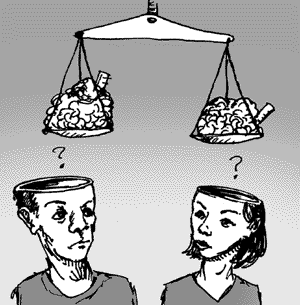
“divergent selection pressures on males and females are expected to produce consistent – and often substantial – psychological differences between the sexes. By the logic of sexual selection theory and parental investment theory, large sex differences are most likely to be found in traits and behaviors that ultimately relate to mating and parenting. More generally, sex differences are expected in those domains in which males and females have consistently faced different adaptive problems.”
Teen Pregnancy and the Bible Belt
What does the following two graphic images have to say about teenage pregnancy and religion? It might be a coincidence that the most conservative religious states have the most teenage pregnancies, but it might also be that both of these factors are related to some other factor. The researchers who studied this data suggest that it may be conservative religious views on birth control (and abortion?) that are causing this result. What can be said for sure is teenage sexual activity doesn’t appear to be less prevalent in more religiously conservative areas of the country.
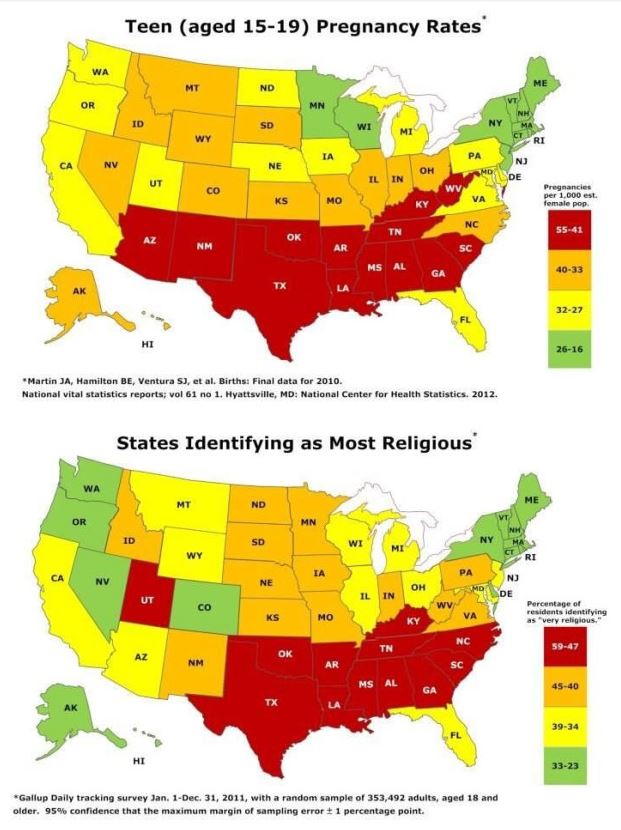
Religiosity and teen birth rate in the United States
Abstract
Background
The children of teen mothers have been reported to have higher rates of several unfavorable mental health outcomes. Past research suggests several possible mechanisms for an association between religiosity and teen birth rate in communities.
Methods
The present study compiled publicly accessible data on birth rates, conservative religious beliefs, income, and abortion rates in the U.S., aggregated at the state level. Data on teen birth rates and abortion originated from the Center for Disease Control; on income, from the U.S. Bureau of the Census, and on religious beliefs, from the U.S. Religious Landscape Survey carried out by the Pew Forum on Religion and Public Life. We computed correlations and partial correlations.
Results
Increased religiosity in residents of states in the U.S. strongly predicted a higher teen birth rate, with r = 0.73 (p < 0.0005). Religiosity correlated negatively with median household income, with r = -0.66, and income correlated negatively with teen birth rate, with r = -0.63. But the correlation between religiosity and teen birth rate remained highly significant when income was controlled for via partial correlation: the partial correlation between religiosity and teen birth rate, controlling for income, was 0.53 (p < 0.0005). Abortion rate correlated negatively with religiosity, with r = -0.45, p = 0.002. However, the partial correlation between teen birth rate and religiosity remained high and significant when controlling for abortion rate (partial correlation = 0.68, p < 0.0005) and when controlling for both abortion rate and income (partial correlation = 0.54, p = 0.001).
Conclusion
With data aggregated at the state level, conservative religious beliefs strongly predict U.S. teen birth rates, in a relationship that does not appear to be the result of confounding by income or abortion rates. One possible explanation for this relationship is that teens in more religious communities may be less likely to use contraception.
Wealth Inequality and Our Brewing Social Crisis
by Brian T. Lynch, MSW
Wealth disparity has a profound, relativistic impact in human societies and this is worth understanding. Even in the most egalitarian societies where everything is shared, there are subtle differences in the distribution of goods and services. These small differences convey powerful social messages that are keenly felt by all its members. These messages impact social interactions and the social order. Wealth distribution has powerful symbolic meaning in every society, large or small, rich or poor.

Wealth Disparity is Worse Than You Think – Business Insider
http://www.businessinsider.com/inequality-is-worse-than-you-think-2013-3
When the actual material differences in wealth are subtle, the costs or benefits conferred by wealth distribution are limited to social perceptions and its impact on social order or governance. These material differences are not existential threats to the socially disadvantaged. However, as the actual material differences between members of society grows, the scarcity of essential resources for some may follow. This becomes ever more consequential as it increases the efforts needed to assure survival. It introduces more uncertainty and decreases the sense of personal control. Distribution induced disparity can grow to the point where it can even become life threaten. Additionally, the social power differential grows to the point where social relationships by the advantaged towards the disadvantaged can become exploitive and extractive.
Under conditions of extreme wealth disparity there are physical and psychological impacts on both the powerful and less powerful. The Socially disadvantaged undergo significant stress and will exhibit all the symptoms and conditions associated with chronic stress (alcoholism, drug abuse, depression, maladaptive behaviors, obesity, child abuse, poor health outcomes, etc.). What is important to understand is that it is the disparity in wealth that induces social stress, not the absolute measure of wealth. Extreme wealth disparity becomes pathological in all societies, both rich or poor. This appears to have been true throughout history. Evidence of the corrosive effects of social disparity has even been demonstrated in research studying the impact of dominance on subordinate primate populations, so this appears to be a natural phenomenon.
Extreme wealth disparity is a threat to society. This fact is underappreciated by many. And distribution induced shortages don’t need to be at starvation levels before reaching critical mass, especially in wealthy countries like ours. Pundits have used this starvation metric or comparisons of our poverty to that found in poor countries to dismiss the current threat we face from rapidly growing wealth disparity. A better measure of our social instability is the health and welfare of the nation’s poor. The ranks of the poor are growing and their welfare is rapidly deteriorating. Here we find a conspiracy of silence in the main stream press. The symptoms of poverty induced stress have been reinterpreted as moral weaknesses and personal failings for which the poor have no one but themselves to blame. Both the unfair distribution of current wages and the redistribution of wealth through taxes to assist the poor are almost taboo subjects. To raise these issues is to be accused of inciting class warfare, which is exactly what has been raging for decades to bring us to this point.
The last time America experienced such enormous wealth disparity we were fortunate that the worst consequence was the Great Depression and not a total social collapse. The Great Recession of 2008 is an early warning of what will happen if we don’t correct our current wealth imbalance. So far the alarm bells are ringing but the public address system is still on mute.
When Beauty is Average
Beauty is average. This is truly a paradigm shifting truth. It is confirmed by both digital photography studies and new understandings of how our brains process information. It turns out Plato had it right when he said there was a place where ideal objects existed, he just didn’t know he was describing a function of our cerebral cortex. The ideal table, for instance, is a mental construct or image in our brain that allows us to recognize infinite variations in size, shape, purpose, color, aspect, texture, design, etc. as an object that is still a table. This is a remarkable fact in itself. But then comes the discovery that the most beautiful human faces ends up being the average face. This is mind blown.
http://faceresearch.org/students/averageness
 |
 |
 |
 |
 |
 |
| Individual Faces | Composite Face | ||||
|---|---|---|---|---|---|
The idea that beauty is average comes from the digital age where photographs can be rendered in pixel formats. The size of the pixels determines the resolution of the photographs. High resolution photographs have many more pixels. Some researchers got the bright idea of taking a lot of high resolution digital portraits of men and woman and then averaging the value of all the pixels that comprised the human male and female face to create a composite image. The images they created of the pixel averaged faces for men and woman turned out to be strikingly beautiful.
Next the researchers took the composite images along with the digital photos of the faces that made up the composite face, and showed these to lots of people. They asked the subjects to rate or rank the beauty of the faces. The researchers found that the average pixel face was most often rated the most beautiful. And so we discovered that beauty is literally the average.
The researchers suggested that as a species the ability to identify beauty, or the average face, may have served a natural selection purpose. They speculated that people with an exactly average appearance are more likely to be healthy, normal and able to have children. Maybe so. Who knows.
What the study also proved, but what the researchers didn’t highlight, is the amazing ability of the brain to identify the exact average of so many faces it encounters. If you think of a bell curve from statistics, the exact average is a relatively small or thin line within the normal range while the normal range of human faces is huge. Just look around and you will see tremendous variations of human faces and body types. But the exact average, or median, of all faces or body types occurs in very few individuals within the population. This fact preserves the truth that beauty is actually very rare.
If it seems like an impossible task for the brain to identify the approximate average human face, then recent understandings of the hierarchical nature of how our cortex processes data suggest how this is done. It turns out that our cerebral cortex creates idealized images of every object we see in our world. This allows us to rapidly and correctly identify object no matter what portion of them we see or individual attributes they may have, such as color, size, texture, composition, design, etc. This attribute also allows us to create idealized images of a human face.
So beauty is average and our brains have a nearly universal sense of beauty. We share this sense because we all have a similar pool of faces from which to identify the average face.
This has profound implications for the arts, but even more profound social implications. It explains how in my desire to be different as a young man I found myself conforming to my peers. When I was young and wanted to distinguish myself from my parents generation. One way I did this was by crudely cutting off the legs off my jeans to create cut-off. It turns out everyone else in my generation was wearing them. I was one of the crowd. In trying to be different from my parents I conformed to others who, like me, also wanted to be different. I identified with an image of who I wanted to be that happened to be the idealized, or exact average, of every other young person wishing to make the same statement.
As it turns out, this self-identified peer conformity is a ubiquitous feature of our human nature. It is possible because of our ability to sort out and idealize groups of objects or people. If I asked you to imagine yourself as a Harley motorcycle biker, you would conger up an idealized version of a biker that approximately represents the average Harley biker. If you acted on this image you might buy and personalize a leather jacket, and do the same for other garments and accessories, until you were satisfied that you fit in with the self-identified peer group of Harley bikers.
We almost effortlessly do this sorting and self-identifying all the time. It explains how we are both so diverse and yet so conforming. We are always moving toward some idealized average image of the groups or things with which we identify even as those idealized averages are shifting over time. But when it comes to thinking about beauty, there is something reassuring about the fact that what makes beautiful people so special is the fact that they are so average. It somehow makes me more content being more or less “normal”.
Breadwinner Moms – A New Pew Research Report
The following report is an important story of America’s demographic shifts with significant impliciations for children. If 40% of households with children are headed by working mothers, and some smaller percentage are headed by working fathers, then we are approaching the point where only about half of the children growing up are coming from two parent families. What is the impact on tomorrows society when nearly have the young adults have not grown up with a father or mother role model in their life? It also has other significant implications in terms of equal pay for women issues, day care needs, after school programming and much more. Combine this data with the recent mile stone that there are more poor people living in the suburbs than the city and it all represents some significant social challenges that we must face.
Breadwinner Moms
Mothers Are the Sole or Primary Provider in Four-in-Ten Households with Children; Public Conflicted about the Growing Trend
by Wendy Wang, Kim Parker and Paul Taylor
http://www.pewsocialtrends.org/2013/05/29/breadwinner-moms/
CHAPTER 1: OVERVIEW

A record 40% of all households with children under the age of 18 include mothers who are either the sole or primary source of income for the family, according to a new Pew Research Center analysis of data from the U.S. Census Bureau. The share was just 11% in 1960.
These “breadwinner moms” are made up of two very different groups: 5.1 million (37%) are married mothers who have a higher income than their husbands, and 8.6 million (63%) are single mothers.1
The income gap between the two groups is quite large. The median total family income of married mothers who earn more than their husbands was nearly $80,000 in 2011, well above the national median of $57,100 for all families with children, and nearly four times the $23,000 median for families led by a single mother.2
Continue reading at the following URL: http://www.pewsocialtrends.org/2013/05/29/breadwinner-moms/
Visualizing Our Wealth Inequality
Wealth Inequality in America
Ruppert Murdoch, Ayn Rand and A Sociopathic Economy
Rupert Murdoch, chairman and CEO of News Corp., and one of the richest men on the planet, recently claimed that free markets are morally superior to more social based ideas of morality and fairness. “We’ve won the efficiency argument,” he claimed. Now he hopes to persuade us that free markets are morally superior and that socialism fails because of its “denial of fundamental freedoms.” In Murdoch’s world the idea that market success is based on greed is a false characterization that creates confusion. He believe that markets succeeds where governments fail, not because of greed, but because people are given “… incentives to put their own wants and needs aside to address the wants and needs of others.”
It sounds great! But before you buy into this idea you should know he goes on to say, “To succeed, you have to produce something that other people are willing to pay for.”
Therein lies the rub. To succeed you must “produce.” For Murdoch, distributive justice is the natural outcome of these purely commercial transactions. He quotes Arthur Brooks at the American Enterprise Institute who defines fairness as, “… the universal opportunity to enjoy earned success”. The key words here being “earned success.” Accordingly, producers are entitled to all they earn because if their product wasn’t successful, consumers are free to not buy their product. This is a cruel argument to make in the face of an elderly person having to choose between buying food or medicine, of course. Nevertheless, in this view every sale in a free market system automatically results in a fair distribution of wealth. No other social factors should apply. In fact, to take from producers what they’ve earned to support the lives of less successful or non-producing human beings is immoral, in Murdoch’s view.
“What’s fair about taking money from people who’ve earned it and giving it to people who didn’t,” Murdoch asks.
But Murdoch’s whole notion, which closely mirrors that of Ayn Rand, ignores the whole complex social economy in which commerce and every other human activity actually takes place. It rejects the wisdom that markets only exist to serve societies needs. Markets are manmade entities and not a natural phenomenon, but Murdoch’s narrow view treats markets as natural entities that are morally superior to society. It limits the meaning of production to that which has a monetary exchange value. It assigns social value to the creators of products according to their market success, measured in material gain. It does not account for the material contributions of the public domain in making commerce and stable markets possible. Even though the monetary value of a product is co-dependent on a consumers’ willingness to pay, it does not assign any social value to the consumer. Only the source of a buyers money gives them any social status.
This leaves open the question of how, or even whether, to assign social value to those not immediately involved in commercial production. These folks include children, the disabled, the elderly, the unemployed, those who care for children, woman on maternity leave, all government employees, military personal, clergy, law enforcement, etc. Murdoch’s view begs the question; What is a person worth when their value to society cannot be directly measured by their market place success?
Murdoch’s views are shared by many of today’s corporate elite. It is the makers vs. takers mentality. It is a view that can only be described as anti-social at best, sociopathic at its extreme. It opposes all government interventions in the market place and opposes most government regulations. It is a philosophy designed to restricts the ability of ordinary citizens (i.e. government) to assure that our markets and commerce works for the good of society and not just for the benefit of the economically powerful. It implicitly confers ownership and control of the markets to the most powerful market makers while failing to acknowledge the corrupting effects of power on financially successful human beings. By denying the humanity of markets it denies the vulnerability of markets to human weaknesses. This puts society at risk and cripples humanity from solving some of the really big challenges we face as a species. How we chose to define distributive justice is arguably the most important economic question of our time. How we ultimately marshal our economic resources to solve our really big problems depends on how we ultimately organize our economy.
[Ruppert Murdoch’s views as expressed can be found at the following URL: http://nation.foxnews.com/rupert-murdoch/2013/04/22/rupert-murdoch-op-ed-case-market-s-morality?utm_source=feedly&utm_medium=feed&utm_campaign=Feed%3A+FoxNation+(Fox+Nation)]
Ideological Barriers to High School Graduation For Every Child
Thanks to the efforts of the US Department of Education, high school graduation rates can be compared across state lines for the first time. The results of the 2010-11 Four-Year Regulatory Adjusted Cohort Graduation Rates report is revealing and a bit disturbing. The top high school graduation rate was in Iowa where 88% of all students graduated . The lowest was in Nevada where just 61% graduated. (What’s happening there?) The median of state averages for graduation rates was just 80%.
The nations high school graduation rates are disappointing, but when you break down the numbers they become truly disturbing. In almost every state, White children had the highest graduation rates. In most states the graduation rates for African American and Native American students fell 10 to 20 points below White students. A similar gap can be seen between White students and those who are economically disadvantaged. The largest race based gap was in Minnesota where 84% of White students graduate verses only 49% of Black students. That’s a 35 percentage point gap. The other states with large race based graduation gaps include Nevada (28 pts.), Wisconsin (27 pts.) and Ohio (26 pts.). These are not the states we tend to think of when we talk about the racial divide.
But the biggest and most disturbing graduation gaps are not along racial, ethnic or even economic lines. They occur in two unexpected categories, children with disabilities and children for whom English is their second language.
In Mississippi and Nevada only 23% of disabled students graduated high school. These are children who, through no fault of their own, require every advantage they can get if they are to lead happy, productive lives. In Nevada the graduation gap between students with disabilities and White students was 48 percentage points. Mississippi did a much better job then Nevada overal . White students graduated at a respectable rate of 82%. The graduation gap for Mississippi’s disabled children, however, was 59 points lower. Contrast that with Arkansas where there was only a 9 point gap, or with South Dakota where there was just a 2 point difference between White students and disabled students. What is possible for disabled children in South Dakota should be possible in every state. Over all, the graduation gap between abled and disabled students is greater than ethnic, racial or economic factors. The biggest gaps were mostly in the South, but almost every state needs to do a better job.
The second disturbing category is the graduation gaps for immigrant children whose first language is not English. While states such as West Virginia, Maine, South Dakota and Arkansas were able to graduate English-language learners on par with White students, most other states were less successful. The graduation gaps in Georgia (44 pts.), Nevada, Alabama (both 42 pts.) and New York (40 pts.) were among the biggest. But it is Arizona, by far, that had the largest gap in the graduation rates between White students (85%) and those who needed to learn English (23%). This was a 60 percentage point drop in graduation rates for English-language learners in Arizona, and the reason for this poor performance has a lot to do with ideological politics. Voters in Arizona eliminated bilingual education in a 2000 ballot measure. Proposition 203 was a popular backlash against bilingual education in favor of a more nationalistic “English for the Children Philosophy”. Bilingual education was viewed as a politically correct relic of our liberal past.
It is unconscionable to hold children in the cross-fire of America’s ideological wars. Children are a special class of citizens who rightfully have special protections and certain undeniable rights, including the right to equal educational opportunities. To set different standards based on race, religion, disabilities or place of origin is unacceptable. To eliminate educational opportunities or to choose educational programs based on politics over empirical practice is malfeasance. It harms children and ultimately harms our society. There is no excuse for not duplicating the success many other state already have in educating children of color, children with disabilities and children who speak another language. State sovereignty be damned. Children everywhere are every citizens concern. We must do all we can to remove politics from public schooling and press the case for competent practices that gives every child a fair shot at success. High School Graduation for every child should be our national goal.
(Below are excerpts from an article detailing the struggle to improve educational outcome for English-language learning students in Arizona.)
Bilingual Education vs. English Immersion
http://cqresearcherblog.blogspot.com/2009/12/bilingual-education-vs-english.html
Excerpts:
… Spanish-speaking [families in] Nogales [Arizona]… in 1992 [filed] a federal suit aimed at improving educational opportunities for non-English-speaking students in the overwhelmingly Hispanic town. The class action suit claimed the school district was failing to comply with a federal law – the Equal Educational Opportunities Act of 1974 – which requires each state to take “appropriate action” to ensure that English-language learners (ELLs) enjoy “equal participation in its instructional programs.”
… The plaintiffs won a pivotal decision in 2001 requiring Arizona to boost funding for English-language learning in Nogales and the rest of the state. In a narrowly divided decision in June, however, the Supreme Court gave state officials an opportunity to set aside the lower court ruling.
Writing for the 5-4 majority, Justice Samuel A. Alito Jr. said the federal district judge had failed to adequately consider changed circumstances since 2001. Among other changes, Alito cited the state’s decision to drop bilingual education in favor of so-called “sheltered English immersion” as the officially prescribed method of instruction for students with limited English proficiency.
Arizona’s voters had decisively rejected bilingual education in a 2000 ballot measure. Along with similar measures passed in California in 1998 and Massachusetts in 2002, Arizona’s Proposition 203 embodied a popular backlash against bilingual education that had grown since the 1980s. Critics of bilingual teaching viewed it as a politically correct relic of the 1960s and ‘70s that had proven academically ineffective and politically divisive. [snip]
… The debate between English-only instruction and bilingual education has been fierce for decades. “People get very hot under the collar,” says Christine Rossell, a professor of political science at Boston University and critic of bilingual education. [snip]
… Those who support a bilingual approach, says Arizona Superintendent of Instruction Thomas Horne, “aren’t interested in teaching the kids English,” but want to maintain “a separatist nationalism that they can take advantage of.” Horne, a Republican, intervened with the state’s GOP legislative leaders to try to undo the federal court injunction. [Snip]
… “It’s a growing challenge,” says Patte Barth, director of the Center for Public Education at the National School Boards Association (NSBA). “We have many more children coming into our schools for whom their first language is not English… Voluminous, statistics-heavy studies are cited by opposing advocacy groups as evidence to support their respective positions on the bilingual versus English-only debate. But Barth says language politics, not research, often determines school districts’ choice of instructional method. “A lot of it is political,” she says. “A lot of decisions about language instruction aren’t really informed by the research about what works for children.”
Minimum Wage Proposal A Small Step
In his State-of-the-Union Address President Obama proposed raising the federal minimum wage to $9.00 per hour and indexing it to inflation. He said a family of four with two children still lives below the poverty line when one parent works full-time at minimum wage. The proposed increase would lift them out of poverty, he said.

by Google Images
What a welcome suprise! Virtually no attention was given to the working poor in the last election. In the past decade real wages rapidly declined for the working poor, driving ever more citizens into the grip of intractable poverty.
When a person works full-time for a profitable company their compensation should enable them to care for their family. When this isn’t the case, they must rely on taxpayer-subsidized housing, food stamps, medical care, daycare, or other supportive services. This takes a toll. It can erode a person’s dignity and self-worth. It can foster a sense of inadequacy or self-loathing.
On a social level the working poor are often labeled and marginalized. They are deemed to be less worthy. They are less likely to be promoted or rehired after a layoff. Any economic hardship at all can lock them into a cycle of poverty where their hope for a better life evaporates with each passing year. Escaping poverty in America today is the exception, not the rule.
Many wealthy companies are just as dependent on government subsidies for cheap labor. Without taxpayer assistance for their workers these companies would have to pay a living wage in order to maintain a stable workforce.
And what is wrong with that? Shouldn’t adequate compensation be part of the cost of doing business? Why should business owners be allowed to pad their profits by cutting labor costs at taxpayer expense?
We can expect the pro-business lobby to oppose an increase in low-wage pay while calling for more spending cuts and lower business taxes. Austerity can’t create more jobs and spending cuts will never result in more pay for low-wage earners. Only an increase in the minimum wage or a living-wage law can do that.
Pro-business economists will claim that a higher minimum wage will increase unemployment and hamstring businesses, especially small businesses. Much evidence suggests the opposite. Higher minimum wages have a simulative effect on the economy. The extra $1.75 per hour will be spent immediately, boosting business profits and sparking more demand.
The pro-business lobby will claim the proposed increase is excessive, but here the facts are against them. Even President Obama got this wrong. The poverty wage for a family of four is current $10.60 per hour. If passed, President Obama’s proposal would still means a minimum-wage worker would have to work overtime, take another part-time job, or have their spouse work part-time to reach the poverty line.
And what does it really mean to be at the poverty line? Does this make a family economically self-sufficient?
No, it does not. A living wage to lift a family of four above the need for taxpayer subsidies is considerably higher. In Wyoming, for example, a living wage for this family is $16.93 per hour. In Virginia it is $20.88 per hour, and in California it is $22.15 per hour. These figures are not government artifacts. They are actual costs based on local free-market economies.
While business owners and corporations may squeal at the size of the proposed increase in the minimum wage, they would still benefit greatly from taxpayer subsidies for their low-wage employees. Raising the minimum wage shifts some of the burden of caring for employees to the employers, but not much. It still doesn’t hold wealthy corporations responsible for their low-wage workers or for the harm that poverty wages inflict on their families.
 Data Driven Viewpoints