Home » Uncategorized (Page 2)
Category Archives: Uncategorized
Daily US COVID-19 Response Global Comparison
by Brian T. Lynch, MSW
April 30, 2020 12:18 pm
[Check back for daily updates below]
Much of the national and local coverage of this coronavirus outbreak in the United States fails to set the proper global context as to how we are doing at handling it relative to every other country on earth. This lack of perspective gives us a false sense of success at how well we are doing in reducing new infections and COVID-19 deaths. This false sense of being over the hump fuels the polarized political debates that further divide us on every issue. We should be united behind the science of infection controls during a global pandemic rather than driving wedges into the public debate to support or defend our political instincts. The virus certainly doesn’t play politics, and neither should we.
So, for a better perspective on how the United States is doing in our efforts to control this epidemic against the backdrop of the rest of the world, here are a few observation based on the number of new infections and deaths from yesterday, April 29th:

1. The United States had nearly as many new cases of COVID-19 yesterday than the next seven countries combined. The USA has 35% of the world’s new cases but only 4.2% of the global population.

2. The united states had more COVID-19 deaths yesterday than the next six countries combined. We had 36% of all COVID-19 deaths in the world in the prior 24 hour period.
These comparisons clearly show that COVID-19 infection rates and deaths make the United States a huge outlier in the world. We are not doing nearly as well as most other countries. And keep in mind that every nation still only has social distancing as the primary means to control the spread of infections. Testing, isolation, and contact tracing are part of the mix, but keeping infected people away from healthy people is all we’ve got at this point until we have a vaccine or effective treatments available. We are all in the same boat.
These data, by the way, are continuously updated from the Worldometer.info website, a non-government, non-affiliated international effort to provide global statistics in an easy to access formate.
So, the question has been asked, why are we doing so poorly compared with other countries?
The answer is clear and inconvenient for many Americans. We have a lack of political leadership from the top.
The wealthiest, most inventive, and industrious country in the history of the planet should, by now, have the capacity of testing 10 million citizens per day for the virus. Millions of people who are now unemployed should be hired, by now, to conduct testing, contract tracing, and welfare checks the millions who test positive for the disease and placed under quarantined. We should have in place a national stay at home order the same as every other country. We should have exceptions for stay at home order for essential workers, but we should have massive testing and mandatory guidelines, with aggressive enforcement, for those workers. We should not only have all the PPE we need by now, but we should also be exporting vast quantities of PPE to other nations that don’t have our manufacturing capacity.
This is a picture of the nation we should be, the great country we once were. Nations of the world should be looking to us for guidance and help. Instead, we are inching our way back towards another round of disaster and death.
______________________________________________________________________
MAY 1, 2020
The USA’s new infections are up and the death total is down today. Total COVID-19 tests are at 6,416,393 total tests or 19,311 per million population. We are ranked 44th in the number of tests/million.


——————————————————-
MAY 2, 2020
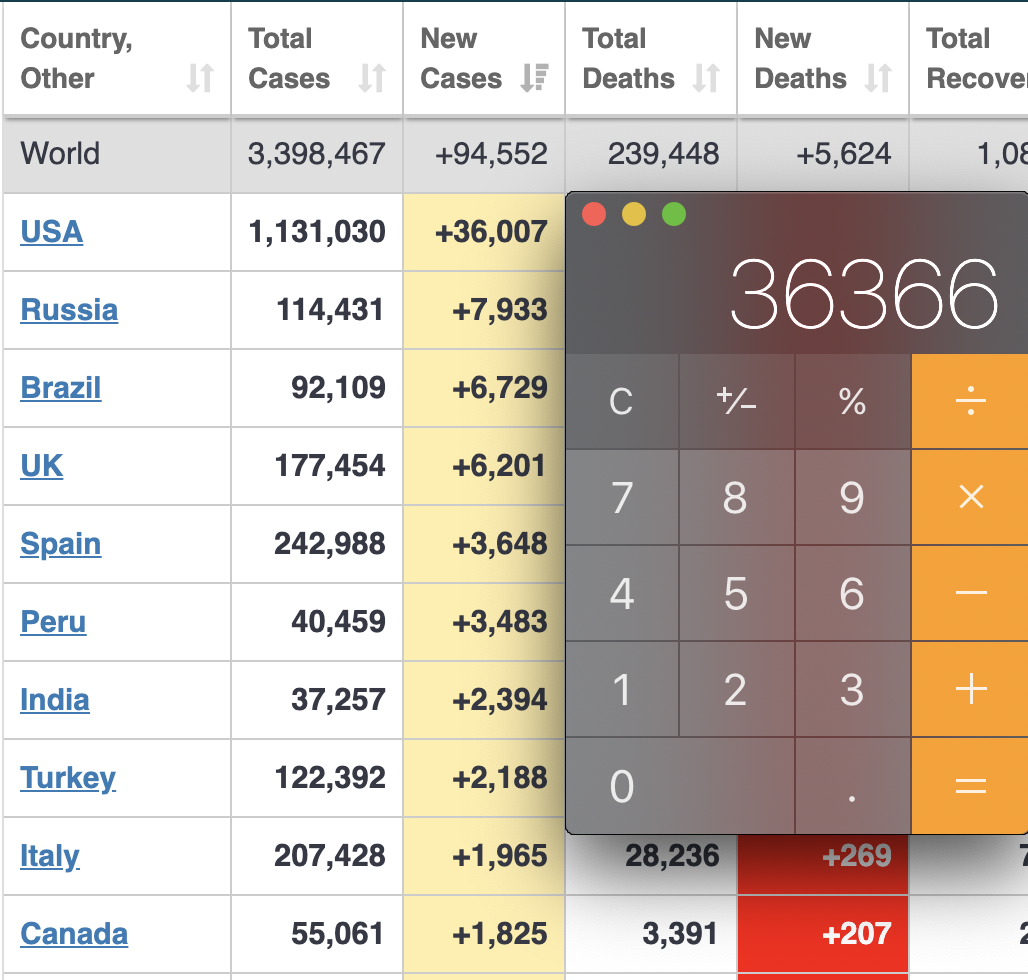
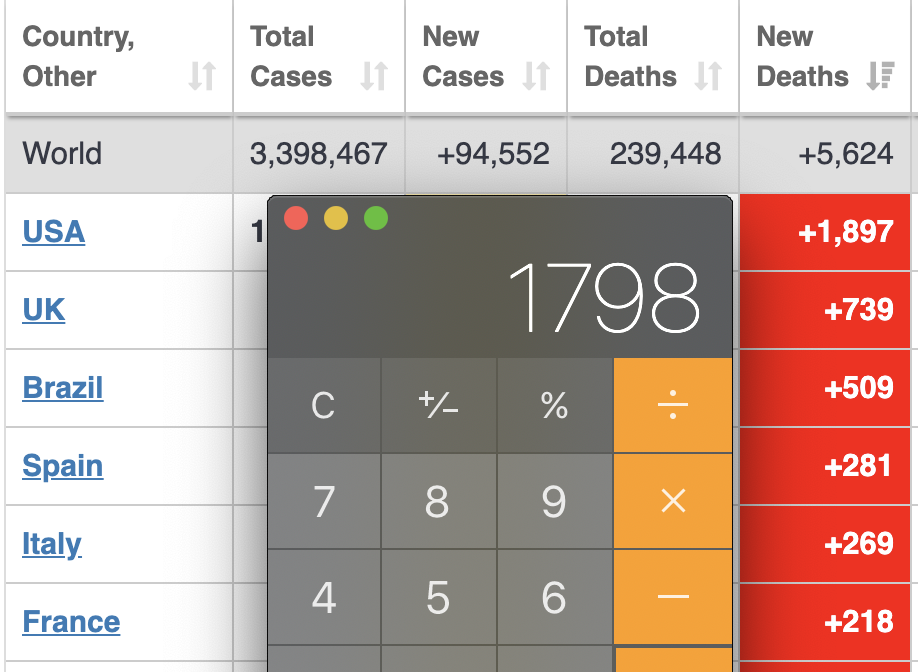
The USA’s new infections are up to 36,007 new cases. That over 5,000 more cases in a day, more new cases than the next 9 countries combined. The death total (a lagging indicator) is down to 1,798 today. The total COVID-19 tests are at 6,600,878 total tests or 20,241 per million population. We are still ranked 43rd worldwide in the number of tests/million.
——————————————————————————————–
MAY 3, 2020
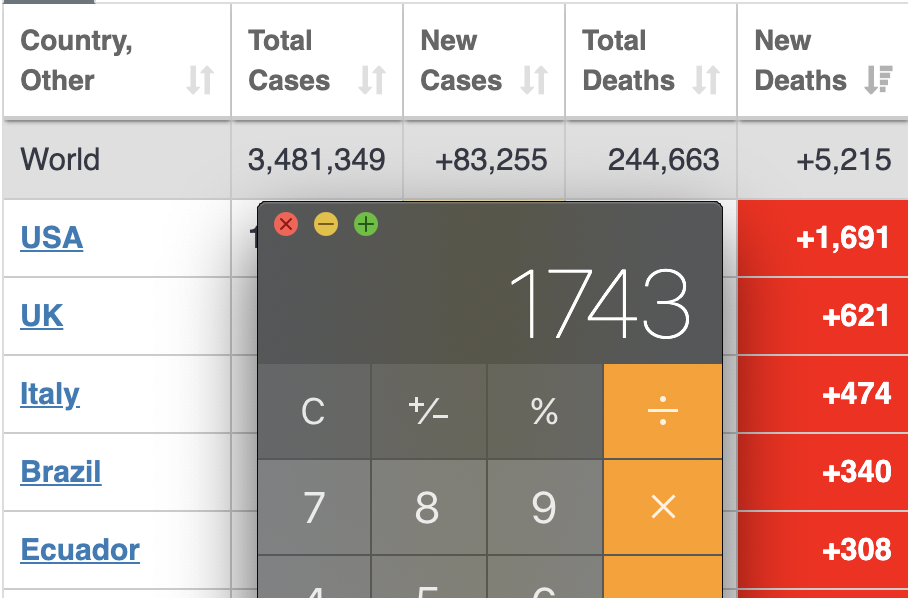
The USA’s new infections are down from yesterday to 29,744 new cases in a day, more new cases than the next 6 countries combined. The death total (a lagging indicator) is also down from yesterday to 1,691 today. The total COVID-19 tests administered yesterday were 328,511 for a cumulative total of 6,931,132 total tests or 20,940 per million population. We are still ranked 42nd worldwide in the number of tests/million.

__________________________________________________________
MAY 4, 2020
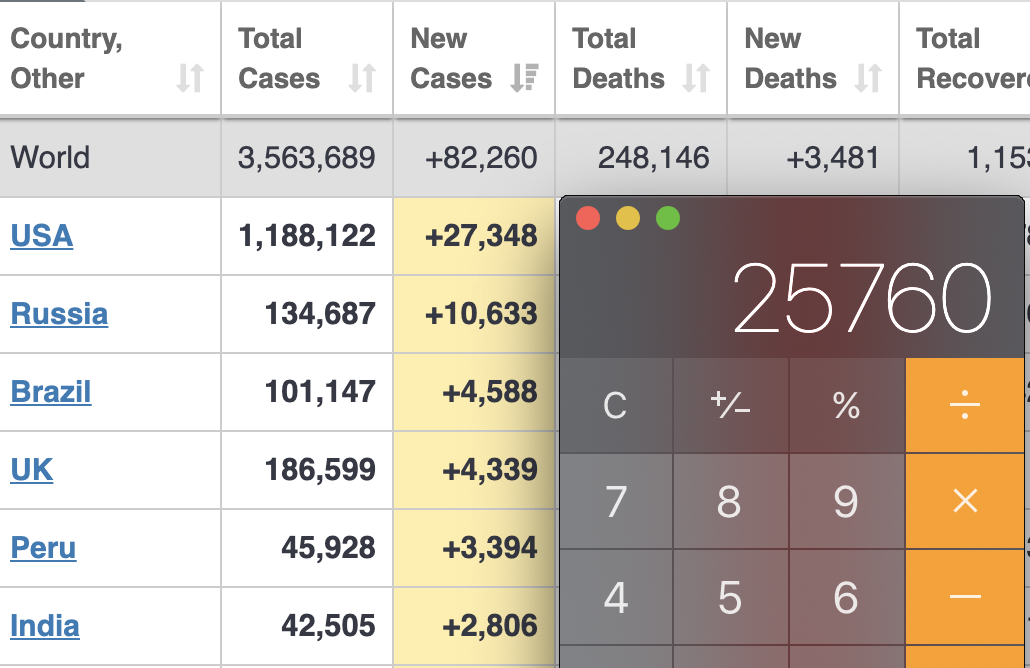
The USA’s new infections are down 2 days in a row from to 27,348 new cases, more new cases than the next 5 countries combined. The death total is also down from the past 2 days to 1,154 today. The total COVID-19 tests administered yesterday were 265,608 for a cumulative total of7,196,740 total tests or 21,742 per million population. We are ranked 41st worldwide in the number of tests/million.
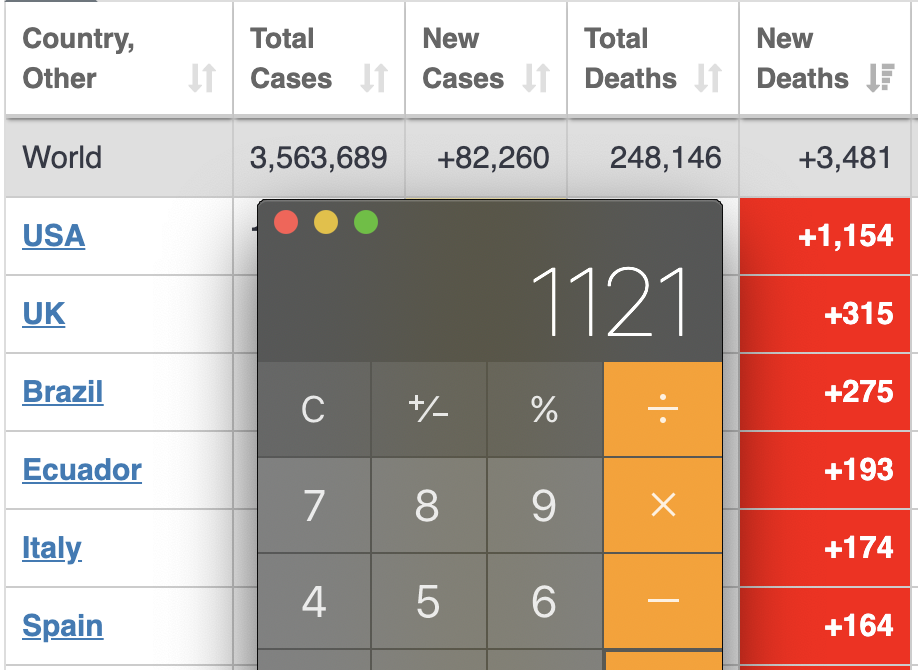
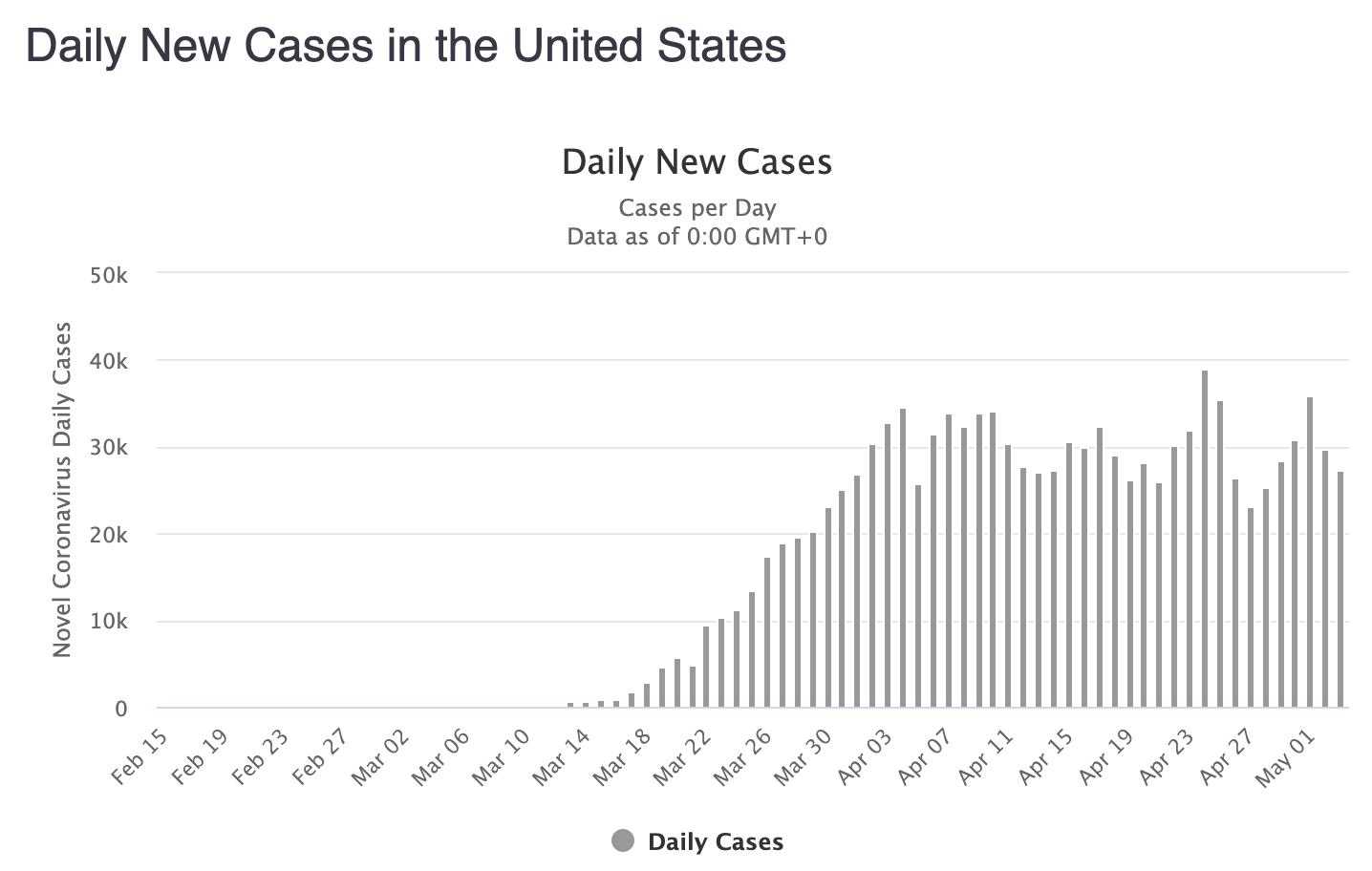
When I started tracking how well we are doing fighting the virus compared to other countries a few days back I made the error of not looking back on the data far enough to see the existing pattern. I will correct that here with two bar charts. The first shows the shape of the curve for new cases of COVID-19 in the US and the second shows the death rates over time. Both reveal the spikes and dips in numbers as outbreaks flair and social distancing takes its effect on transmission rates. The overall message is one of encouragement as COVID-19 deaths are trending down and to a lesser extent, so are infection rates. The cautionary message is that some of the flair-up have spiked to record levels of transmission and death. This suggests that we should maintain our social distancing behaviors while being more proactively to take steps to prevent COVID-19 hotspots from flaring up in places where hotspots are likely to occur.
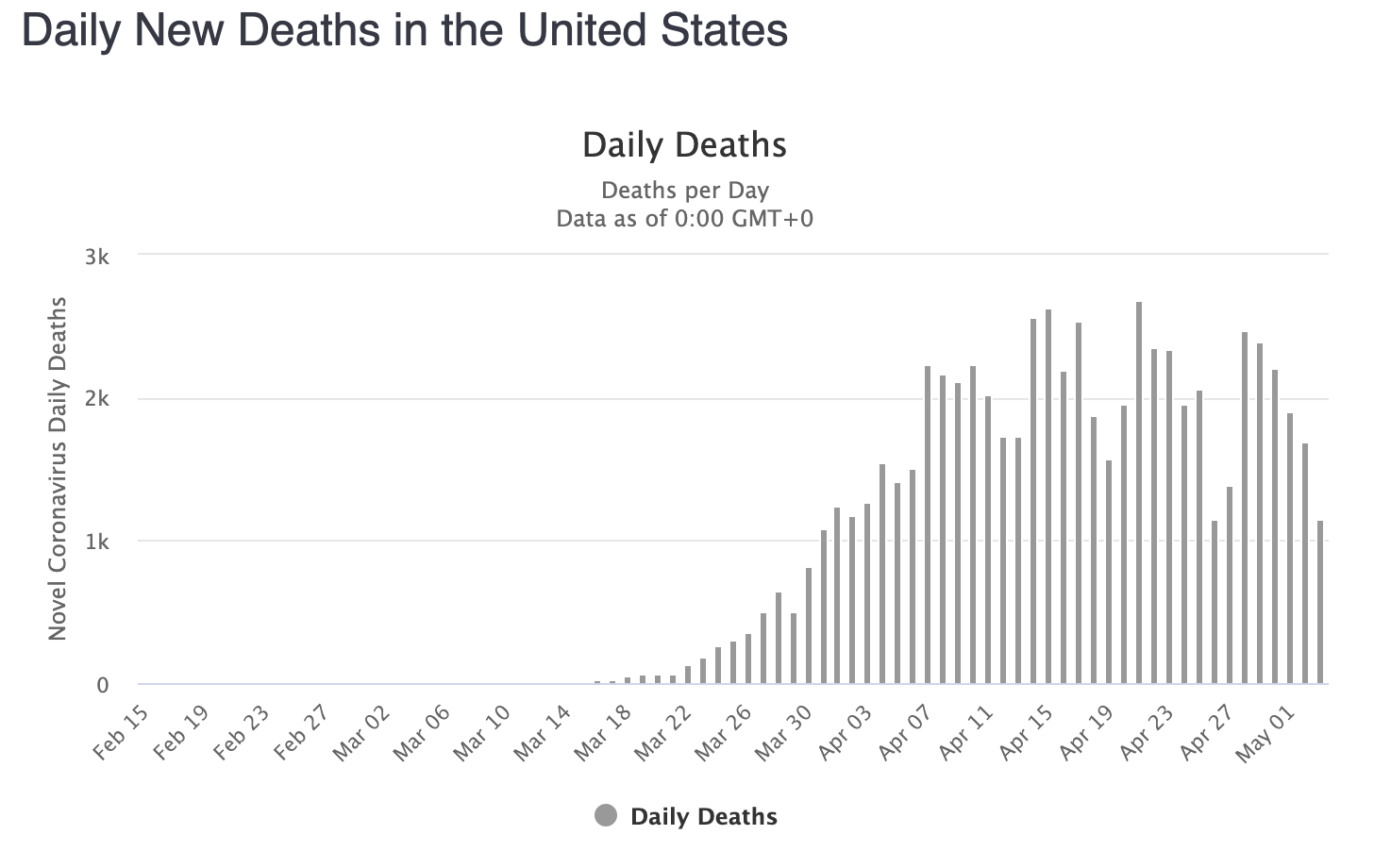
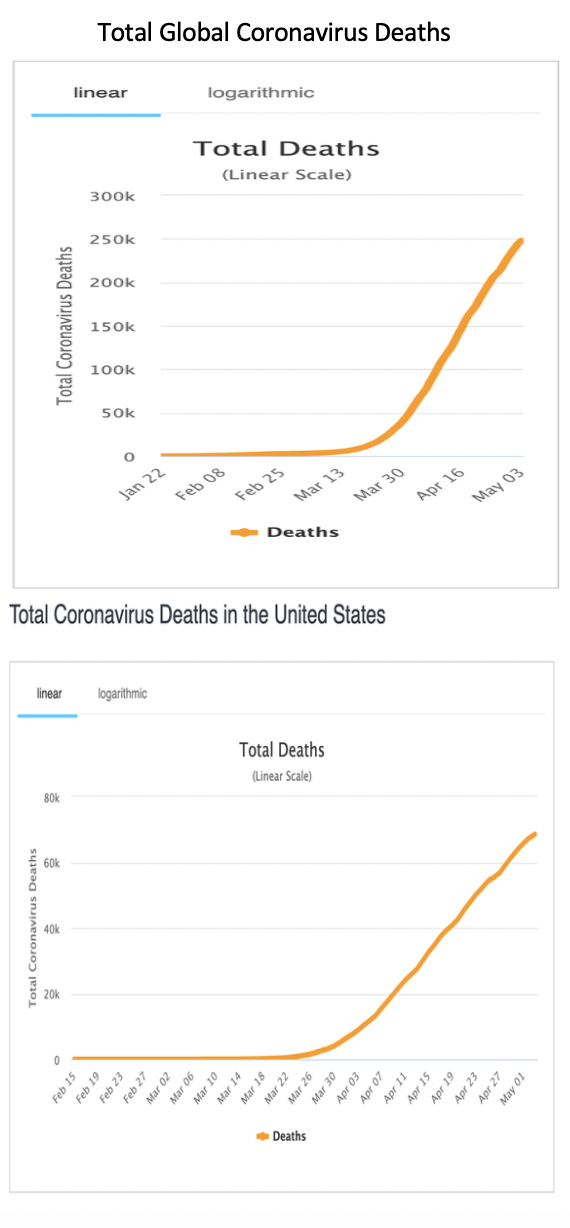
And because this is a global comparison, here is a side by side comparison of the graphs supplied by Worldometer on global and US deaths. While the global graph is weekly and the US graph is daily, the overall time period is similar, so the graphs were sized alike to try and get a fair comparison of the shape of the curves, and they appear to be similar in slop.
_____________________________________________________________________
MAY 5, 2020
The USA’s new infections are down 3 days in a row to 24,713 new cases, nearly as many new cases as the next 4 countries combined. The death total rose, however, from 1,154 to 1,324. The total COVID-19 tests administered yesterday were 265,691, up just 83 additional tests from yesterday, for a cumulative total of 7,462,431 total tests or 22,545 per million population. We are ranked 41st worldwide in the number of tests/million.


_____________________________________________________________________
MAY 6, 2020
The USA’s new infections are up slightly to 24,798 new cases, nearly as many new cases as the next 5 countries combined. The death total rose again from 1,324 new deaths to 2,350 in the last 24 hour period. The total COVID-19 tests administered yesterday were 265,507, down 184 fewer tests from yesterday, for a cumulative total of 7,727,938 total tests or 23,347 per million population. We are ranked 41st worldwide in the number of tests/million.
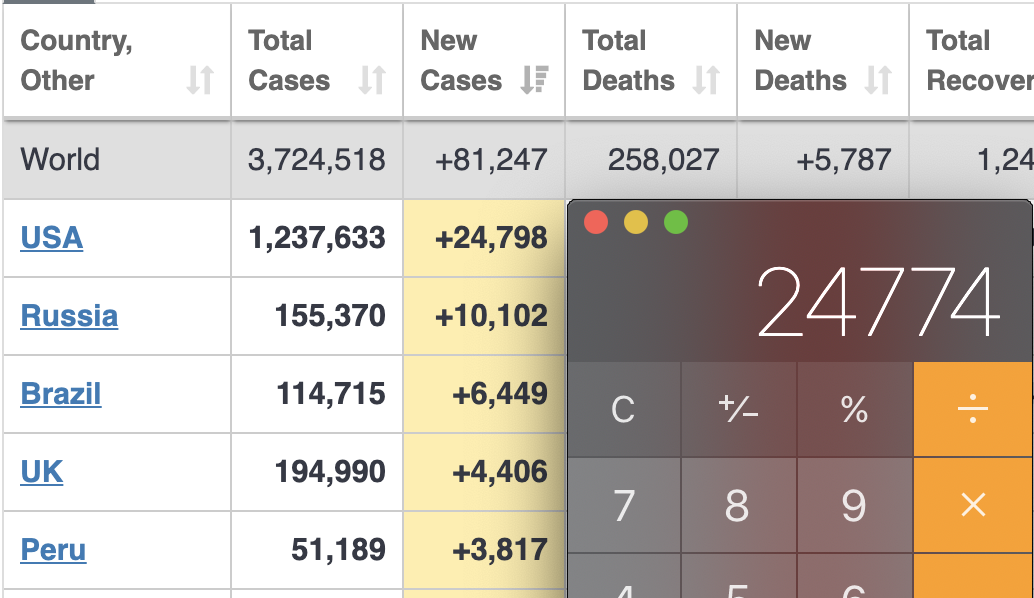

To give us some perspective on how the United States is doing in comparison to other countries that have had a massive COVID-19 outbreak like us, Here are side by side comparisons of the daily number of new deaths and new infection rates for Spain, Italy, and the United States. You can clearly see that the United States is still struggling while the other two countries are clearly getting the virus under control.

USA COVID-19 Response TODAY Against the Backdrop of the WORLD
by Brian T. Lynch, MSW
April 30, 2020 12:18 pm
Much of the national and local coverage of this coronavirus outbreak in the United States fails to set the proper global context as to how we are doing at handling it relative to every other country on earth. This lack of perspective gives us a false sense of success at how well we are doing in reducing new infections and COVID-19 deaths. This false sense of being over the hump fuels the polarized political debates that further divide us on every issue. We should be united behind the science of infection controls during a global pandemic rather than driving wedges into the public debate to support or defend our political instincts. The virus certainly doesn’t play politics, and neither should we.
So, for a better perspective on how the United States is doing in our efforts to control this epidemic against the backdrop of the rest of the world, here are a few observation based on the number of new infections and deaths from yesterday, April 29th:
1. The United States had nearly as many new cases of COVID-19 yesterday than the next seven countries combined.
2. The united states had more COVID-19 deaths yesterday than the next six countries combined.
These comparisons clearly show that COVID-19 infection rates and deaths make the United States a huge outlier in the world. We are not doing nearly as well as most other countries. And keep in mind that every nation still only has social distancing as the primary means to control the spread of infections. Testing, isolation, and contact tracing are part of the mix, but keeping infected people away from healthy people is all we’ve got at this point until we have a vaccine or effective treatments available. We are all in the same boat.
These data, by the way, are continuously updated from the Worldometer.info website, a non-government, non-affiliated international effort to provide global statistics in an easy to access formate.
So, the question has been asked, why are we doing so poorly compared with other countries?
The answer is clear and inconvenient for many Americans. We have a lack of political leadership from the top.
The wealthiest, most inventive, and industrious country in the history of the planet should, by now, have the capacity of testing 10 million citizens per day for the virus. Millions of people who are now unemployed should be hired, by now, to conduct testing, contract tracing, and welfare checks the millions who test positive for the disease and placed under quarantined. We should have in place a national stay at home order the same as every other country. We should have exceptions for stay at home order for essential workers, but we should have massive testing and mandatory guidelines, with aggressive enforcement, for those workers. We should not only have all the PPE we need by now, but we should also be exporting vast quantities of PPE to other nations that don’t have our manufacturing capacity.
This is a picture of the nation we should be, the great country we once were. Nations of the world should be looking to us for guidance and help. Instead, we are inching our way back towards another round of disaster and death.
The Most Rugged Individualist Still Has Only Two Hands
by Brian T. Lynch, MSW
Our survival and success as a species are the result of being social, and not by acting only to further our own self-interests. That lesson has gotten lost in recent times. The idea that we all act in our own self-interest will somehow serve our collective benefit is simply wrong. We should think for ourselves, yes, but act with consideration towards the common good.
We are nothing if not social beings. This may sound a bit more controversial than it is, but even our most intimate view of ourselves, of who we are as a person, is a composite of our interactions with others, beginning with our parents. We are literally nothing if we are not social, and we can only survive in community with others.
The high value we place on individualism today is a message of disunity that degrades our greatest survival strengths. The most rugged individualists still have only two hands. A better balance would be one hand for yourself and one for all others.
Has Wealth Inequality Always Been Un-American? A Conversation
by Brian T. Lynch, MSW
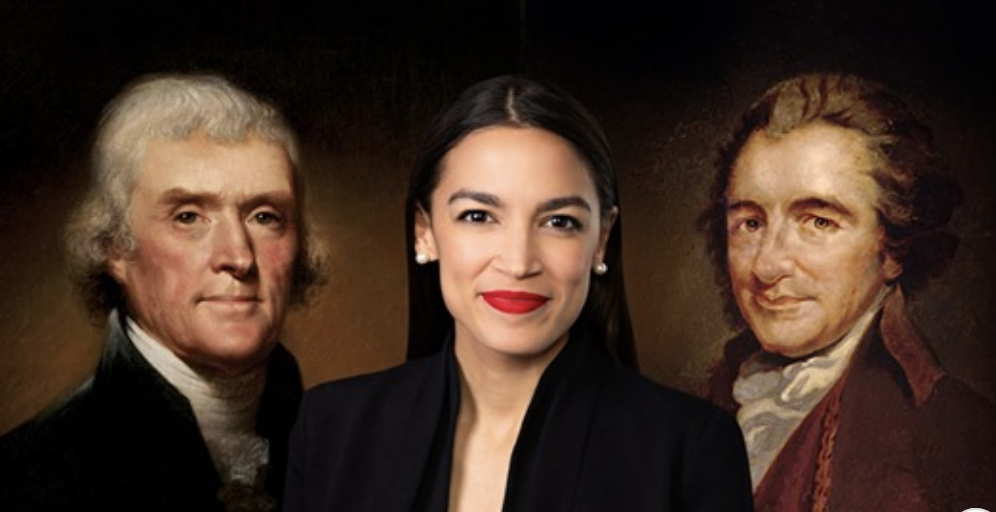
Reaction to a previous blog post provoked a dialogue about wealth inequality which I am sharing here in the hope of generating a broader conversation. The post, which you can read in full here, lays out the premise in the initial paragraph:
In an Intelligencer article entitled, “AOC Thinks Concentrated Wealth Is Incompatible with Democracy. So Did Our Founders,” Eric Levitz writes, “ [Alexandria] Ocasio-Cortez’s second argument against the existence of billionaires — that concentrated wealth is incompatible with genuine democracy — was something close to conventional wisdom among the founders.”
ANON: Brian, this is debatable.
ME: So, what are your views?
As I see it, one of the main thrusts of the American Revolution as a rejection of the enormous inequality of wealth and power between the colonists and their land-owning aristocracy. The founders did not want there to ever be such a large inequality here so they created a democratic republic. Every initial sale of property in the settlements involved payment to the royal aristocracy who literally owned everything in the new world. And unlike the wealthy landowners within the English system, colonists who managed to purchase large land holdings here had no voice within their own Parliament in London.
Today we tend to forget that the wealthy landholders in the colonies were clearly not considered wealthy or powerful within their own country, England.
ANON: Brian, wealth inequality is not in and of itself immoral. What is immoral is when people gain wealth through a rip-off of other people.
ME: Your point about wealth inequality no being immoral is also debatable (see Mark 10:25 for an example), but that would be a complete change of topic that we need not go into here.
The question here is whether or not extremes of private wealth is incompatible with a democratic form of government, and the answer to that question is yes, they are incompatible.
As a way to think about this, imagine how radical it would be if corporate governance adopted a system of one vote per shareholder rather than one vote per share of stock to reflect an ownership stake in the company. This is sort of the situation we are faced with today in our republic. The vote per shareholder method of corporate governance is a democracy, and the basis of our republican form of government, the latter and usual method, one vote per share of stock, would result in a plutocracy if it was applied to nations. That is what we very much want to avoid, and have always wanted to avoid from our founding. The wealthiest individual in this country should have no more influence over government decisions, theoretically, than their one citizen vote. We are already very far from that democratic ideal.
ANON: Brian, why should wealth be taken from people who created it and redistributed to people who have done nothing to deserve any right to it?
ME: I have seen commentary similar to yours in response to a discussion of wealth inequality. It is a familiar conservative talking point, and not a very good one. It is more of a dodge using a dog-whistle reference to higher taxes on high-income earners while pitting them against the “undeserving” poor who don’t materially contribute to our GDP.
But we aren’t discussing the redistribution of income here, nor are we discussing the fair distribution of income wages generally. We are discussing wealth inequality and extreme accumulations of private wealth. We are also not talking about you or me or almost anyone else. The extremes of private wealth are concentrated in less than a thousand families, wealthiest elites who own nearly all of the equity in this country.
There are two primary methods to redistribute wealth and neither one benefits the poor. In fact, the poor, the working class and almost have of the middle-class have no wealth at all, so it isn’t being redistributed to them.
The first wealth redistribution scheme is property tax. Owners of personal property are taxed on the estimated sales value of their property. But even here homeowners are not taxed on their equity stake in their homes, but on the value of their houses as if they owned them free and clear. It is really a tax on their future equity if they can hold on to it for 30 years. This is a very regressive wealth tax and a steep price to pay for new membership into the property-ownership club.
The second method of wealth redistribution is estate taxes that are paid once in a lifetime after you die. The vast majority of citizens will never pay a penny in estate taxes after they die because, again, they have no wealth. Estates that have at least a few million dollars or more may pay some small percentage in estate taxes, but most of the wealth and assets of the very rich, when they die, end up in the hands of their children and named beneficiaries.
The vast majority of estates — 99.9% — do not pay federal estate taxes. While the top estate tax rate is 40%, the average tax rate paid is just 17%. The estate tax is only paid on assets greater than $5.3 million per individual ($10.6 million per couple). https://americansfortaxfairness.org/tax-fairness-briefing-booklet/fact-sheet-the-estate-inheritance-tax/
Most of the wealth passed along after death goes to children and beneficiaries who never earned any of it, and therefore are “underserved” in the exact same context as your meaning of that word in your comments above. Inheritance is the direct transfer of wealth and power by right of succession.
So, the short answer to your question is that there is no redistribution of wealth from those who (may have) earn it to the “undeserving” poor you referenced above.
[Please feel free to add your comments to this discussion]
Wealth, Carbon, and Human Culture
by Brian T. Lynch, MSW
The rising accumulation of private wealth is to civilized governments as rising levels of CO2 are to Earth’s climate.
 Let that sink in. Extremes accumulations of private wealth in human society and the extreme build-up of carbon dioxide in the Earth’s atmosphere are both transformative, disruptive of a complex equilibrium and ultimately destructive for humanity.
Human culture is both a cause and a barrier to solving these two great threats to our collective welfare. In fact, these two looming catastrophes of extreme wealth inequality and extreme climate change are different aspects of a singular human flaw – personal greed. More specifically, both of these threats are outcomes of a powerful cultural priority that places profits over people. We don’t do what is our health best for human society because the cost would reduce personal profits for those who profit the most. The idea that we would not sacrifice personal wealth to save our immediate family from ruin is unthinkable, yet in the abstract of corporate enterprise, the concept of sacrificing business profits to benefit society as a whole is equally unthinkable.
We are at the second great inflection point as a species. We once again face social deterioration and possible extinction, despite being at the apex of our success as a species.
Humanity’s first inflection point was over 50,000 years ago when we almost became extinct. We were down to a very small number of survivors in Ethiopia. As a species, we were incapable of self-sacrifice to benefit the survival of the clan. This nearly caused our extinction. In this regard, we were much like many other species in this regard.
Consider the wolf. In the presence of a kill, the strongest wolf defends its right to eat its fill. It cannot eat less in order to save some meat for members of the pack who are starving. This is how evolution ensures the survival of the fittest among these top predators. But humans were never top predators. Our strength as a species is in our social bonds and the coordination of our collective actions. We, as a species, needed to suppress our self-preservation instincts to achieve our survival as a species.
We are told that this genetic alteration happened at this point around 50,000 years ago. It allowed individuals to sacrifice their personal welfare for the sake of the welfare of the group. This great self-sacrifice gene has carried us forward to the present. It has allowed us to create this massively interdependent human culture we enjoy today.
But now our more primitive personal greed tendencies are finding expression in an inability to sacrifice corporate profit (a hypothetical construct, and not an actual reality) to benefit the welfare of human society as a whole. Our inability to sacrifice corporate profits is once again threatening our existence as a species.
Why Democrats Should Care About People Who Don’t Vote
by Brian T. Lynch

Both political parties in America, along with virtually all television pundits and political opinion polling companies focus entirely on 60% of likely voters. We all ignore 40% of potential voters who don’t vote. Polling surveys commissioned by both the Democratic and Republican Parties are always predicated on some variation of likely voters. The results are then grise for the mill of television and newspaper commentators and political party prognosticators. And so it is settled wisdom that all of our elections boil down to 7% of likely voters who are also the swing voters among us. Rightly or not, these much fawned over swing voters are considered most independent voters with centrist political ideology. These swing voters have a disproportionate influence over electoral strategies and policy positioning. As a result, we never hear from those who are disillusioned with politics.
The conventional wisdom is that these non-voters don’t care about politics, but it is equally true that the body politic doesn’t care about these non-voters. We have come to the point where non-voters are the largest block of eligible voters in America. But are they really unreachable? Or are they justifiably disengaged because they are neglected by both the Democratic and Republican Parties? What is the potential for re-engaging this huge block of the electorate, and which political party has the most to gain? Which of our current Presidential candidates have the best shot at reaching out to these non-voters? And who are they anyway?
Why Democrats should care more about non-voters than swing voters
- Among likely voters, there are about 10 million swing voters or 7% of all likely voters according to Nate Silver at FiveThirtyEight
- There were 91.7 million non-voters in the 2016 presidential election or 40% of all eligible voters. Non-voters are the largest group of eligible voters
- 54% of non-voters (49.5 million votes) are Democrats or left-leaning non-voters
- Another 10% of non-voters (14.7 million votes) have no political leaning
- 52% of all non-voters (47.7 million votes) want more government services, not less
- The 64.2 million non-voting Democrats, left-leaning or neutral eligible voters represent over 6.4 times the number of swing voters in the 2016 election
- This compares with 65.9 million Democratic votes for Hillary Clinton in the 2016 election
Who are the eligible voters that are not engaged in voting?
- 66 million non-voters (72%) are under age 50. They are mostly younger voters
- 59.6 million non-voters (65%) are dissatisfied with the way things are in the country
- 54.1 million non-voters (59%) are White (non-Latino) citizens
- 19.3 million non-voters (21%) are Latino citizens
- 11 million non-voters (12%) are Black citizens
- 55 million non-voters (60%) either graduated or dropped out of high school
- 54.1 million non-voters (59%) are single
- 46.8 million non-voters (51%) experienced unemployment in their household in the prior 12 months
39.4 million non-voters (43%) have household incomes of $30,000 or less per year
By far, the largest number of eligible non-voters are people who once made up the base of the Democratic Party. They are citizens for whom the rightward and upward shift of both political parties over the year has left them without a voice in government. It is not only the right thing to do to reconnect with these less-fortunate Americans, but it is also in the best interest of the Democratic Party and the Nation. These disillusions, often angry citizens are most vulnerable to the nationalistic authoritarian appeals to which they are being targeted.
Reaffirming Our Faith in This Republic
by Brian T. Lynch, MSW
This five-minute video message of actor Matthew Cooke, below, is worth a listen. It is a reaffirmation of faith in our republic at a time when it is most threatened and vulnerable. It articulates our founding principles, which contrasts sharply with current Republican behavior in Congress.
I try not to refer to Republicans as a “party” anymore because, despite any philosophical differences, political parties always maintain their fidelity to the nation’s constitution. That isn’t true of Congressional Republicans. Under Mitch McConnell, Republicans in Congress are more of a political movement to replace democracy with a plutocratic autocracy, a single “party” system that mostly represents a small but wealthy minority. So, it is time for each of us to stand up in unity to depose those for whom democracy, with its equitable distribution of power, is an obstacle to their corrupt designs.
How many more billionaires can we sustain before we collapse?
by Brian T. Lynch
The New York Times recently asked each of the Democratic primary candidates for President a series of identical questions. The last question on their list was, “Does anyone deserve to have a billion dollars?”
The trivial framing of that question bypassed the grave urgency for asking it in the first place. In a variant form of the question the Times was essentially asking, “Isn’t it OK to be a billionaire if you played by the rules and worked hard to earn it?”
The wording of the question pre-supposes that the laws and social rules in place, by which a person may accumulate a billion-dollars, are fair and open to anyone. It ignores whether inherited wealth is also deserved. Most importantly, it treats wealth as if it is only a money count and not a measure of privilege and social power. By doing so, the question as it was posed ignored the essential problem that extreme private wealth is toxic to human society regardless of a person’s character or how they obtained it.
A more salient question would have been, “How many more billionaires can this human society sustain before it collapses?
In the 50,000-year history of human civilization, the concepts of private ownership and private wealth are recent developments. The full ramifications of these constructs on our social cohesion and collective welfare are still being revealed. The written history of civilizations offers no comfort. There are no examples of a happy, stable society where extremes of wealth inequality existed. The lessons of history seem to be that a suitable balance of power is required to sustain a healthy and stable society. Human populations simply cannot tolerate distributions of wealth/power that either force unnatural equality or permit unlimited extremes of private wealth.
There is no question that we crossed the Rubicon into a world where extreme wealth inequality is corrupting world governments and destroying the balance of nature. The questions we should be asking candidates for President and all our elected officials are, “What are your plans to rebalance the distribution of wealth and social power in America?” And then the follow-up question, “What are you going to do to stabilize and rebalance the Earth’s damaged ecology?”
How many more billionaires can we sustain before we collapse?
by Brian T. Lynch
The New York Times recently asked each of the Democratic primary candidates for President a series of identical questions. The last question on their list was, “Does anyone deserve to have a billion dollars?”
The trivial framing of that question bypassed the grave urgency for asking it in the first place. In a variant form of the question the Times was essentially asking, “Isn’t it OK to be a billionaire if you played by the rules and worked hard to earn it?”
The wording of the question pre-supposes that the laws and social rules in place, by which a person may accumulate a billion-dollars, are fair and open to anyone. It ignores whether inherited wealth is also deserved. Most importantly, it treats wealth as if it is only a money count and not a measure of privilege and social power. By doing so, the question as it was posed ignored the essential problem that extreme private wealth is toxic to human society regardless of a person’s character or how they obtained it.
A more salient question would have been, “How many more billionaires can this human society sustain before it collapses?
In the 50,000-year history of human civilization, the concepts of private ownership and private wealth are recent developments. The full ramifications of these constructs on our social cohesion and collective welfare are still being revealed. The written history of civilizations offers no comfort. There are no examples of a happy, stable society where extremes of wealth inequality existed. The lessons of history seem to be that a suitable balance of power is required to sustain a healthy and stable society. Human populations simply cannot tolerate distributions of wealth/power that either force unnatural equality or permit unlimited extremes of private wealth.
There is no question that we crossed the Rubicon into a world where extreme wealth inequality is corrupting world governments and destroying the balance of nature. The questions we should be asking candidates for President and all our elected officials are, “What are your plans to rebalance the distribution of wealth and social power in America?” And then the follow-up question, “What are you going to do to stabilize and rebalance the Earth’s damaged ecology?”
Humanizing the Minimum Wage
by Brian T. Lynch, MSW
A State Senator in New Jersey fears a $1 raise for the working poor in this state will be too much of a hardship for businesses if the economy slows down a little.

For some national context, New Jersey passed a minimum wage law last year that will boost the minimum to $15 per hour by the year 2024. After the initial jump this past January, the working poor will receive a one dollar per hour raise every January between now and January of 2024.
New Jersey is an expensive state in which to live. The northern half of the state is part of the New York City metropolis. The central sections of the state are within the Philadelphia metropolis. The latest Economic Policy Institute study estimates a family of two adults and two children in Morris County would need a combined income of $104,121 per year to live comfortably. That works out to $50 per hour, 40 hours per week for one breadwinner, or $25 per hour if both parents work full-time. It also means that a single mother making the current minimum wage of $8.85 per hour would have to work 25 hours per day, 9 days per week to live comfortably in Morris County.
State Senator Vin Gopal, a Democrat from Monmouth County, NJ, said the state minimum wage law was an “irresponsible bill” when it passed. He is sponsoring a bill that would suspend minimum wage hikes in the future if there are signs of an economic slowdown. He calls this, “a basic, common-sense precaution.”
Back when workers and business owners were neighbors, owners cared about what would happen to an employee’s family during economic downturns. They would make adjustments and only ask all of their workers to make a small temporary sacrifice if needed so that the business and workers could both survive.
In today’s callus corporate environments, workers are a commodity (labor) to be hired or fired as a way of fine-tuning profits. This jaded view of people is reflected in the pending NJ Senate bill, S3607, which would suspend future minimum wage increases when there are signs of a slowing economy.
This bill doesn’t ask every employee to sacrifice during hard times. It asks only the most vulnerable workers to take a hit for the company. And where is there any built-in expectation that businesses should make any temporary accommodations to their bottom line?
If a company is really so economically fragile that it can’t afford an extra $58 dollars a week for a low wage worker during a downturn, they should have an option to apply to the state for an economic bridge loan to cover the cost of the raise until the economy turns around. Increasing worker incomes during an economic downturn, after all, makes economic sense. It is what economists call an economic stimulus. It increases local spending which helps jumpstart the economy.
For businesses to shift the economic stress caused by the normal ups and downs of the business cycle onto the backs of the lowest-paid workers is repugnant to me.
 Data Driven Viewpoints