“Serve and Protect” or “Enforce and Collect” The Changing Character of Local PD
by Brian T. Lynch, MSW
Police officers come in two basic flavors, the “serve and protect” peace officers and the “enforce and collect” enforcement officers. These represent (in the overly simplified terms used here) two fundamentally different and incompatible philosophies that are competing for the heart and soul of the profession. I needn’t mention which view is winning out since 9/11. Still, the drama playing out among departments also plays out within departments, which might help account for some of the reasons behind the article below. You might not see it at first, but so often the emotional motivations behind what seems like petty disputes are really underlying rifts involving fundamentally different world views. That’s what I suspect is happening here in New Jersey and elsewhere around the country.

Good Cop, Bad Cop: How Infighting is Costing NJ Taxpayers
In the opening account in this article a female officer in Camden is made Chief of Police. When she inspects the unmarked car that comes with the job she discovers that one of her fellow officers planted crack cocaine in the car to derail her promotion and her life. Incidents like this reveal just how serious the clash of ideologies can be within public police departments.
I had a good friend who spent his entire career in local police departments. He dedicated himself to serving the public. Sometimes that meant arresting people who endangered others or disturbed the peace, but it also meant going the extra mile to help out a resident in a pinch. In smaller towns and communities it isn’t all bad guys all the time. He was never cynical or jaded by his work, but his philosophy on small town policing set him at odds with a segment of his fellow officers. It played out in many internal conflicts and unfavorable personnel decisions over the course of his career. In the end he retired early in part because of the hostility he felt in the workplace.
I have other police officer friends, even some who are of the “enforce and collect” variety who received negative attention in their careers when they strayed a bit from that philosophy. Another person I know who aspires to be a police officer was turned off by the militancy and hardnosed cynicism that has been built into the police training curriculum. Just what does the current police training curriculum look like these days? The public has a right to know.
What all this really means is that the drama playing out in society as a whole between ultra-conservative ideologies and more liberal ideologies is also playing out in all our institutions, including police agencies. Local departments are not immune to what affects society as a whole. What’s different here is that even small, local police departments shun transparency. While they work for the public they tend to view us as civilians outside of their fraternity. It is hard to penetrate a Departments cultural view. At the same time, there is clearly money and military style equipment flowing into even local law enforcement agencies, which serves to alter the character of local policing.
These changes are real. What is missing, in addition to transparency, is a robust public debate on what role we want local police to play in our communities. Are we aware of the changes character of our local police departments and are we comfortable with those changes?
Kids in Cages – Refugee Crisis at Our Border
by Brian T. Lynch, MSW
 It is It was Father’s Day and I was still haunted by story I hear about earlier this week. Over 70,000 children a year are coming across the US border from places like Guatemala, Honduras, El Salvador and Mexico, many of whom are unaccompanied minors. The United States is forced to house these children in temporary detention facilities under very difficult conditions. The situation is desperate as federal agencies and facilities designed to house adults races to accommodate the special needs of young children.
On All In with Chris Hayes, José Diaz Balart reported about the humanitarian crisis at the US Mexican border. Unaccompanied minors are crossing the border in record numbers, sometimes as many as 300 a day. Some of these children are as young as 18 months old. But also, there are couples trying to cross the border with their children who are being met by members of Mexico’s drug cartel that take one of the parents hostages for ransom, allowing the other parent and children to cross into the States.
Balart also reported on the conditions that are creating these developments. One Guatemalan mother told him gang violence in her country is so bad that when their daughters reach puberty, gang members will come in and either rape them, kill them, or take them as their property. These parents feel they have no option but to send their children across the border to safety. When US officials try to interview young children to learn who their parents are it is not unusual for 4 and 5 years to not know their parents names or the name of the towns in which they lived. In some cases, trying to reunite children with their families is impossible.

While we flounder around once again in Iraq and other foreign lands with oil resources of interest, we are ignoring the deteriorating humanitarian situations in our own hemisphere. The immigration issues we face are usually couched in protectionist language when the root of the problem is really about promoting growth and stability in foreign countries much closer to home.
We need to direct more resources and attention on foreign aid and international diplomacy among our Latin American neighbors. The social and economic conditions in these countries have reach a crisis proportions. Our immigration problem is a massive refugee problem that our politics and the media isn’t addressing. The answers to real immigration reform fall well beyond the scope of our current political dialogue.
De-Cantoring Big Business
by Brian T. Lynch, MSW

The defeat of Eric Cantor in his primary, and the article below, is instructive because it illuminates the growing populist enmity towards politicians who serve business interests over voter interests. This is at the heart of the growing rift in the Republican party. The GOP establishment serves the interests of Big business over all else and almost mockingly manipulate ordinary voter segments and the small business owners they claim as their base.
The beltway seems baffled by this, but the trend has been clear for some time. Putting people first in politics will be key to winning over the real voter base of both parties going forward. And peeling off small business owners by promoting specific policies that support them and level their playing field against corporate abuses is an essential element for Democrats. Democrats should be the champions of small community business leaders and ordinary citizens. They should be resist the growing corporate influence over government and our lives (without being overtly hostile).
Campaign funding should also be as populist and grass roots as possible, or at least have that as a prominent feature. People should be able to contribute small donations to their candidate’s campaign on line using their pay pal accounts, or they should be able to text a contribution on their smart phone. This not only sets the right tone, it takes action against the influence of big money in politics even if particular campaign must still rely on big donors.. But note that in this race Eric Cantor outspent Brat by a 40 to 1 ratio. The strength of Brats message overcame this huge spending advantage.
As I tweeted earlier today in reference to Cantor: In drawing democrat-proof districts the GOP created congressional district that are toxic to traditional conservative Republicans as well. And traditional conservative Republicans are virtually all big business Republicans. So there is a clear message here for all Democratic candidates. Stop cozening up with corporations and start representing real people.
If Democrats messaging can thread this needle they may be able to pick up disaffected moderate Republican votes while making it harder for radical right-wing Republican’s to vote for GOP supporter of ever more crony capitalism.
Here is a snip of the Nation’s article by John Nicols:
from The Nation
Breaking news and analysis of politics, the economy and activism.
Eric Cantor Defeated by a Conservative Who Rips Crony Capitalism
John Nichols on June 11, 2014 – 12:21 AM ET
http://www.thenation.com/blog/180189/eric-cantor-defeated-conservative-who-rips-crony-capitalism#
The DC-insider storyline about this being a great year for the Republican establishment is undergoing a rapid rewrite. For the first time since the post was formally established in 1899, a House majority leader has been defeated in a bid for renomination. And as political prognosticators, Republican stalwarts and savvy Democrats search for explanations, they are being forced to consider complexities they had not previously entertained — including the prospect of conservatives who are ready and willing to criticize big business.
Eric Cantor, the face of the GOP establishment, one of the party’s most prodigious fundraisers and the odds-on favorite to become the next speaker of the House, lost his Virginia Republican primary Tuesday to a challenger who promised, “I will fight to end crony capitalist programs that benefit the rich and powerful.”
Dave Brat, who defeated the number-two Republican in the House by a 56-44 margin, tore into big business almost as frequently as he did the incumbent. “I am running against Cantor because he does not represent the citizens of the 7th District, but rather large corporations seeking insider deals, crony bailouts and a constant supply of low-wage workers,” declared the challenger.
Image credit: www.businessinsider.com
Our Chronic Wage Stagnation, Symptoms and Treatments
by Brian T. Lynch, MSW
Decades of frozen wages relative to our expanding wealth is the root cause of many economic problems. More people falling into poverty, a shrinking middle class, declining retirement savings, increased welfare spending, higher unemployment, more aid to working families, declining government tax revenues, diminished funding for Social Security and Medicare, a sluggish economy (despite a record high stock market), slow job growth and heighten social tensions along the traditional fault lines of race, ethnicity and gender are among the many issues influenced by decades of wage stagnation.
Beginning in the late1970’s most American workers received only cost of living adjustments in their paychecks while their real earnings gradually diminished each year. Employers increased hourly wages to keep pace with inflation, but they suddenly stopped raising wages to reward workers for their productivity. Earned income has declined for most Americans as a percentage of our gross domestic product (GDP) This amounts to a dramatic and intentional redistribution of new wealth over the last 40 years. Nearly all this new wealth has gone to the rich and powerful.
The visual evidence of wage stagnation relative to hourly GDP is apparent in one powerful graph (below). You may have this it before.

SYMPTOMS
The effects of wage stagnation on our economy have been gradual and cumulative. Its impacts don’t raise red flags from one year to the next, but the cumulative effects are obvious. The trending rise in income inequality, for example, was missed entirely for 25 years, and then it still took another decade for it to catch the public’s attention.
According to USDA data on the real historical GDP and growth rates[i], the U.S. economy grew by $368 trillion between 1976 and 2013. That is a 109.4% rise in national wealth, more than a doubling of the national economy. Almost none of that wealth was shared with wage earners. If hourly wages continued to grow in proportion to hourly GDP, as it had for decades prior to the mid-70’s, the current median family income today would be close to $100,000 a year instead of the current $51,017 per year.[ii]
Think about that for a moment, and about all the implications for wage based taxes and payroll deductions. For simplicity sake, let’s say wages would have double if the workforce received productivity raises. That would significantly reduce the number of families currently eligible for taxpayer subsidies such as SNAP (food stamps), housing assistance, daycare and the like. At the same time the workforce would be generating much more income tax revenue.
Consider next the impact wage stagnation has had on payroll deductions. Social Security and Medicare premiums have not financially benefited from the growing economy. Double current wages and you double current revenues for these programs as well. Moreover, the economy has grown at an annual rate of 2.9% since 1976. If Social Security and Medicare had benefited from this new annual wealth, the effect on current revenue projections would be profound. We would not be looking at a projected shortfall any time in the future.
The impact of wage stagnation on consumer spending is perhaps the most insidious problem. While worker wages have stagnated, the production of goods and services has grown. How is that possible? Some of this production is sold in foreign markets, but domestic markets are still primary. And it is here where economic theories have done a disservice.
A generation of economists and business leaders have treated consumers and workers as if they were not one and the same. This has fractured how we look at the economy and given rise to the notion that labor is just another business commodity. It disguises the fact that labors wages fuel consumer spending. Wages help drive the whole economy while wage stagnation reduces consumption over time.
To overcome this effect we have seen the need for mother’s to enter the workforce in mass, and for banks to invent credit cards to bolster consumer spending. These and other creative measures can no longer forestall the decline in worker spending. So while the financial markets ride the tide of America’s growing wealth, the fortunes of those who have been cut off from that new wealth continue to slip beneath the waves.
As for social tensions among different racial, ethnic and gender groups, the effect of stagnant wages relative to the nation’s growing wealth creates a lifeboat mentality and zero sum thinking. For the first time in many generations parents are worried that their children will have less in life than they had. When the whole pie is shrinking a bigger slice by one person means a smaller piece for others. This thinking exists because for over 95% of wage earners the economic pie hasn’t grown in 40 years.
TREATMENTS
You may not be ready to accept chronic wage stagnation as “the syndrome” underlying our economic woes, but it’s also true from my experience that having solutions (or “treatment options”) at hand often makes it easier to identifying the problems they resolve. With that in mind, I want to offer some solutions to America’s low wage conundrum.
One direct approach to raising worker wages is the one currently being discussed in the public dialogue, raising the minimum wage. This benefits the lowest paid workers and also puts pressure on employers to increase pay for other lower wage earners. The current target of $10.10 per hour would still leave many families at or below the poverty line. Workers making the new minimum wage would still be eligible for some public assistance for the working poor. While passing a minimum wage law is at least possible, this option is not a systemic solution to wage stagnation. Even index the minimum wage to inflation would not compensate for declining wages relative to GDP growth.
Another direct approach to ending wage stagnation is to pass a living wage law. This would set the minimum wage at a level that would allow everyone working full-time to be financial independent from government assistance, including subsidized health care. A living wage law could be indexed to the local cost of living where a person is employed. This is idea because it takes into account local economic conditions which are determined by market forces rather than government edict. But passing a living wage law in the current political climate is unlikely.
There are other ways of encouraging wage growth that don’t involve direct wage regulation. One idea would require the federal government to recoup, through business income tax rebates, the cost of taxpayer supported aid to working families from profitable businesses that pay employees less than a living wage. Employee wages are easily identified through individual tax returns. Eligibility for taxpayer supported subsidies are relatively easy to estimate as well, so recouping public funding to support a company’s workforce is a practical possibility. A portion of the recovered money could be paid into Social Security and Medicare to make up for lost revenue due to substandard wages.
A welfare cost recovery plan could gain popular support given the growing public resentment towards taxpayer funded social programs. At least 40% of all full-time employees in America currently require some form of taxpayer assistance to financially survive. More importantly, this plan places the burden of supporting the workforce back on profitable businesses where the responsibility lies.
Another solution has been suggested by former US Labor Secretary, Robert Reich, and others. They support proposed legislation, SB 1372, that sets corporate taxes according to the ratio of CEO pay to the pay of the company’s typical worker. Corporations with low pay ratios get a tax break. Those with high ratios get a tax increase. This would effectively index worker wages to CEO compensation in a carrot and stick approach to corporate taxes. The details and merits of this approach is outlined elsewhere.[iii]
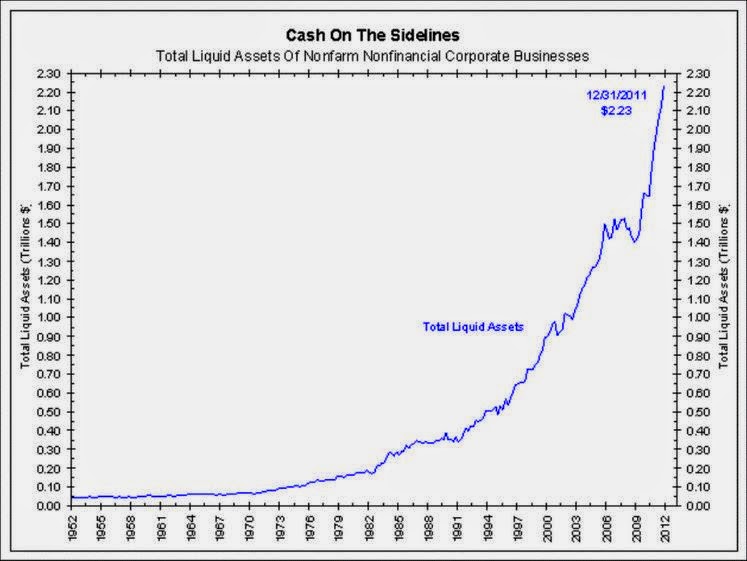
Do U.S. businesses have the financial capacity to offer higher wages to their workers? I would like to answer that question with another graph that you may also have seen before.
Credit: Blue Point Trading http://www.blue-point-trading.com/blue-point-trading-market-view-june-07-2012
There is a clock ticking somewhere in the background on this issue. There is a point somewhere in the future where it will be too late to fix wage stagnation through the normal democratic processes. History has proven this to be true. We are not at that point now, but we are past the point treating wage stagnation earnestly.
______________________________________________________
[i] Link: Real Historical Gross Domestic Product (GDP)
[ii] As of 2013 the median family income of $51,017 x GDP growth of 109.4% = $104,796 per year
[iii] Link: Raising Taxes on Corporations that Pay Their CEOs Royally and Treat Their Workers Like Serfs
New Jersey’s Regressive Public School Funding
by Brian T. Lynch, MSW
New Jersey recently published the annual “Taxpayers Guide to Educational Spending”. The headline in the Star Ledger was that school spending is up 5% over last year. This is hardly news given that inflation alone accounted for 1.7% of the increase.
Much of the remaining 3.3% increase in school spending is structural by design. Consider that new teacher salaries start low and increase annually as they gain experience. We also compensate teachers as they obtain higher educational degrees as a means of improving the quality of our teachers. Add to this the fact that the total number of teachers gradually increase as student enrolled numbers creep up a little every year. Then there is the higher than inflation increases in fuel costs that drive up the cost of student transportation each year. The retirement of higher paid teachers and administrators don’t quite balance out these other factors.
What irks the public most about this 5% increase is really the story behind how we fund public education in New Jersey. It just seems unfair. And when you look under the hood, it really is unfair. Wealth based public school funding is regressive in nature. It favors the wealthy and disfavors the poor. What it costs to educate a child doesn’t vary that much between wealthy and poor school districts, but the value of property and therefore the tax base varies a lot. In today’s economy especially, the prosperity in wealthy school districts is growing rapidly relative to per pupil costs while property values in less prosperous school districts are in decline.

To understand the disparity of wealth based public education funding, let’s take affluent Morris County as an example (located in the central most area of the Northern half of the State). Morris County has many wealthy school districts, such as Harding where the average home sells for over a million dollars. It also has districts like Wharton where the average home sells for a quarter of that amount, or about $251,000. Property values in Dover are a bit higher, but the median family income in the Dover school district is just $59,000 compared with $160,000 per year in Mountain Lakes. (Fig.1 below)
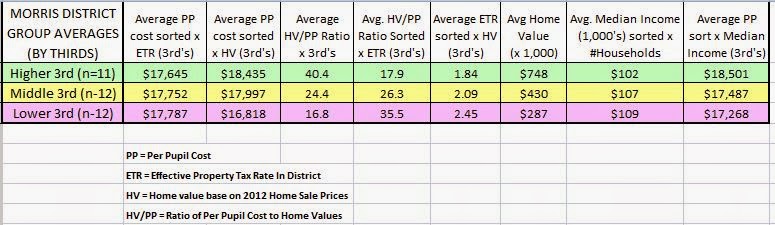
One way to gain some perspective on property based school funding is to compare what it costs to educate a student with what it costs to buy a home in the same district. In the eleven wealthiest districts of Morris County, home prices are 30 to 50 times more than the educational cost per pupil. Home values are just 16 to 18 times more than per pupil costs in the 12 poorest districts. As a general rule, the higher a district’s property values, the lower the tax rates. The reverse is usually true in poorer districts. Districts with lower property values, and lower income levels, generally have higher tax rates. While the 11 wealthiest districts in Morris County pay a little more to educate children in their district, their property tax rates are about one-third less than in the 12 poorest districts. (Fig. 2 below)
The dramatic contrast between home values and per pupil costs is partially masked when just comparing tax rates because, in the suburbs, wealthier districts tend to have fewer households. Fewer household to share the tax burden mean higher tax rates to generate sufficient revenue. Despite this fact, tax rates in 8 or the 11 richest districts is among the lowest in Morris County. Only three of these wealthy districts have higher per pupil costs while three have among the lowest per pupil costs. This highlights the fact that education costs are similar across the county. The average district cost per pupil is $17,730, plus or minus $2,038. There are a few outliers in either direction.
Educational costs vary far less than home values from district to district, so families in wealthier districts have a far easier time affording public education than families at the lower end of the economic ladder. While New Jersey’s State School Aid formula is supposed to help balance school funding across all districts, it does little to correct the underlying inequality and unfairness of wealth based educational funding.
Sources
Taxpayers’ Guide to Educational Spending 2013: http://www.state.nj.us/education/guide/2013/
General Tax Rates : http://www.state.nj.us/treasury/taxation/pdf/lpt/gtr13mor.pdf
Average Home Sales : NJ Spotlight News @ http://www.njspotlight.com/stories/13/02/28/average-home-sales-prices/ For March 1, 2013
Median Income and # Households: http://www.njspotlight.com/stories/13/12/19/median-income/
Figure 1
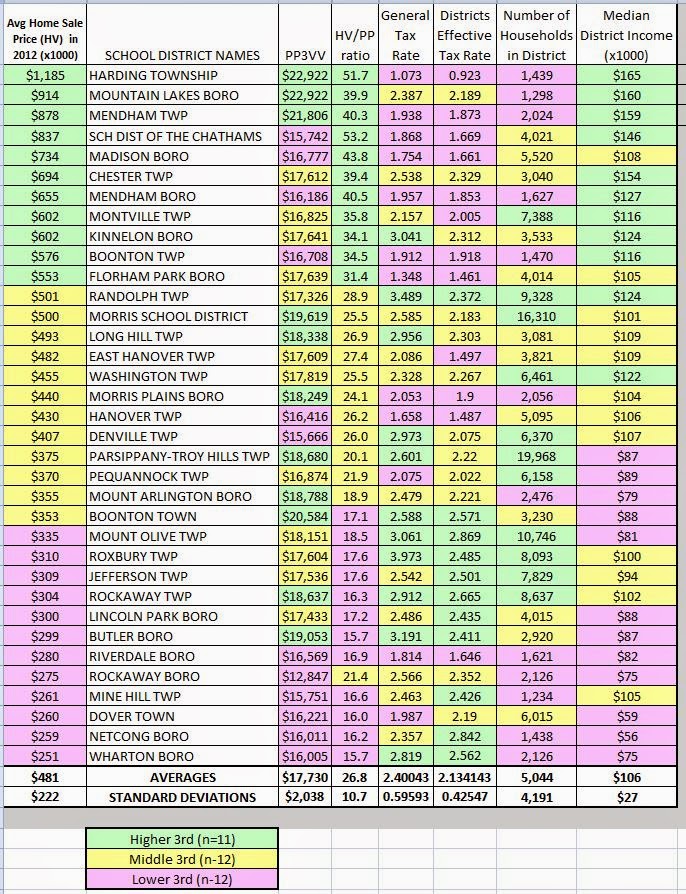
Figure 2
The Worthy and Unworthy Rich
By Brian T. Lynch, MSW
How should sensible people respond to divisive attacks on the poor and vulnerable? Should we begin making similar distinctions between the worthy and unworthy rich? Should we affirm those who earned their great wealth and provide social benefit but rescind all advantages given to those who use their inherited wealth to squeeze the people and their government for still more?
It should be obvious that social polarity is not between Democrat and Republican, or between liberal and conservative, but rather where it has always derived, between rich and poor.
GOP Senate Candidate: Republicans Must Turn Poor against Each Other (Video)
Watch N.C. House Speaker Thom Tillis explain: .“What we have to do is find a way to divide and conquer the people who are on assistance,”
Are You Forced to Subsidize Low Wage Workers?
by Brian T. Lynch
According to the NY Times: “As in 2011, 46 percent, or nearly half of New Yorkers, were making less than 150 percent of the poverty threshold, a figure that describes people who are struggling to get by.
Even with fewer people unemployed, the poverty rate for working-age adults working full time reached 8 percent, by the city’s measure. Fully 17 percent of families with a full-time worker lived in poverty, and even among families with two full-time workers, the rate was 5.2 percent.”
NOTE: This means that 8% of adults working FULL-TIME are at or below the poverty line, while 46% percent of all EMPLOYED New Yorkers are struggling to get by. This reinforces my analysis that NEARLY HALF of all working families must rely on some form of PUBLIC ASSISTANCE to make ends meet. Government assistance to these fully employed families = a tax subsidy on labor costs for the companies that employee them.
Put another way, people who earn more are being made to subsidize the company’s low wage employees through their federal income tax withholding. Ordinary wages have been held hostage to the 1% for almost 40 years.
AMERICANS NEED A RAISE
In, “Making the Case for a LIVING WAGE” I discussed more fully why it must be the obligation of business to compensate their employees to a level of at least minimal self-sufficiency (a living wage). Once all wage earners realize they shoulder the burden for low wage workers there will be more activism to at least raise the minimum wage. Ask yourself, “How much does my companies low wage policies cost me in income taxes?”
Here below is the link to the New York Times article which is about New York City, but could be about any city in America.

Prologue To Wealth Inequality Awarness
By Brian T. Lynch, MSW
Before I had a blog, before the Wall Street “privateers of equity” crashed the economy, and long before the Occupy movement occupied anything, there were seemingly crazy folks like me trying to sound the alarm on our economy. I wrote Letters to the Editor in local newspapers and sent copies to every newspapers across the country for which I had an email addresses. What disturbed me back then was that no one in the media, or even in academia, seemed to be paying much attention. Event have consequences, and the crash in 2008 caught us flat footed.
It is unknown how social problems that exist for years suddenly become public issues to be solved. No one knows what triggers these tipping points. Even when a single individual is clearly associated with a change or a movement or a discovery (Einstein, for example), that person is responding to what ever came before. Sometime it is the consequential event rather than any alarm bells that finally get our attention. The firmament that precedes public cognition before a disastrous event remains a mystery to me.
My wife just came across one of my old letters. What startled me is that I could have written this same letter today, except the statistics are far worse now.
Here below is my Daily Record Letter to the Editor published on Christmas Eve, 2006.

Hey Main Street, Meet Your Wall Street Landlords

by Brian T. Lynch, MSW
If you lost your home when Wall Street investment bankers made a hash of the home mortgage industry, you may be terrified to learn they want to become your landlord.
Up to now most single home rentals have been owned by local owners or regional companies. Private equity firms are taking advantage of loopholes in financial regulation and the depressed housing market to create national home rental corporations. They are scooping up foreclosed homes at fire sale prices all across the country and turning them into rentals. Their ultimate aim is to turn the equity in all those rental agreements into rent-backed securities that can be bought and sold on Wall Street. (Gentlemen, place your bets!)
Under this business model, the equity present in rental agreements will be aggregated into tranches based on confidence in the financial ability of the tenants pay their rent. The collateralized security instruments from these tranches will have various rates of return based on risk factors from the underlying leases. Should these rent-backed securities default, the security owners may even have an ownership stake in the properties to fall back on. If you haven’t heard about this before, you can read more in the Wall Street Journal, the Daily Finance or one of several good articles in Mother Jones.

The initial sale of rent-backed securities by these corporations will allow them to free up equity in these properties to purchase even more distressed homes. If the underlying financial structure of these plans sounds familiar, it should. Substitute mortgage equity for equity in these lease agreements and the securitized bonds are nearly identical to mortgage backed securities that inflated the housing bubble and crashed the economy in 2008. The only element missing so far are the “credit default swaps” inside investors bought to bet that the mortgage bonds would fail.
Hubris is the word that comes to mind when considering that the same class of players who foreclosed on the American Dream now want to be our landlord under these same self-serving schemes.
To be fair, the concept of private equity firms buying distressed houses to fix up and rent does has merit. Turning vacant houses into renovated rental properties has a positive patina best explained in theirpromotional videos.
Moreover, whenever investment money is applied directly to tangible projects that benefit ordinary families it is always a blessing. It brings jobs, boosts local economies, improves the quality of life and strengthens families.
If Wall Street investors could just be satisfied with the profound social benefits and ordinary financial returns on their investments it would be great. In fact, it is what Wall Street owes Main Street for all the pain they inflicted. But social benefits are not the things they value these days, and ordinary investment returns are never good enough. They must relentlessly drive to maximize profits.
Scratch the surface on their nationalized real estate plans and ominous consequences emerge. Ask yourself, what type of landlords will these national private equity firms become?
On April 15, 2014, the grass roots housing advocacy organization, Occupy Our Homes Atlanta (OOHA), published their “grassroots research” to answer that question. They looked at the earliest entrant into this field, the Blackstone Group, which owns Hilton Hotels, the Weather Channel, Sea World and Invitation Homes, a subsidiary that has purchased tens of thousands of homes across the country.
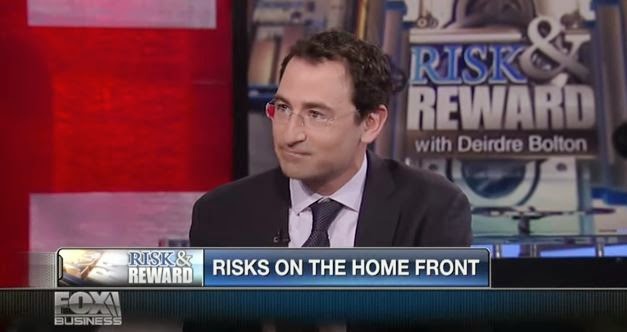
Here is some background on the Blackstone group. It is a private equity firm with global real estate holdings in the U.S., Parts of Europe and China. According to Jon Gray, the Head of Global Real Estate for Blackstone, their real estate holdings make up 60% of their assets, or around $80 billion dollars. It is already the largest landlord in the united states and it sees the distressed U.S. housing market as a growth opportunity.
According to an April 9th, 2014, interview Gray gave on the Fox News network “… distressed asset pricing is attractive,” with single family homes selling for less than half their pre-recession values in parts of Europe and the U.S. Blackstone has already purchased 47,000 foreclosure homes in 14 US cities, spending $8 billion dollars, or an average of $190,000 per home. Blackstone is betting on rising housing prices in part because depressed new home construction is a third of what it was before the recession.
What Blackstone doesn’t say can be found in the OOAH research report on how this nation’s biggest landlord has affected renters in Atlanta. Families who rent from Invitation Homes in the Atlanta area face higher rents, higher rental fees, less responsive property management service and some even face automatic rent increases as high as 20% per year. The OOAH report caught the attention of Congressman Mark Takano, who sent out a disturbing press release highlighting some of the findings ( appended below).
And there are other potentially negative consequences yet to follow. Tenancy laws and regulations are diverse across the states and local municipalities to reflect local and regional values. What impact might the power of national corporate landlords have in influencing those laws to suit their business interests?
The shame of it all is that most of the former home owners now renting from private equity landlords would still be in their own homes if it hadn’t been more profitable for banks to foreclose than to participate in the federal government’s HAMP, HARP, PRA or 2MP mortgage assistance programs. But then, if that happened, this private equity investment opportunity wouldn’t exist today, would it?
————————————————————–
FOR IMMEDIATE RELEASE
Wednesday, April 16, 2014
Contact: Brett Morrow
brett.morrow@mail.house.gov; (202) 225-2305
Rep. Mark Takano Statement on “Blackstone: Atlanta’s Newest Landlord” Report
Washington DC – Earlier today, the organization Occupy Our Homes Atlanta released its report titled “Blackstone: Atlanta’s Newest Landlord” showing that:
· Tenants wishing to stay in their homes can face automatic rent increases as much as 20% annually.
· Survey participants living in Invitation Homes pay nearly $300 more in rent than the Metro Atlanta median.
· 45% of survey participants pay more than 30% of their income on rent, by definition making the rent unaffordable.
· Tenants face high fees, including a $200 late fee for rental payments.
· 78% of the surveyed tenants do not have consistent or reliable access to the landlord or property manager.
After the report was released, Rep. Mark Takano issued the following statement:
“The report released today gives a snapshot of the experiences faced by Invitation Homes renters in the greater Atlanta area, and further shows the need for Congress and regulatory agencies to examine the growing phenomenon of large institutional investors owning rental properties. Local residents who rent from large institutional investors should not be subjected to unfair practices or poor service. I once again call on the House Financial Services committee to hold hearings on the issue, and request regulatory agencies begin looking at the emerging REO to rental market.”
Background Information:
In January, Rep. Takano released his Riverside” report examining the cause of rising rents in Riverside County, California. In the report, Takano discovered that one of the potential causes of rents increasing is the rise of large institutional investors purchasing single-family homes, renting them out.
Takano then sent a letter to House Financial Services Chairman Jeb Hensarling and Ranking Member Maxine Waters requesting Congressional hearings into single-family rental backed securities that are being developed by The Blackstone Group, Colony Capital, American Homes 4 Rent, and others.
Takano later sent letters to federal regulators, including the Department of Housing and Urban Development and the Federal Housing Finance Agency, requesting information about how institutional landlords can impact local housing markets and the tenant experience.
###
Brett Morrow
Communications Director | Congressman Mark Takano
1507 Longworth HOB, Washington, DC 20515
Office: (202) 225-2305 | Cell: 202-440-2268
Image Credits:
House Image : (World Law Directory) http://www.worldlawdirect.com/forum/law-wiki/12476-unlawful-detainer.html
Jon Gray Image: (Fox News Network) https://www.youtube.com/watch?v=d5pGbKGQtrU)
Wall Street: (Google Images) etruthseeker.co.uk/?p=54365
Government of the People Is Gone- Here’s Proof
by Brian T. Lynch
Martin Gilens of Princeton University, and Benjamin I. Page of Northwestern University , conducted a multivariate analysis of 1,779 policy issues in the United States, the results of which confirmed that the United States is no longer a Majoritarian Electoral Democracy.
In other words, we have lost majority rule. The United States has become an oligarchy. Business interests and the interests of the wealthy elite have overwhelming dominance in influencing United States policy and laws. You can read their conclusions below and read this newly published study in full at this URL:
Click to access Gilens%20and%20Page%202014-Testing%20Theories%203-7-14.pdf
According to the authors, “Multivariate analysis indicates that economic elites and organized groups representing business interests have substantial independent impacts on U.S. government policy, while average citizens and mass-based interest groups have little or no independent influence. The results provide substantial support for theories of Economic Elite Domination and for theories of Biased Pluralism, but not for theories of Majoritarian Electoral Democracy or Majoritarian Pluralism.”
Of course, anyone paying attention to government policies versus the popular will of the electorate would already have drawn this conclusion. I recently posted a two part piece on this very subject a few months ago: http://j.mp/1bz7aO5
The Gilens and Page study opens by asking a critical question, who really rules? Are we, the people, the sovereigns of our nation, or have we become “largely powerless?” He begins to answer this by summarizing four different theoretical traditions recognized by scholars who study democratic governance.
The first of these theoretical traditions discussed is the Majoritarian Electoral Democracy, which is best “… encapsulated in Abraham Lincoln’s reference to government “of the people, by the people, for the people.” This tradition holds that laws and policies should reflect the views of the average voter, and that the positions of politicians seeking election should converge towards the center of the normal range of voter opinion. It is this view of democracy most often presented by major media outlets when covering our politics. More importantly, this is these are the outcomes most of us expect from our democracy.
The second tradition is the Economic Elite Domination tradition in which US policy making is dominated by those with high levels of wealth or income. Some scholars also include social status or position as part of this tradition. The economic elites often exercise their influence through foundations, think-tanks and “opinion shaping apparatus,” as well as to the lobbyists and politicians they finance.
Majoritarian pluralism is the third theoretical tradition that Gilens and Page discusse. This tradition analyzes politics through the lens of competing interest groups within the population. These groups may include political parties, organized interest groups, business firms or industry sector organizations. All things being equal, the struggle between diverse factions within the population should also produce policy outcomes that are at least compatible with civil majority opinions. But all things are not necessarily equal, leading to the fourth, related tradition called Biased Pluralism.
Biased pluralism entails policy outcomes that result from contending, but unrepresentative organized interest groups. These unrepresentative interest groups are generally made up of upper-class citizens with the power and influence to tilt policy towards the wishes of corporations, businesses and professional associations.So, after statistically comparing almost 2,000 policy outcomes against these four models of political influence in our democracy, what did the researchers find? In their own words:
“By directly pitting the predictions of ideal-type theories against each other within a single statistical model … we have been able to produce some striking findings. One is the nearly total failure of “median voter” and other Majoritarian Electoral Democracy theories. When the preferences of economic elites and the stands of organized interest groups are controlled for, the preferences of the average American appear to have only a minuscule, near-zero, statistically non-significant impact upon public policy.”
“Nor do organized interest groups substitute for direct citizen influence [snip]… Over-all, net interest group alignments are not significantly related to the preferences of average citizens.” The net alignments of the most influential, business oriented groups are negatively related to the average citizen’s wishes.”
“Furthermore, the preferences of economic elites… have far more independent impact upon policy change than the preferences of average citizens do.
What then has become of our democracy? It has been usurped by billionaires who directly fund candidates for public office, directly influence policy through lobbying and heavily fund public marketing campaigns to influence public opinion for their own advantage.

We have seen this before during the “Gilded Age” at the turn of the last Century. We found our voice a hundred years ago and we took back our democracy from the wealthy elite. Today they are smarter, richer and have more control over the media and government than they did back then, so the challenges we face to save civil democracy and regain majority rule won’t be easy. But history tells us that power is ultimately with the people. We must start by recognizing our situation and begin organizing ourselves to collectively act in our own best interest. We need to become, once again, a nation of citizens, not a nation of businesses and the rich.
 Data Driven Viewpoints