Home » Posts tagged 'Government Regulations' (Page 2)
Tag Archives: Government Regulations
NSA Data Collection Can’t Be Made Safe
President Obama said, ” Between all the safeguards and checks that we put in place within the executive branch, and the federal court oversight that takes place on the program, and congressional oversight, people are still concerned as to whether their emails are being read or their phone calls are being listened to.”

Wrong premise, Mr. President! I am upset because a government program directs that my emails and phone calls be collected and stored somewhere. Whether the government ever reviews them is beside the point. The whole concept of the NSA’s data collection ideology is unconstitutional. For government to collect private communications is a criminal act, one the United States would have forcefully condemned if this had taken place in the former Soviet Union.
Sending emails or placing calls isn’t like putting out the trash. I willingly release my garbage to the public streets. Any passerby can grab it, so I have a diminished expectation of privacy. This isn’t true of my personal communications. My neighbors can’t read every email I send. I do expect that personal communications are not in public view. But even if the government required trash haulers to catalogue and save the contents if my garbage it would be an outrage.
Governments need systems of checks and balances more robust than then the character of those who administer them. The mass collection of domestic communications by or for the NSA already crosses the line, so no safeguards or checks can make it safe or acceptable.
It’s Time for Citizens to Take Control of Our Democracy
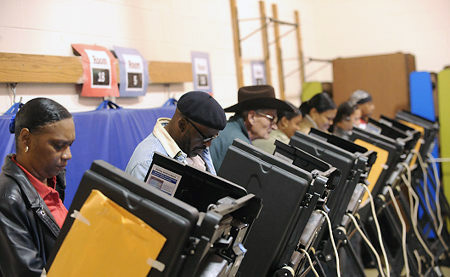
North Carolina doesn’t want you to vote if you live in a college dormitory in that state. They don’t want you to vote if you don’t have a special state identification card. There is a provision in state law that polling places can serve a maximum of 1500 voters, but in Boone, where college students nearly caused the parish to go for Barak Obama, you must now travel out of your way to the one polling place left, which serves over 9,000 voters. With only 45 parking spaces the parking lot will need to fill and empty every 6 or 7 minutes to accommodate everyone. Of course, accommodating all the voters is the last thing this Republican controlled local voting board has in mind.
Throughout the South and in other conservative stronghold around the country the story is pretty much the same. Since the United States Supreme Court struck down part of the Voting Rights Act an ideologically obstinate Republican Party, which is in demographic decline, is responding to growing pluralism and power sharing by rejecting democratic majority rule in favor of vote manipulation and dirty tricks. In one voting precinct in Texas, changes to the distribution of voting machines would have predominately African-American polling places handle ten times the number of voters as predominately White polling places. In every Republican controlled state the voting districts have been redrawn to make it nearly impossible for them to lose their incumbency. And all these changes are not random developments but elements of a nationwide plot to project conservative power and suppress opposing or alternative social views.
Admitting that there is a problem with our democratic process is difficult enough. Fixing it will be even harder. Elections are the province of state governments, each with unique constitutions, chapter laws and administrative policies. In a previous post [http://wp.me/p2WIGz-7B ] I reported on the results of a survey I conducted of the constitutional voting rights articulated in every state constitution. The results were disturbing. Most of the rights we think we have are not supported in the language of most state constitutions and no state constitution has adequately defined voting rights.
Voting is, of course, the cornerstone of democracy. It is the means by which political power is aggregated and distributed within a democratic society. Each vote is a transfer of power collected by the chosen candidate. The integrity of the voting process is therefore critical to a democratic society. It is too precious to entrust in partisan hands. The administration of the election process should be pre-partisan, outside of total government control. It should be directly under citizen control.
Our present system of election relies on election administrators appointed by the party in power. In most states that means the State Secretary of State. Keeping in mind that most states don’t have constitutionally secure voting rights, the legislatures have significant control over election procedures and the Secretary of States have great leeway over how these laws are implemented. Among the strange consequences this has cause is the turning over of elections to private voting companies. Most or our votes are cast and counted by private companies using electronic machines run on proprietary software. The voting companies are accountable to no one. We citizens didn’t ask for this and there was no discussion about this prior to hiring these private firms to collect and count our votes. Since these companies have taken over the election process we have had some of the most unusual and controversial elections in modern times. I have written extensively on this subject in the past (see below).
How should we protect our voting rights? By electing non-partisan, independent citizen boards to run our elections. All voting policies and procedures should be approved through public referendum developed by these citizen Boards of Election. Citizens on these boards should have no party affiliations and should not hold any public office. These citizen boards should be responsible for everything from drawing congressional districts, maintaining voter registrations preparing ballots, assigning polling places, etc. right down to training poll workers and monitoring elections. Any significant changes in voting policy should have to be put to a public vote. If private companies are to be hired to count our votes, it is the voters who should decide whether or not to use them. In my view, there should be nothing involving the franchise that isn’t itself subject to direct citizen approval.
The candidate who collects the most votes wins the consent to govern. In the bargain, the candidate in a representative democracy is expected to represent everyone, even those opposed to him or her. In exchange, all the people consent to be governed by majority rule even if there candidate didn’t win. Representatives should do what is right for the greatest good even if it isn’t what is popular at the moment or aligned with the interests of those who supported the candidate. Of course, this is the ideal, not the practice. But today, the basic bargain that makes a Republic work has broken down. Elected representatives are narrowly pursuing the interests of their political donors and party constituents almost exclusively. The Republican minority in the Senate no longer accepts majority rule, using filibusters to forcing super-majorities on nearly every vote. With this same disregard they are making it harder for citizens who don’t agree with them to vote in public elections. Governments and powerful interests have broken faith with democracy. It’s time for ordinary citizens to take back control over the democratic voting process.
MY BLOGLIOGROPHY ON VOTING ISSUES
The sorry state of voting rights in America, a 50 state comparison
http://aseyeseesit.blogspot.com/2012/03/sorry-states-of-voting-rights-in.html
How voter ID laws might block you from voting
http://aseyeseesit.blogspot.com/2012/07/seven-ways-voter-id-could-block-you.html
Republicans have a 5% election fraud handicap built into the voting system
http://aseyeseesit.blogspot.com/2012/08/republicans-have-5-election-fraud.html
Many state are unprepared for a fair and free election
http://aseyeseesit.blogspot.com/2012/07/many-states-unprepared-for-fair-and.html
Outsourcing or privatized voting process overseas
http://aseyeseesit.blogspot.com/2012/07/outsourcing-our-privatized-voting.html
Voting rights denied to a record number of “felons”
http://aseyeseesit.blogspot.com/2012/07/voting-rights-denied-for-record-numbers.html
Ireland Scraps Electronic Voting Machines for Good
http://aseyeseesit.blogspot.com/2012/06/ireland-scraps-electronic-voting.html
Secret flawed voting software discovered and exposed
http://aseyeseesit.blogspot.com/2012/06/ireland-scraps-electronic-voting.html
Does voter suppression have a new target in Florida (Latino’s)
http://aseyeseesit.blogspot.com/2012/05/does-voter-suppression-have-new-target.html
To know your Voting Rights you must know your state constitution
http://aseyeseesit.blogspot.com/2012/03/voting-know-your-rights-know-your-state.html
Can a convicted, or formerly convicted felon vote? Lots of confusion
http://aseyeseesit.blogspot.com/2012/04/can-convicted-felon-vote-major.html
Colorado sues for voting privacy, but do we have that right
http://aseyeseesit.blogspot.com/2012/02/colorado-group-sues-for-vote-privacy.html
A private company has the first peek at election results
http://aseyeseesit.blogspot.com/2012/02/company-wprivate-access-to-vote-totals.html
Voter suppression in America to get a hearing at the United Nations
http://aseyeseesit.blogspot.com/2012/03/voter-suppression-in-america-to-get.html
Caucus voting flubs highlight election system flaws
http://aseyeseesit.blogspot.com/2012/02/caucus-voting-flubs-highlight-our.html
South Carolina out sources vote count to Spain
http://aseyeseesit.blogspot.com/2012/01/south-carolina-outsources-vote-count-to.html
A voters “Bill of Rights”
http://aseyeseesit.blogspot.com/2011/10/voters-bill-of-rights.html
The Real IRS Tax Scandal
by Brian T. Lynch, MSW
Here is the Internal Revenue Service controversy in a nut shell. Rank and file IRS agents used search terms such as “tea party” to triage a mountain of applications for tax exempt status. What the agents were trying to identify were applications where the purposes of the organizations were primarily political. Under IRS regulations, organizations applying for 501(c)(4) tax exempt status must primarily be involved in social welfare activity. All the triaged applications were eventually approved. Virtually everyone agrees the IRS must be politically neutral, so the methods the agents used to organize their workload is not an acceptable practice.
This principle and these core facts are not in dispute by anyone familiar with the details. The partisan contentions understandably arise from the lengthy inaction by senior IRS officials to end this practice. Were senior managers incredibly blind to what agents were doing or did they turn a blind eye? If it was the latter, did they ignore the practice for practical reasons or political reasons? Who up the political chain of command knew of the practice and when did they learn about it?
As happens often in today’s politically charged atmosphere, the partisan conflagration set off by the revelations is sucking all the oxygen out of the room leaving no one to explore why these practices developed in the first place. The “scandal” is a media induced distraction from much more serious problems under the surface. Among the questions we should be asking are these:
Is there an increase in tax exempt applications and is the increase asymmetrical?
Probably so, although the assessment of this is indirect. According to an analysis of data released by the IRS in response to the criticism, Martin A. Sullivan of TaxAnalysitst.org found that among the tax exempt applications approved by the IRS about two-thirds were submitted by conservative organizations. The remainder were either liberal leaning organizations or politically neutral. According to Professor Rob Reich in the April/May Boston Review, there has also been an unprecedented growth in the number of charitable foundation, or 501(c)(3) organizations. He attributes this to the growing wealth of the richest Americans. They are establishing foundations to leave a legacy and project their political influence on society from beyond the grave. So far, according to the IRS and other sources, there does appear to be a sharp increase in 501(c)(3) and (4) applications for tax exempt status. It also appears that this increase in applications are skewed towards conservative organizations and wealthy donors.
Is there a problem with tax exempt 501(c)(3) and (4) organizations being too overtly political, and if so, is the problem asymmetrical?

Image of Karl Rove by chicagopublicmedia/Flickr
According to some sources, since the Supreme Court’s Citizens United case there has been a growing number of wealthy people and corporations creating charitable foundations and social welfare organizations through which predominantly political messages are being delivered to the public, tax free. Just as we have increasingly been subsidizing big business through corporate welfare, we may now be subsidizing political messaging campaigns directed at us.
Here is an experiment readers can replicate for themselves. Type “left wing organizations” in a Google search. You will see that two right wing organizations and one left wing organization pop up. The first of these is discoverthenetwors.org, a “Guide to the Political Left” put out by David Horowitz’ Freedom Center Foundation. This guide is an alphabetical listing of allegedly left wing organizations, but looking down the list you will see it lumps together such “subversive” left wing organizations as the AARP and Abu Nidal. Abu Nidal is a Middle-East, “Spinoff of the Palestine Liberation Organization… [that] Has killed or maimed more than 900 people in over 20 countries.”
According to it’s mission, “The David Horowitz Freedom Center combats the efforts of the radical left and its Islamist allies to destroy American values and disarm this country as it attempts to defend itself in a time of terror.”
Painting the American left as affiliates of Islamist terrorists (or other notorious dictatorships as seen in on other sites) is a common theme on some conservative websites. This information is what passes as a public educational service justifying tax exempt status. Additionally, the site contains ads, which may or may not be paid advertizing. The site does claim to be 501(c)(3) tax exempt and solicits the viewers tax exempt donations.
The next organization on the search list is the Western Center for Journalism. It bills itself as a 501(c)3 tax exempt foundation and accepts tax exempt donations, yet it describes itself as a conservative organization and promotes a book written by the organizations current president, Floyd Brown. Brown’s latest book, “Obama Enemies List: How Barack Obama Intimidated America and Stole the Election”, was released in January 2013. Virtually all of the contents on this site are partisan in topic and perspective. One article by Steve Baldwin, for instance, starts out this way:
” Very few Americans realize there exists a large network of far left philanthropists and foundations in America dedicated to destroying the American way of life, our Christian-based culture and our free enterprise system. They seek to remove America from its constitutional foundations and move it toward a European-style socialism. Much of this effort is coordinated by a little known group called the Tides Foundation and its related group, the Tides Center.”
So I looked into the Tides Center and found it to be a 501(c)(3) organization dedicated to fund projects related to:
“ Art & Film, Civic Engagement, Civil Discourse, Community Development, Disability Rights, Economic Justice,’ Economic Opportunity, Education/Training, Environmental Sustainability, Faith & Spirituality, Food & Agriculture, Health Services/Healthcare Reform, HIV/AIDS, Housing/Homelessness, Human Rights, Immigration, International Development, LGBT Issues, Media ,Native Communities, Nonprofit Spaces, Peace & Conflict Resolution, Professional Development, Racial Justice, Reproductive Justice & Health, Technology, Women & Gender, Youth Development & Organizing”
Donations to the Tides Center are tax exempt, but other than its support for some issues unpopular with conservatives you will find nothing overtly political on the web site.
The third organization on the Google search list is the RightWingWatch.org operated by People for the American Way. This is a liberal organization. RightWingWatch was on the search list in connection with an article refuting a claim by Rick Joyner that Timothy McVeigh (Oklahoma City Bomber) was actually a left wing radical, not a right wing terrorist. Rick Joyner is the founder and executive director of MorningStar Ministries and Heritage International Ministries. He is also the Senior Pastor at the MorningStar Fellowship Church, a tax exempt organization.
People for the American Way bills itself as a 501(c)(4) organization, but they don’t use our tax money. When you donate you get this disclaimer:
“Because we lobby Congress, donations to People For the American Way, a nonprofit 501(c)(4) organization, are not tax deductible.”
In contrast, Freedom Works Foundation is a conservative non-profit organization. It is currently headed by former U.S. House Majority Leader Dick Armey, a Republican. The site say it is inspired by the leadership of Barry Goldwater and Ronald Reagan. It’s content is distinctly and exclusively conservative. If you press the icon to donate to the foundation web site you are taken to the donation page for Freedom Works (without the word “foundation”) which is a political action organization. There you will be given a choice to donate, “… where my donation will be used directly in the fight in Washington,” or “… where my donation will be 100% tax deductable and will be used for education, research and other efforts.” So the Freedom Works Foundation, which is tax exempt, shares the donation page of Freedom Works, which isn’t tax exempt.
Now, for symmetry sake, Google “right wing organizations.” The first three organizations (excluding the C.S. Monitor) on the search list are People for the American Way (or RightWingWatch), which does not count donations as tax deductions, the PublicEye.org operated by a tax exempt group named Political Research Associates, and Common Dreams, also tax exempt. The Common Dreams link is to a three paragraph article on the resignation of the IRS commissioner. It isn’t particularly political. The People for the American Way provides an extensive list of right leaning organizations with detailed information on each. Unlike the David Horowitz Freedom Center, this list appears to contain only US organizations. There is no attempt to link these groups to foreign or domestic terrorist organizations. The site describes their effort this way:
“Right Wing organizations come in all shapes and sizes, from think tanks to legal groups, local and national lobbying organizations, foundations and media forums. At any given moment, the Right is at work in our public school systems, courthouses, in Congress and state assemblies. At the same time, right-wing groups are reaching huge audiences through media outlets they own or influence — promoting regressive policies that seek to drive wedges between and among Americans.”
So regressive policies and promoting division among citizens is the worst this group has to say about right wing organizations.
Political Research Associates also provides a list of right wing organizations similar to the one at the PFAW. This list is far less detailed. It doesn’t include foreign or terrorist organizations. There are no militia groups, or hate groups or overtly raciest organizations on the list as far as I can tell. It doesn’t include the Aryan Nation or the Klu Klux Klan, for instance.
This isn’t an exhaustive survey, of course. It’s just an exercise. But on the face of things it does appear that some tax exempt organizations have a very political agenda. It also seems that conservative leaning non-profits are more overtly political and include more information of questionable educational value. The problem of political activity among tax exempt groups seems asymmetrical. The added value to the public worthy of extending tax credits to these, or to any overtly political organization is dubious.
Does the IRS have the personnel and resources to properly handle their workload?
According to the IRS, the answer is no. IRS funding was held flat for three years between FY 2005 and 2007. There was a 2.5% cut in its 2012 budget and now it is being squeezed by budget cuts and the sequestration, prompting protests by IRS personnel. There is also this summary of the IRS situation prior to the last two years of budget cuts:
The most serious problem facing U.S. taxpayers is the combination of the IRS’ expanding workload and the limited resources available to the IRS to handle it. Among the consequences:
• the IRS is unable to adequately meet the service needs of the taxpaying public. [it’s only funded at an 80% level for this service.]
• the IRS is unable to adequately detect and address noncompliance, requiring honest taxpayers to shoulder a disproportionately large share of the tax burden.
• the IRS is unable to maximize revenue collection, contributing to the federal budget deficit.
—National Taxpayer Advocate, 2011 Annual Report to Congress
So the answer to this question seems to be no. This gives credence to claims that IRS line staff were triaging tax exempt applications to better handle their workloads. It also suggests that the problem of the huge collection gap, between what is owed and what is paid, won’t be fixed anytime soon. It has been estimated by the IRS’s own computer analysis that there are about a million tax returns each year that appear to contain fraudulent information but are not audited. At a time when the federal government is starving for revenue the anti-tax sentiments in congress seem to extent to collection of legally due taxes, not just tax increases.
Finally, is IRS agents to determine the degree of political activity permitted by current IRS regulations an impossible job?
The answer to this last question is yes, it is absolutely impossible. In the increasingly polarized politics of today there are often disagrements on who is a liberal or a conservative. The two camps can’t even on a common set of facts for any given topic. How can the IRS possibly create a suitable metric for deciding which 501(c)(4) organizations have crossed the political line. Even more importantly, why is the IRS even trying to make room for political activity for tax exempt organizations? The clear intent of the law excludes the from any political activity at all. This is what tax payers should demand in exchange for the tax break these organization receive from us.
Here then is the real scandal. The IRS, one of the most fundamental agencies in government, is under staff and without resources by congressional design at a time when it faces massive fraud and abuse, growing anti-tax sentiments and a groundswell of people and organizations trying to claim tax exemptions for overtly political purposes. It is trying to police this latter situation with an unenforceable and illegal regulation that it has been saddled with for over 60 years. Why isn’t this the real IRS scandal?
America’s Social Contract And The Measure of Our Commitment
(Note: contains some material from prior posts)
by Brian T. Lynch, MSW
A key element in America’s social contract is the idea that government derives its authority from the consent of the people. So the question should occasional be asked, is our mutual consent to be governed wearing thin? There is evidence to suggest a growing restiveness in certain populations. Some symptoms of declining consent include gridlock in congress marked by an inability to pass any legislation on a simple majority vote, the resurgence in states’ rights activism, calls in some states for secession, citizens arming themselves in fear (or perhaps the hope) of armed resistance and wide spread efforts to manipulate elections. Perhaps the best, most quantitative way to judge the degree to which we consent (or commitment) to self-government is by our willingness to pay taxes.
The attitudes we have towards paying taxes, and the extent to which people and organizations will go to avoid them, is an underappreciated index of our consent to be governed. Just as taxation without representation was a rallying cry leading up to the Revolutionary War, the Tea Party and many other popular reform or resistance groups today rally around taxes as a central point of contention. Objectively speaking, the Tea Party’s opposition to taxes makes no sense since their complaint corresponded with the lowest federal tax rate since the Eisenhower administration. It isn’t until we understand that our attitude towards taxes is a barometer of our consent to be governed that the Tea Party’s tax objections become clear.
For the sake of discussion it is helpful to identify different segments of the population that are particularly opposed to taxes. But keep in mind that our personal attitude towards paying taxes is just as valid an indicator of where each of us falls on this measure of consent.
Let’s begin with those who see themselves through the lens of American individualism. They value self-reliance and see this as a patriotic duty. They tend to think less of those who are more collaborative, more dependent or less successful. They tend to discount the contribution of the public commons to their own welfare and don’t often recognize how massively interdependent advanced societies really are. They believe that less government is best for everyone. These folks are less willing to contribute to tax supported government services other than for military defense. They are ideological individualist. This group may include some libertarians and on the extreme fringes may also include some anarchists or survivalists.
There are those who are suspicious or uncomfortable with American pluralism. These folks tend to live in parts of the country where there is little diversity or just a single predominate minority group. However, folks who hold this belief can be found everywhere. They believe a disproportionate amount of their taxes go to support other ethnic or cultural groups whose members don’t share their same values or work ethic. They may fear that these other groups are taking advantage of government largess. As a result, they are more resentful of paying taxes and more critical of what they see as wasteful government spending. These folks are pluralism-adverse and at the extreme fringes this group may include racists or hate groups. A highly nationalistic subset of this pluralism-adverse group believe their government has already broken faith with them and is threatening their liberty. For them, paying taxes is akin to paying tribute to a foreign potentate. The most extreme of these consider themselves to be soverign citizens.
There are some religious fundamentalists who believe all secular government is evil. Some fundamentalist sects focus on The Book of Revelations and an apocalyptic view of the world in which governments plays a role in the rise of the false prophet. For these groups anything that expands government is evil as well, including increased taxes. They are usually considered to be on the fringe of the Christian community, but they have an impact beyond their numbers.
Then there are those who believe taxes compete or interfere with commerce and free markets. They believe that taxes reduce the capital available for businesses investments. They fear that more taxes will lead to more government regulations and further hinder commerce. They don’t see government spending as simulative for the economy. For them, the provision of government services to those who aren’t successful contributors is an unfair redistribution of wealth. Members of this group are more likely to have higher incomes and a sense of entitlement. They may pride themselves in their ability to avoid paying taxes. At the extreme fringes of this group members tend to see society as being made up of the have and the have nots, the makers and the takers. They are often contemptuous of taxes and government.
Next, there are the disaffected and those too self-absorbed to care much about government. For this group all taxes are an annoyance to be avoided. This is a large and diverse group that is often underrepresented in our national conversations. They include many who are poor, but also many who are middle class folks working hard just to make ends meet. They tend to be swing voters when they vote and their grasp of politics and government policies are more maliable. The underground cash economy is significant for them.
The impact of this growing reluctance by some citizens to pay income taxes is huge. According to a GAO report called “HIGH-RISK SERIES, An Update”, the Internal Revenue Service estimated that the gross tax gap–the difference between taxes owed and taxes paid on time–was $450 billion for tax year 2006. The IRS estimated that it would collect $65 billion from these taxpayers through enforcement actions and late payments, leaving a net tax gap of $385 billion. This doesn’t include the loss of tax revenue due to the underground cash economy and foreign US cash transactions. These create an additional tax gap estimated to be between $400 billion and $540 billion annually. There is also the tax gap created when wealthy investors hide their money in off shore tax havens. According to a study by the Tax Justice Network the world’s super rich have at least $21 trillion secretly hidden away in tax shelters as of 2010. This is equivalent to the size of the Japanese and United States economies combined, according to The Price of Offshore Revisited report. Further, the amount of secretly hidden wealth may be as high as $32 trillion.
Arguably the most tax resistant groups, which also have the greatest fiscal and political impact, are businesses and corporations. The largest loss of tax revenue, representing the lowest level of consent to be governed, comes from the corporate sector. The shift in the percentage of total federal income taxes paid by individuals verses businesses has grown substantially over the years. Individual income taxes raised 41% of the total tax revenue in 1943 while business income taxes made up the rest, or more than half of the income tax receipts. Compare this with today where 79% of total revenues comes from individual income taxes. This shift in tax receipts from corporations to individuals cannot be explained by a shift away from C corporations (who pay the corporate income tax) to S corporations (who don’t). According to the financial site NerdWallet, the 10 most profitable U.S. companies paid an average federal tax rate of just 9 percent in 2011. The group includes such giants as Exxon Mobil, Apple, Microsoft, JPMorgan Chase and General Electric. The Economist recently posted a graphic by the Bureau of Economic Analysis that depicts the decline in corporate taxes juxtaposed to the rise in corporate profits.

The inability of the federal government to collect taxes from the nation’s elite and its biggest corporations is a serious sign of trouble. It signals a real strain in our social contract and severly limits the ability of the government to serve its people. The problem is compounded by the fact that anti-tax sentiments are being exploited by wealthy business interests to ferment dissatisfaction and distrust of our government. A coalition of the most anti-tax, anti government constituents from the various tax adverse segments of society described above would look very similar to the Tea Party base of today’s Republican Party. The power we invest in civil government is the only check we have to balance the power of the largest corporations to do as they wish in pursuit of profits. It would be a mistake to weaken our commitment to good government now when it is under assault.
There are still many who believe taxes are the price we must pay for a just and robust society. Paying taxes is our civic duty and evidence of our commitment to one another. It reflects confidence that our government is representing us and upholding the social contract. The present IRS scandal over the targeting of Tea Party groups for selective scrutiny of their 503(c)4 tax status is really a minor but convenient distraction from the real tax crisis we face. We are facing a crisis of confidence in self-government. It is a challenge of our time to rekindle a popular passion for civil government that is truly of, by and for the people.
Corporate Taxes Fall as Profits Soar
The Economist states it just right. Big corporations are avoiding their tax obligation. They have no sense of duty or obligation towards the peoples government which created corporations and the condition in which they have flourished. Increasingly, government is a gadfly to corporate profit making as citizens insist, through their government, that we breath clean air, drink pure water and eat healthy foods. Corporations are so large and powerful today that the only checks on their power is big government… hence the sustained attacks they are waging on big government. But when governments no longer have the power or ability to collect taxes from the elite or the largest corporations, they are close to colapsing. That is the message I take away from this latest report. I encourage everyone to go there and read more.
Taxing for some
America’s corporation-tax receipts falter even as company profits soar
THE pressure on tax-avoiders is mounting. In the latest episode Tim Cook, Apple’s boss, was called before a Senate subcommittee to explain why the tech giant had paid no tax on $74 billion of its profits over the past four years—though it has done nothing illegal. This comes at a time when America’s corporate profits are at a record high, thanks to the swift sacking of workers at the start of the recession, lower interest expenses, and the fact that cheap labour in emerging markets has eroded union power, allowing firms to move production offshore and defy demands for pay rises. Meanwhile corporation tax, which makes up 10% of the taxman’s total haul (down from about a third in the 1950s) has plummeted. An increase in businesses structuring themselves as partnerships and “S” corporations, which subject profits to individual rather than corporate income tax, is in part to blame. But tax havens are also culprits, as they lower their tax levels to lure in bigger firms.
International Corporate Plans to Oversee National Governments
Have you ever heard of the Trans-Pacific Partnership Agreement?
This posting is not so much an article on the Trans-Pacific Partnership agreement being negotiated as it is a gateway to articles on the subject. It is important to learn about this subject because, as Dave Johnson wrote in OpEdNews, “You will be hearing a lot about the upcoming Trans-Pacific Partnership (TPP) agreement. TPP’s negotiations are being held in secret with details kept secret even from our Congress. But giant corporations are in the loop.”
I would like to suggest you watch the DemocracyNow video from last June (see below) to UNDERSTAND this pending trade agreement and why it is a really big deal. Note, however, that the video of an awards cerimony was actually an anti-TPP activist’s hoax.
Here is an excerpt from Public Citizens analysis of TPP: ” TPP is a “trade” agreement between several Pacific-rim countries that is actually about much more than just trade. It will be sold as a trade agreement (because everyone knows that “trade” is good) but much of it appears to be (from what we know) a corporate end-run around things We the People want to do to reign in the giant corporations — like Wall Street regulation, environmental regulation and corporate taxation. ” [Note: Once finalized, this trade agreement will remain open ended so that any other nations may sign on to it in the future.]
http://www.democracynow.org/2012/6/14/breaking_08_pledge_leaked_trade_doc
Online Sales Tax Not So Simple or Wonderful
In the New Jersey Star Ledgers editorial, “A Level Field,” it is argued that it is time for online sellers to collect state sales tax. The principle concern is that New Jersey is losing out on tax revenue. But the issue is not that simple. There is the little matter of the interstate commerce clause in the US Constitution. In the case of Complete Auto Transit vs. Brady, U.S. Supreme Court said that collecting taxes on out-of-state sales is constitutional when:
1. The activity taxed has a substantial nexus with the taxing state
2. The tax is fairly apportioned
3. The tax does not discriminate against interstate commerce, and
4. The tax is fairly related to services the state provides the taxpayer
With this in mind, consider the example of a couple in New Jersey who goes online to the website of a California firm to buy a product made and shipped from New York State. Where is the point of sale? Which state can claim to have the most substantial nexus? In which state are the most taxpayer supported services provided as related to this sales ransaction?
These are questions for those drafting the Market Place Fairness Act to consider. If raising state revenue was the primary consideration, each state might decide to impose their own sales tax in the above example. This situation would discriminate against interstate commerce. More importantly, if raising state revenues is the issue then the obvious places to start would be the elimination of tax loop holes and sweetheart deals for businesses, elimination of the ridiculous tax loopholes for wealthy individuals, and maybe raising taxes on those who financially benefit the most in New Jersey. Sales taxes are already far too regressive and burdensome to the poor.
GAO – $450 Billion Gap in Taxes Owed Per Year
The following excerpt is taken directly from a GAO report called “HIGH-RISK SERIES An Update,” which highlights the difficulties in collecting revenue legally owed to our federal government. You will note from the steps recommended that significant collection efforts are to be focused on corporations and other business practices. The $450 billion in annual lost revenue does not take into account other shady tax loopholes used by the wealthy hide their income. It also isn’t clear if this total includes taxes lost in the underground cash and barter economies, which costs us billions in lost revenue. Unpaid taxes are an affront to a fair and balanced tax system. Lost revenue must be made up out of the pockets of law abiding citizens. Any changes to tax laws to make them fairer must include provisions to make collection more uniform.
Enforcement of Tax Laws
The Internal Revenue Service (IRS) recently estimated that the gross tax gap—the difference between taxes owed and taxes paid on time—was $450 billion for tax year 2006. For a portion of the gap, IRS is able to identify the responsible taxpayers. IRS estimated that it would collect $65 billion from these taxpayers through enforcement actions and late payments, leaving a net tax gap of $385 billion. The tax gap has been a persistent problem in spite of a myriad of congressional and IRS efforts to reduce it, as the rate at which taxpayers voluntarily comply with U.S. tax laws has changed little over the past three decades. Given that the tax gap has been persistent and dispersed across different types of taxes and taxpayers, coupled with tax code complexity and a globalizing economy, reducing the tax gap will require applying multiple strategies over a sustained period of time.
IRS enforcement of the tax laws is vital for financing the U.S. government. Through enforcement, IRS collects revenue from noncompliant taxpayers and, perhaps more importantly, promotes voluntary compliance by giving taxpayers confidence that others are paying their fair share. GAO designated the enforcement of tax laws as a high-risk area in 1990.IRS and Congress have shown a commitment to addressing the tax gap. Importantly, IRS continues to research the extent and causes of taxpayer noncompliance and is using the results to revise its examination programs. While still in the early planning stages, IRS has met with key stakeholders to develop options for expanding compliance checks before issuing refunds to taxpayers. IRS is also extending a program to encourage taxpayers to voluntarily report their previously undisclosed foreign accounts and assets, which has resulted in billions of dollars in collections. IRS, as well as Congress, has taken other innovative actions aimed at further improving tax compliance, often directly based on GAO’s work, including the following:
• Since 2012, brokers have been required to report their clients’ basis for securities sales.
• Since 2011, banks and other third parties have been required to report businesses’ credit card and similar receipts.
• Starting in 2014, U.S. financial institutions and other entities are required to withhold a portion of certain payments made to foreign financial institutions that have not entered into an agreement with IRS to report details on U.S. account holders to IRS
• Starting with tax year 2010, IRS is requiring businesses to report on their tax returns uncertain tax positions—those for which a business reported a reserve amount in its financial statements to account for the possibility that IRS does not sustain the position upon examination or that the position may be litigated.
• IRS is continuing its multiyear effort to replace the systems it uses to process individual tax returns and receive electronically filed tax returns.
The impact of these initiatives on taxpayer compliance and the tax gap may not be known for years and will depend, in part, on how IRS implements them. Using the new information from financial institutions could require IRS to develop new business processes and uses of information technology. Implementation will also be influenced by IRS’s ability to provide quality taxpayer services, such as telephone, correspondence, and online assistance. GAO found that some services
have experienced performance declines in recent years and IRS’s website could offer additional interactivity for taxpayers.
Another initiative IRS undertook in 2010 was to begin implementing new requirements for paid tax return preparers, such as competency testing, with the goals of leveraging relationships with paid preparers and improving the accuracy of the tax returns they prepare. Given that they prepare approximately 60 percent of all tax returns filed, paid preparers have an enormous impact on IRS’s ability to administer tax laws effectively. In January 2013, the U.S. District Court for the District of Columbia enjoined IRS from enforcing the new requirements for paid preparers. IRS has filed a motion to suspend the injunction and intends to appeal the District Court’s decision.
Further refining of direct revenue return-on-investment measures of its enforcement programs could improve how IRS allocates resources across its programs. Better use of such measures, subject to other considerations of tax administration, such as minimizing compliance costs and ensuring equitable treatment across different groups of taxpayers, could help maximize income tax collections. Resource allocation will become increasingly important as IRS is tasked with broader responsibilities, such as those in the Patient Protection and Affordable Care Act, in a time of tight budgets.
Additionally, targeted legislative action may be needed to address some compliance issues. IRS has statutory authority — called math error authority—to correct certain errors, such as calculation mistakes or omitted or inconsistent entries, during tax return processing. Expanding such math error authority could help IRS correct additional errors before interest is owed by taxpayers and avoid burdensome audits. Additional types of information reporting could also help improve compliance.
Taxpayers are much more likely to report their income accurately when the income is also reported to IRS by a third party. By matching information received from third-party payers with what payees report on their tax returns, IRS can detect income underreporting, including the failure to file a tax return. Currently, businesses must report to IRS payments for services they make to unincorporated persons or businesses, but payments to corporations generally do not have to be reported.
Taxpayers who rent out real estate are required to report to IRS expense payments for certain services, such as payments for property repairs, only if their rental activity is considered a trade or business. Expanding information reporting in these areas could increase payee reporting compliance. In 2010, the Joint Committee on Taxation estimated revenue increases for a 10-year period from third-party reporting of (1) rental real estate service payments to be $2.5 billion and (2) service payments to corporations to be $3.4 billion.
A broader opportunity to address the tax gap involves simplifying the Internal Revenue Code, as complexity can cause taxpayer confusion and provide opportunities to hide willful noncompliance. Fundamental tax reform could result in a smaller tax gap if the new system has fewer tax preferences or complex tax code provisions, reducing IRS’s enforcement challenges and increasing public confidence in the fairness of the tax system. Short of fundamental reform, targeted implification opportunities exist. For example, changing tax laws to include more consistent definitions across tax provisions, such as which higher education expenses qualify for some of the savings and tax credit provisions in the tax code, could help taxpayers more easily understand and comply with their obligations. For IRS to improve its enforcement of tax laws it must continue to:
• perform compliance research on a regular basis and use the results to identify areas of noncompliance;
• seek ways to leverage paid preparers to improve tax compliance;
• implement new (1) requirements for sources of taxpayer information and (2) technologies to enhance the effectiveness and timeliness of service and enforcement corrective measures; and
• develop return on investment measures to better allocate resources and maximize income tax collection.
In that regard, IRS should implement GAO’s open recommendations, such as those on developing measures of direct revenue return on investment. To assist IRS in reducing the tax gap, Congress should consider expanding IRS’s math error authority to correct taxpayer calculation mistakes or omitted or inconsistent entries during tax return processing before issuing refunds. Congress should also consider requiring payers to report service payments to corporations and making rental real estate owners subject to the same payment reporting requirements regardless of whether they engaged in a trade or business under current law. In the event that IRS cannot implement its new requirements without additional statutory authority, Congress should consider whether tax compliance could be improved by regulating paid preparers. The ongoing debate about tax reform also provides opportunities to consider the effect of tax simplification on taxpayer compliance and the tax gap.
Clearing the Air – We’ve Made Progress in Fighting Pollution
Government regulation is so demonized today in part because it is a victim of its own success. Who needs air pollution standards when skies are blue and the air smells sweet? Aren’t federal government regulations just a drag on the economy? As progress is made in cleaning up the air we breath, push back to dismantle the regulations that have been working becomes greater sometimes. The same powers of industry that created unbearable air quality in the past are pressuring Congress today to ease up on clean air emissions standards. We must hold the line and, in fact, move forward with improved standards.
What Pittsburgh Looked Like When It Decided It Had a Pollution Problem

In 1941, influenced by a similar policy introduced in St. Louis four years earlier, the city of Pittsburgh passed a law designed to reduce coal production in pursuit of cleaner air. Not willing to cripple such an important part of the local economy, it promised to clean the air by using treated local coal. The new policy ended up not being fully enacted until after World War II.
While the idea was a small step in the right direction, other factors ultimately helped improvePittsburgh’s notorious air quality. Natural gas was piped into the city. Regional railroad companies switched from coal to diesel locomotives. And, ultimately, the collapse of the iron and steel production industries in the 1980s led to rapidly improved air quality leading into the 21st century. Control of coal smoke made it possible to clean soot-covered buildings and to re-plant hillsides, helping provide the city a look it could hardly envision in the depths of its industrial heyday.


[excerpt]
The year 1970 has been a year of great progress in this field. In February, you will recall that I submitted the most comprehensive message on the environment ever proposed by a President of the United States. During the year, there have been some administrative actions, some legislative actions.
Time, however, has been required for the Congress to consider the proposals of the administration and, finally, to agree on the legislation that will be sent to the President for signature.
This is the most important piece of legislation, in my opinion, dealing with the problem of clean air that we have this year and the most important in our history.
It provides, as you know, for provisions dealing with fuel emissions and also for air quality standards, and it provides for ‘the additional enforcement procedures which are absolutely important in this particular area.
How did this come about? It came about by the President proposing. It came about by a bipartisan effort represented by the Senators and Congressmen, who are here today, in acting. Senator Randolph, Senator Cooper, and Congressman Springer represent both parties and both Houses of the Congress. [snip]
And if, as we sign this bill in this room, we can look back and say, in the Roosevelt Room on the last day of 1970, we signed a historic piece of legislation that put us far down the road toward a goal that Theodore Roosevelt, 70 years ago, spoke eloquently about: a goal of clean air, clean water, and open spaces for the future generations of America.
Read more at the American Presidency Project:Richard Nixon: Remarks on Signing the Clean Air Amendments of 1970.
A Billionaire to Regulate Billionaires at the SEC
A TALE OF TWO NORMS

NORM AS DIRECTOR:
SEC Names Norm Champ as Director of Division of Investment Management
2012-129
 Data Driven Viewpoints