Home » Posts tagged 'Government' (Page 3)
Tag Archives: Government
Is Our Obesity Epidemic a Result of the War on Wages?
America has a growing obesity epidemic. This we know for certain. We also know that obesity is far more prevalent among poor Americans and that more and more Americans are slipping into poverty. Real, inflation adjusted wages have been stagnant for over 30 years. Current wages are in decline and the number of people below the poverty line is near an all time high.
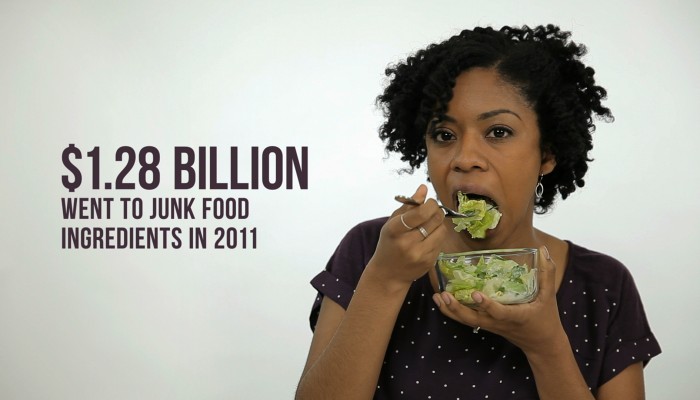
What is the link between poverty and obesity? It is a fact that the five states with the greatest obesity levels are also among the ten poorest states. They are also among the states with the lowest life expectancy. One theory as to why the poor are more likely to be obese is that they don’t have access to healthy foods in poor neighborhoods.
In April of this year the New York Times published an article highlighting two recent studies that looked at whether people in poor communities had access to stores and supermarkets that sold fresh, healthy foods. These two studies found that the poor have as much, or more access to stores selling healthy foods. One study found that poor neighborhoods have twice as many fast food restaurants and corner stores, but almost twice as many supermarkets as well. So the “food desert” theory of why poor American are more obese appears to be false.
A second theory on the connection between obesity and the poor is that they can’t afford to eat healthy. This is the “calories are cheap, nutrition is expensive” theory. Supporting this notion a recent American Journal of Clinical Nutrition study that found $1 could buy 1,200 calories of potato chips but just 250 calories of vegetables and 170 calories of fresh fruit. An excellent CNN article recently reported that:
“Ground beef that is 80/20 is fattier but cheaper than 90/10. Ground turkey breast is leaner than the other two but is usually the more expensive. And many of us can’t even begin to think about free-range chicken and organic produce — food without pesticides and antibiotics that’ll cost you a second mortgage in no time at all.”
And the cost of groceries is rising. The U.S. Department of Agriculture estimated the weekly grocery bill for a family of four was about at $134.50 in 2010 and $141.20 in 2011. An extra $7.00 per week is a lot for families living below the poverty line, especial when family incomes are in decline.
Other recent research also suggests a strong link between poverty, obesity and US food policy. While genetics may play a role in obesity, socioeconomic class may be a better predictor of obesity.
AcademicEarth.org has posted a brief video on their Website explaining this link that also relates it to current U.S. food policies. They report that Americans today eat 25% more calories than they did in the 1970’s (the same time period when hourly wages stopped rising with hourly productivity). The additional calorie intake is skewed towards lower income families. This important video federal food subsidies and other U.S. policies may be directly contributing to the current obesity crisis. Please view the video here: http://academicearth.org/electives/the-economic-cost-of-obesity/.
Created by AcademicEarth.org
The Real IRS Tax Scandal
by Brian T. Lynch, MSW
Here is the Internal Revenue Service controversy in a nut shell. Rank and file IRS agents used search terms such as “tea party” to triage a mountain of applications for tax exempt status. What the agents were trying to identify were applications where the purposes of the organizations were primarily political. Under IRS regulations, organizations applying for 501(c)(4) tax exempt status must primarily be involved in social welfare activity. All the triaged applications were eventually approved. Virtually everyone agrees the IRS must be politically neutral, so the methods the agents used to organize their workload is not an acceptable practice.
This principle and these core facts are not in dispute by anyone familiar with the details. The partisan contentions understandably arise from the lengthy inaction by senior IRS officials to end this practice. Were senior managers incredibly blind to what agents were doing or did they turn a blind eye? If it was the latter, did they ignore the practice for practical reasons or political reasons? Who up the political chain of command knew of the practice and when did they learn about it?
As happens often in today’s politically charged atmosphere, the partisan conflagration set off by the revelations is sucking all the oxygen out of the room leaving no one to explore why these practices developed in the first place. The “scandal” is a media induced distraction from much more serious problems under the surface. Among the questions we should be asking are these:
Is there an increase in tax exempt applications and is the increase asymmetrical?
Probably so, although the assessment of this is indirect. According to an analysis of data released by the IRS in response to the criticism, Martin A. Sullivan of TaxAnalysitst.org found that among the tax exempt applications approved by the IRS about two-thirds were submitted by conservative organizations. The remainder were either liberal leaning organizations or politically neutral. According to Professor Rob Reich in the April/May Boston Review, there has also been an unprecedented growth in the number of charitable foundation, or 501(c)(3) organizations. He attributes this to the growing wealth of the richest Americans. They are establishing foundations to leave a legacy and project their political influence on society from beyond the grave. So far, according to the IRS and other sources, there does appear to be a sharp increase in 501(c)(3) and (4) applications for tax exempt status. It also appears that this increase in applications are skewed towards conservative organizations and wealthy donors.
Is there a problem with tax exempt 501(c)(3) and (4) organizations being too overtly political, and if so, is the problem asymmetrical?

Image of Karl Rove by chicagopublicmedia/Flickr
According to some sources, since the Supreme Court’s Citizens United case there has been a growing number of wealthy people and corporations creating charitable foundations and social welfare organizations through which predominantly political messages are being delivered to the public, tax free. Just as we have increasingly been subsidizing big business through corporate welfare, we may now be subsidizing political messaging campaigns directed at us.
Here is an experiment readers can replicate for themselves. Type “left wing organizations” in a Google search. You will see that two right wing organizations and one left wing organization pop up. The first of these is discoverthenetwors.org, a “Guide to the Political Left” put out by David Horowitz’ Freedom Center Foundation. This guide is an alphabetical listing of allegedly left wing organizations, but looking down the list you will see it lumps together such “subversive” left wing organizations as the AARP and Abu Nidal. Abu Nidal is a Middle-East, “Spinoff of the Palestine Liberation Organization… [that] Has killed or maimed more than 900 people in over 20 countries.”
According to it’s mission, “The David Horowitz Freedom Center combats the efforts of the radical left and its Islamist allies to destroy American values and disarm this country as it attempts to defend itself in a time of terror.”
Painting the American left as affiliates of Islamist terrorists (or other notorious dictatorships as seen in on other sites) is a common theme on some conservative websites. This information is what passes as a public educational service justifying tax exempt status. Additionally, the site contains ads, which may or may not be paid advertizing. The site does claim to be 501(c)(3) tax exempt and solicits the viewers tax exempt donations.
The next organization on the search list is the Western Center for Journalism. It bills itself as a 501(c)3 tax exempt foundation and accepts tax exempt donations, yet it describes itself as a conservative organization and promotes a book written by the organizations current president, Floyd Brown. Brown’s latest book, “Obama Enemies List: How Barack Obama Intimidated America and Stole the Election”, was released in January 2013. Virtually all of the contents on this site are partisan in topic and perspective. One article by Steve Baldwin, for instance, starts out this way:
” Very few Americans realize there exists a large network of far left philanthropists and foundations in America dedicated to destroying the American way of life, our Christian-based culture and our free enterprise system. They seek to remove America from its constitutional foundations and move it toward a European-style socialism. Much of this effort is coordinated by a little known group called the Tides Foundation and its related group, the Tides Center.”
So I looked into the Tides Center and found it to be a 501(c)(3) organization dedicated to fund projects related to:
“ Art & Film, Civic Engagement, Civil Discourse, Community Development, Disability Rights, Economic Justice,’ Economic Opportunity, Education/Training, Environmental Sustainability, Faith & Spirituality, Food & Agriculture, Health Services/Healthcare Reform, HIV/AIDS, Housing/Homelessness, Human Rights, Immigration, International Development, LGBT Issues, Media ,Native Communities, Nonprofit Spaces, Peace & Conflict Resolution, Professional Development, Racial Justice, Reproductive Justice & Health, Technology, Women & Gender, Youth Development & Organizing”
Donations to the Tides Center are tax exempt, but other than its support for some issues unpopular with conservatives you will find nothing overtly political on the web site.
The third organization on the Google search list is the RightWingWatch.org operated by People for the American Way. This is a liberal organization. RightWingWatch was on the search list in connection with an article refuting a claim by Rick Joyner that Timothy McVeigh (Oklahoma City Bomber) was actually a left wing radical, not a right wing terrorist. Rick Joyner is the founder and executive director of MorningStar Ministries and Heritage International Ministries. He is also the Senior Pastor at the MorningStar Fellowship Church, a tax exempt organization.
People for the American Way bills itself as a 501(c)(4) organization, but they don’t use our tax money. When you donate you get this disclaimer:
“Because we lobby Congress, donations to People For the American Way, a nonprofit 501(c)(4) organization, are not tax deductible.”
In contrast, Freedom Works Foundation is a conservative non-profit organization. It is currently headed by former U.S. House Majority Leader Dick Armey, a Republican. The site say it is inspired by the leadership of Barry Goldwater and Ronald Reagan. It’s content is distinctly and exclusively conservative. If you press the icon to donate to the foundation web site you are taken to the donation page for Freedom Works (without the word “foundation”) which is a political action organization. There you will be given a choice to donate, “… where my donation will be used directly in the fight in Washington,” or “… where my donation will be 100% tax deductable and will be used for education, research and other efforts.” So the Freedom Works Foundation, which is tax exempt, shares the donation page of Freedom Works, which isn’t tax exempt.
Now, for symmetry sake, Google “right wing organizations.” The first three organizations (excluding the C.S. Monitor) on the search list are People for the American Way (or RightWingWatch), which does not count donations as tax deductions, the PublicEye.org operated by a tax exempt group named Political Research Associates, and Common Dreams, also tax exempt. The Common Dreams link is to a three paragraph article on the resignation of the IRS commissioner. It isn’t particularly political. The People for the American Way provides an extensive list of right leaning organizations with detailed information on each. Unlike the David Horowitz Freedom Center, this list appears to contain only US organizations. There is no attempt to link these groups to foreign or domestic terrorist organizations. The site describes their effort this way:
“Right Wing organizations come in all shapes and sizes, from think tanks to legal groups, local and national lobbying organizations, foundations and media forums. At any given moment, the Right is at work in our public school systems, courthouses, in Congress and state assemblies. At the same time, right-wing groups are reaching huge audiences through media outlets they own or influence — promoting regressive policies that seek to drive wedges between and among Americans.”
So regressive policies and promoting division among citizens is the worst this group has to say about right wing organizations.
Political Research Associates also provides a list of right wing organizations similar to the one at the PFAW. This list is far less detailed. It doesn’t include foreign or terrorist organizations. There are no militia groups, or hate groups or overtly raciest organizations on the list as far as I can tell. It doesn’t include the Aryan Nation or the Klu Klux Klan, for instance.
This isn’t an exhaustive survey, of course. It’s just an exercise. But on the face of things it does appear that some tax exempt organizations have a very political agenda. It also seems that conservative leaning non-profits are more overtly political and include more information of questionable educational value. The problem of political activity among tax exempt groups seems asymmetrical. The added value to the public worthy of extending tax credits to these, or to any overtly political organization is dubious.
Does the IRS have the personnel and resources to properly handle their workload?
According to the IRS, the answer is no. IRS funding was held flat for three years between FY 2005 and 2007. There was a 2.5% cut in its 2012 budget and now it is being squeezed by budget cuts and the sequestration, prompting protests by IRS personnel. There is also this summary of the IRS situation prior to the last two years of budget cuts:
The most serious problem facing U.S. taxpayers is the combination of the IRS’ expanding workload and the limited resources available to the IRS to handle it. Among the consequences:
• the IRS is unable to adequately meet the service needs of the taxpaying public. [it’s only funded at an 80% level for this service.]
• the IRS is unable to adequately detect and address noncompliance, requiring honest taxpayers to shoulder a disproportionately large share of the tax burden.
• the IRS is unable to maximize revenue collection, contributing to the federal budget deficit.
—National Taxpayer Advocate, 2011 Annual Report to Congress
So the answer to this question seems to be no. This gives credence to claims that IRS line staff were triaging tax exempt applications to better handle their workloads. It also suggests that the problem of the huge collection gap, between what is owed and what is paid, won’t be fixed anytime soon. It has been estimated by the IRS’s own computer analysis that there are about a million tax returns each year that appear to contain fraudulent information but are not audited. At a time when the federal government is starving for revenue the anti-tax sentiments in congress seem to extent to collection of legally due taxes, not just tax increases.
Finally, is IRS agents to determine the degree of political activity permitted by current IRS regulations an impossible job?
The answer to this last question is yes, it is absolutely impossible. In the increasingly polarized politics of today there are often disagrements on who is a liberal or a conservative. The two camps can’t even on a common set of facts for any given topic. How can the IRS possibly create a suitable metric for deciding which 501(c)(4) organizations have crossed the political line. Even more importantly, why is the IRS even trying to make room for political activity for tax exempt organizations? The clear intent of the law excludes the from any political activity at all. This is what tax payers should demand in exchange for the tax break these organization receive from us.
Here then is the real scandal. The IRS, one of the most fundamental agencies in government, is under staff and without resources by congressional design at a time when it faces massive fraud and abuse, growing anti-tax sentiments and a groundswell of people and organizations trying to claim tax exemptions for overtly political purposes. It is trying to police this latter situation with an unenforceable and illegal regulation that it has been saddled with for over 60 years. Why isn’t this the real IRS scandal?
Tax Breaks Cost US More Revenue than Medicare, Defense or Social Security
Tax breaks, also know as federal tax spending, includes things like mortgage deductions, child tax credits and lowered tax rates on capital gains. The CBO published a report today on what these deductions and tax breaks cost the federal government in annual revenues. The total amount is enormous. The top 10 most revenue syphoning tax cuts (there are more than 200 tax deductions in all) cost $900 billion. Tax spending is greater than budge expenditures for Medicare, Defense, or Social Security. It equals 1/17th of the US economy (or GDP). But taxbreaks or loopholes don’t show up anywhere in the federal budget, so the relative size of these hidden expenses are not usually apparent. They don’t often make it into the national dialogue when we talk about the budget. Below is the CBO report summary.
congressional budget office
supporting the congress since 1975
http://cbo.gov/publication/43768
The Distribution of Major Tax Expenditures in the Individual Income Tax System
report date: May 29, 2013
A number of exclusions, deductions, preferential rates, and credits in the federal tax system cause revenues to be much lower than they would be otherwise for any given structure of tax rates. Some of those provisions—in both the individual and corporate income tax systems—are termed “tax expenditures” because they resemble federal spending by providing financial assistance to specific activities, entities, or groups of people. Tax expenditures, like traditional forms of federal spending, contribute to the federal budget deficit; influence how people work, save, and invest; and affect the distribution of income.
This report examines how 10 of the largest tax expenditures in the individual income tax system in 2013 are distributed among households with different amounts of income. Those expenditures are grouped into four categories:
- Exclusions from taxable income—
- Employer-sponsored health insurance,
- Net pension contributions and earnings,
- Capital gains on assets transferred at death, and
- A portion of Social Security and Railroad Retirement benefits;
- Itemized deductions—
- Certain taxes paid to state and local governments,
- Mortgage interest payments, and
- Charitable contributions;
- Preferential tax rates on capital gains and dividends; and
- Tax credits—
- The earned income tax credit, and
- The child tax credit.
Some of the provisions of law that reduce the amount of taxable income under the individual income tax also decrease the amount of earnings subject to payroll taxes. The figures presented in this report are generally based on the reduction in payroll taxes as well as the reduction in income taxes, but some figures separate those two effects. (Provisions that reduce payroll tax receipts generally reduce future Social Security benefits as well; that effect is not analyzed in this report.)
How Do Tax Expenditures Affect the Federal Budget?
Although the 10 major tax expenditures listed here represent a small fraction of the more than 200 tax expenditures in the individual and corporate income tax systems, they will account for roughly two-thirds of the total budgetary effects of all tax expenditures in fiscal year 2013, CBO estimates. Together, those 10 tax expenditures are estimated to total more than $900 billion, or 5.7 percent of gross domestic product (GDP), in fiscal year 2013 and are projected to amount to nearly $12 trillion, or 5.4 percent of GDP, over the 2014–2023 period. In addition, tax credits to subsidize premiums for health insurance provided through new exchanges to be established under the Affordable Care Act will represent a new tax expenditure beginning in 2014, estimated to equal 0.4 percent of GDP over the 2014–2023 period.
How Are Tax Expenditures Distributed Among Households?
The 10 major tax expenditures considered here are distributed unevenly across the income scale. In calendar year 2013, more than half of the combined benefits of those tax expenditures will accrue to households with income in the highest quintile (or one-fifth) of the population (with 17 percent going to households in the top 1 percent of the population), CBO estimates. In contrast, 13 percent of those tax expenditures will accrue to households in the middle quintile, and only 8 percent will accrue to households in the lowest quintile (see the top panel of the figure below).

When measured relative to after-tax income, those 10 major tax expenditures are largest for the lowest and highest income quintiles. In calendar year 2013, CBO estimates, the combined benefits will equal nearly 12 percent of after-tax income for households in the lowest income quintile, more than 9 percent for households in the highest quintile, and less than 8 percent for households in the middle three quintiles (see the bottom panel of the figure above).
The distribution of tax expenditures across the income scale varies considerably among the different tax expenditures. For example, CBO estimates that more than 90 percent of the benefits of reduced tax rates on capital gains and dividends will accrue to households in the highest income quintile in 2013, with almost 70 percent going to households in the top percentile. Those benefits will equal 2 percent of after-tax income for the highest quintile and 5 percent of after-tax income for households in the top percentile. In contrast, about half of the benefits of the earned income tax credit will accrue to households in the lowest income quintile, equaling 6 percent of after-tax income for households in that group.
Tax credits that will provide assistance in paying premiums in health insurance exchanges are excluded from the distributional results presented here because they are not in effect in 2013. When those tax credits come into effect, they will appreciably increase tax expenditures for households in the lower and middle income quintiles. Individuals and families who have income between 100 percent and 400 percent of the federal poverty guidelines and who meet certain other requirements will be eligible for those credits.
How Do Tax Expenditure Estimates Differ From Revenue Estimates?
Estimates of tax expenditures are traditionally intended to measure the difference between households’ tax liabilities under present law and the tax liabilities they would have incurred if the provisions generating those tax expenditures were repealed but households’ behavior was unchanged. Such estimates do not represent the amount of revenues that would be raised if those provisions were eliminated, because the changes in incentives that would result from eliminating those provisions would lead households to modify their behavior in ways that would mute the impact on revenues. For example, if the preferential tax rates on capital gains realizations were eliminated, taxpayers would reduce the amount of capital gains they realized. Because the size of that tax expenditure is estimated on the basis of the gains that are projected to be realized with the preferential rates in place, the amount of additional revenues that would be received if those preferences were eliminated would be smaller than the reported tax expenditure.
America’s Social Contract And The Measure of Our Commitment
(Note: contains some material from prior posts)
by Brian T. Lynch, MSW
A key element in America’s social contract is the idea that government derives its authority from the consent of the people. So the question should occasional be asked, is our mutual consent to be governed wearing thin? There is evidence to suggest a growing restiveness in certain populations. Some symptoms of declining consent include gridlock in congress marked by an inability to pass any legislation on a simple majority vote, the resurgence in states’ rights activism, calls in some states for secession, citizens arming themselves in fear (or perhaps the hope) of armed resistance and wide spread efforts to manipulate elections. Perhaps the best, most quantitative way to judge the degree to which we consent (or commitment) to self-government is by our willingness to pay taxes.
The attitudes we have towards paying taxes, and the extent to which people and organizations will go to avoid them, is an underappreciated index of our consent to be governed. Just as taxation without representation was a rallying cry leading up to the Revolutionary War, the Tea Party and many other popular reform or resistance groups today rally around taxes as a central point of contention. Objectively speaking, the Tea Party’s opposition to taxes makes no sense since their complaint corresponded with the lowest federal tax rate since the Eisenhower administration. It isn’t until we understand that our attitude towards taxes is a barometer of our consent to be governed that the Tea Party’s tax objections become clear.
For the sake of discussion it is helpful to identify different segments of the population that are particularly opposed to taxes. But keep in mind that our personal attitude towards paying taxes is just as valid an indicator of where each of us falls on this measure of consent.
Let’s begin with those who see themselves through the lens of American individualism. They value self-reliance and see this as a patriotic duty. They tend to think less of those who are more collaborative, more dependent or less successful. They tend to discount the contribution of the public commons to their own welfare and don’t often recognize how massively interdependent advanced societies really are. They believe that less government is best for everyone. These folks are less willing to contribute to tax supported government services other than for military defense. They are ideological individualist. This group may include some libertarians and on the extreme fringes may also include some anarchists or survivalists.
There are those who are suspicious or uncomfortable with American pluralism. These folks tend to live in parts of the country where there is little diversity or just a single predominate minority group. However, folks who hold this belief can be found everywhere. They believe a disproportionate amount of their taxes go to support other ethnic or cultural groups whose members don’t share their same values or work ethic. They may fear that these other groups are taking advantage of government largess. As a result, they are more resentful of paying taxes and more critical of what they see as wasteful government spending. These folks are pluralism-adverse and at the extreme fringes this group may include racists or hate groups. A highly nationalistic subset of this pluralism-adverse group believe their government has already broken faith with them and is threatening their liberty. For them, paying taxes is akin to paying tribute to a foreign potentate. The most extreme of these consider themselves to be soverign citizens.
There are some religious fundamentalists who believe all secular government is evil. Some fundamentalist sects focus on The Book of Revelations and an apocalyptic view of the world in which governments plays a role in the rise of the false prophet. For these groups anything that expands government is evil as well, including increased taxes. They are usually considered to be on the fringe of the Christian community, but they have an impact beyond their numbers.
Then there are those who believe taxes compete or interfere with commerce and free markets. They believe that taxes reduce the capital available for businesses investments. They fear that more taxes will lead to more government regulations and further hinder commerce. They don’t see government spending as simulative for the economy. For them, the provision of government services to those who aren’t successful contributors is an unfair redistribution of wealth. Members of this group are more likely to have higher incomes and a sense of entitlement. They may pride themselves in their ability to avoid paying taxes. At the extreme fringes of this group members tend to see society as being made up of the have and the have nots, the makers and the takers. They are often contemptuous of taxes and government.
Next, there are the disaffected and those too self-absorbed to care much about government. For this group all taxes are an annoyance to be avoided. This is a large and diverse group that is often underrepresented in our national conversations. They include many who are poor, but also many who are middle class folks working hard just to make ends meet. They tend to be swing voters when they vote and their grasp of politics and government policies are more maliable. The underground cash economy is significant for them.
The impact of this growing reluctance by some citizens to pay income taxes is huge. According to a GAO report called “HIGH-RISK SERIES, An Update”, the Internal Revenue Service estimated that the gross tax gap–the difference between taxes owed and taxes paid on time–was $450 billion for tax year 2006. The IRS estimated that it would collect $65 billion from these taxpayers through enforcement actions and late payments, leaving a net tax gap of $385 billion. This doesn’t include the loss of tax revenue due to the underground cash economy and foreign US cash transactions. These create an additional tax gap estimated to be between $400 billion and $540 billion annually. There is also the tax gap created when wealthy investors hide their money in off shore tax havens. According to a study by the Tax Justice Network the world’s super rich have at least $21 trillion secretly hidden away in tax shelters as of 2010. This is equivalent to the size of the Japanese and United States economies combined, according to The Price of Offshore Revisited report. Further, the amount of secretly hidden wealth may be as high as $32 trillion.
Arguably the most tax resistant groups, which also have the greatest fiscal and political impact, are businesses and corporations. The largest loss of tax revenue, representing the lowest level of consent to be governed, comes from the corporate sector. The shift in the percentage of total federal income taxes paid by individuals verses businesses has grown substantially over the years. Individual income taxes raised 41% of the total tax revenue in 1943 while business income taxes made up the rest, or more than half of the income tax receipts. Compare this with today where 79% of total revenues comes from individual income taxes. This shift in tax receipts from corporations to individuals cannot be explained by a shift away from C corporations (who pay the corporate income tax) to S corporations (who don’t). According to the financial site NerdWallet, the 10 most profitable U.S. companies paid an average federal tax rate of just 9 percent in 2011. The group includes such giants as Exxon Mobil, Apple, Microsoft, JPMorgan Chase and General Electric. The Economist recently posted a graphic by the Bureau of Economic Analysis that depicts the decline in corporate taxes juxtaposed to the rise in corporate profits.

The inability of the federal government to collect taxes from the nation’s elite and its biggest corporations is a serious sign of trouble. It signals a real strain in our social contract and severly limits the ability of the government to serve its people. The problem is compounded by the fact that anti-tax sentiments are being exploited by wealthy business interests to ferment dissatisfaction and distrust of our government. A coalition of the most anti-tax, anti government constituents from the various tax adverse segments of society described above would look very similar to the Tea Party base of today’s Republican Party. The power we invest in civil government is the only check we have to balance the power of the largest corporations to do as they wish in pursuit of profits. It would be a mistake to weaken our commitment to good government now when it is under assault.
There are still many who believe taxes are the price we must pay for a just and robust society. Paying taxes is our civic duty and evidence of our commitment to one another. It reflects confidence that our government is representing us and upholding the social contract. The present IRS scandal over the targeting of Tea Party groups for selective scrutiny of their 503(c)4 tax status is really a minor but convenient distraction from the real tax crisis we face. We are facing a crisis of confidence in self-government. It is a challenge of our time to rekindle a popular passion for civil government that is truly of, by and for the people.
Taxes and America’s Social Contract
The American social contract is threadbare in certain parts of America. Areas of this great country are falling into disrepair, dissolution as if under a spell . In places like the Camden, New Jersey and now Josephine County, Oregon, public safety has been compromised by the failure of will to raise taxes. Below you will find a very disturbing report on the latter situation from Oregon Public Broadcasting. It dramatically highlights what can go wrong when citizens can’t make the connection between good government and the tax revenue it takes to have it. First, let’s consider the various segments of our population who oppose raising taxes.
There are those who see themselves through the lens of American individualism. They value self-reliance and see this as a patriotic duty. They tend to think less of those who are more collaborative or more dependent or unsuccessful. They tend to discount the contribution of the public commons to their own welfare and don’t often recognize how massively interdependent our advanced society really is. They believe that less government is best for everyone. These folks are less willing to contribute to tax supported government services other than for military defense. They are ideological individualist. They may include libertarians. On the extreme fringe they may include anarchists or survialists.
There are those who are suspicious or uncomfortable with Ameican pluarism. These folks most often live in parts of the country where there is little diversity or only a single other minority group. But folks who hold this belief can also be found everywhere. They believe a disproportionate amount of their taxes go to support other ethnic or cultual groups whose members don’t share their same values or work ethic. They sometimes fear other groups are taking advantage of government largess. As a result, they are more resentful of paying taxes and more critical of wasteful governement spending. They are pluralism-adverse. At the extremes this group may include racists and hate group. A highly nationalistic subset of this pluralism adverse group believes the federal government has already broken faith with the people and threat our liberty. For them, paying taxes is akin to paying tribute to a foreign potentate.
There are some religious fundamentalists who believe all secular government is evil. For them, anything that expands government is evil as well, including raising taxes.
There are those who believe taxes compete or interfere with commerce and the free market. They think that taxes only reduce the capital available for business and contribute to government regulations. They don’t see government spending as stimulating for the economy. For them, the provision of services to those who aren’t successful contributors to the economy is an unfair redistribution of wealth. This group are more likely to have higher incomes and to pride themselves in their ability to avoid paying taxes. In the extreme they tend to see society as made of the have and have nots, the makers and the takers.
I believe all these groups are being aggitated and moulded into an anti-government political movement to reduce the power of government to regulate powerful corporate interests. But regardless of what you or I believe, the truth of who we are becoming is reflected in the hopes and fears of this 911 caller in Josephine County, Oregon.
With No Officers To Respond To 911 Calls, Josephine Co. Considers Tax Levy
OPB | May 14, 2013 3:40 p.m. | Updated: May 15, 2013 10:50 a.m. | Grants Pass, Oregon
http://www.opb.org/news/article/josephine-county-tax-levy-would-add-deputies-fund-the-jail/
Time to Cap the Debate on Social Security and Medicare
Social Security and Medicare are in serious financial trouble in the future because they have been under attack for so long that how we thing of them has been changed by those who wish to kill these programs. Regardless of whose figures you believe when discussing the financial health of these programs, it could all be fixed by scraping the income cut off cap for contributions. Right now income payroll deduction collect a fixed percent of incomes up to around the first $107,000. This was just raised to this amount this year. All income over that amount is not considered.
I am a reluctant proponent of eliminating the Social Security and Medicare income contribution caps. In the short run this improve the income projects for both programs for some time to come, but it would also plant the seeds of distruction for these programs. It is helpful to understand why there are these caps to understanding my point.
People Falsely Convicted Spend Years In Jail Before Exonerations, And They Are the Luck Ones.
- The procedure for convicting a defendant of a crime is set by law: unless the defendant pleads guilty, he must be convicted at a trial before a judge or a jury by proof beyond a reasonable doubt.
- There is no set legal procedure for deciding that a convicted defendant is innocent when subsequent proof of innocent surfaces.
- Persons convicted of a crime can appeal but
- Appeals are mostly based on some misapplication of law at trial
- New evidence cannot be presented to win a chance to appeal
- Accuracy of the trial court’s judgment is not reviewed
- Winning an appeal triggers a new trial, not an exoneration
- Most exonerated defendants have their convictions vacated by courts at some point, but that almost always occurs in some form of “collateral review” or “extraordinary relief” proceeding after the process of ordinary appellate review has run its course, which can take years.
- We know the race of the defendants in 92% of the cases (802/873):
- 50% were black (399/802),
- 38% were white (303/802),
- 11% were Hispanic (86/802), and
- 2% were Native American or Asian (14/802).
- 8% pled guilty (71/873) and the rest were convicted at trial – 87% by juries and 8% by judges.
- 37% were cleared at least in part with the help of DNA evidence (325/873).
- 63% were cleared without DNA evidence (548/873).
- Almost all had been in prison for years; half for at least 10 years; more than 75% for at least 5 years.
- As a group, the defendants had spent more than 10,000 years in prison for crimes for which they should not have been convicted – an average of more than 11 years each
|
Exonerations by Category of Crime
|
||
|
CRIME
|
1989 – 2003 REPORT
|
1989 – 2012 REPORT
|
|
Murder (including manslaughter)
|
60% (205)
|
48% (416)
|
|
Rape (and other sexual assaults)
|
36% (121)
|
35% (305)
|
|
Adult Victims
|
30% (103)
|
23% (203)
|
|
Minor Victims
|
5% (18)
|
12% (102)
|
|
Other Crimes of Violence
|
3% (11)
|
11% (94)
|
|
Drug and Property Crimes
|
1% (3)
|
7% (58)
|
|
TOTAL
|
100% (340)
|
100% (873)
|
“Free Market” Social Services Fail to Deliver
Where do you turn when your aging mother can’t be by herself anymore or you notice your baby seems a little delayed? Imagine that your teenager start skipping school and staying out all night or imagine you are suddenly diagnosed with a serious illness or disabled in an accident. Where do you go for help?
Sooner or later we all knock on the door of our community’s social service network. What greets us may be far less than we expect. And sadly, the help available to us will depend a lot on where we live and how much money we make. The confusing patchwork of private, public and non-profit social service agencies through which we must navigate is the natural, unintended consequence of the free market model we’ve created to deliver social services.
We are all only temporarily able bodied. We don’t give much thought social services. We are content knowing that free market competition is efficiently keeping down the cost of publicly financed services for the needy.
It isn’t until we seek help ourselves that we encounter a labyrinth of agencies with confusing components and cutesy sounding acronyms for their names. Agencies often list the types of services they offer (counseling, for example) without listing the types of problems they serve (such as adolescent issues). Consumers are expected to know which services work best for their problems. Some agencies over promise results in their marketing or take on people with problems that would be bettered resolved elsewhere. Access to services are often restricted by bewildering eligibility requirements based on age, gender, geography, diagnosis, income, insurance provider, religion, ethnicity, funding source or hours of operation.
If your family has one or two very common problems, chances are you will find the help you need. But if your problems are uncommon or complex, your search will not go smoothly. And if you also happen to be poor, live in an under served community or don’t have transportation, the prospects for getting effective help are slim.
This is the character of our social service networks today. They are not based on matching service availability and capacity to the needs of local communities. They are loosely coordinated networks created by free market forces and competition between private or non-profit agencies scrambling for dollars.
For over thirty years we have been privatizing public social services in the belief that free markets are more efficient than government in providing the best services at the lowest cost. Little attention is given to the inescapable fact that market driven systems create uneven results by their very nature. This is true in commerce but especially true in public social welfare. Larger agencies are more politically connected and better positioned to compete for public dollars. Wealthier communities have a higher profit potential so they attract more and better competitors. Smaller agencies and program models that incorporate innovative ideas are less able to compete for government money.
Innovative approaches to helping people are usually funded in small trials by private foundations. Even when these trials prove successful, bringing them up to scale is almost impossible. Agency competition actually works against it because social service providers are competing on an artificial playing field.
Governments create the playing field on which agencies compete, but the government departments responsible for developing and funding social service contracts are often under staffed and ill equipped to monitor service outcomes. They also lack the personnel and special expertise it takes to design better programs. The time and effort involved in researching literature, writing contract proposals, putting contracts out for bid and guiding the implementation of new programs is enormous . Politicians don’t want to spend what it would cost to create real free market competition for high quality services.
To overcome the uneven distribution of services problem, governments develop specially targeted service contracts with extra financial incentives to serve specific areas. But these initiatives are expensive and tax revenues are declining. Targeted service contracts are usually limited in size and scope because of their higher costs.
We have come to the point where the availability and quality of essential services, to treat an abused child for example, becomes an accident of birth. How often have I seen children getting excellent services in one county while children with identical needs have no such services in another.
Commercial markets are efficient in distributing products according to demand when profits are distributed according to merit. This method breaks down when applied to funding social services. Competition discourages inter-agency coordination and inadequate funding increases agency competition in more profitable locations while discouraging them from entering less profitable communities. This causes unacceptable inequalities in meeting the basic human needs of our people.
There are many pressing issues that demand attention. How we fund social services is rarely among them, yet the wisdom of distributing social services through artificially created free markets cries out for public debate.
Do Pro-business Policies Reduce Poverty?
President Calvin Coolidge once said, “… the business of the American people is business”. He was quoted out of context at the time. His remarks were aimed at newspaper reporters who were inept at covering business news, but this intentional misquotation seemed to sum up his economic policies.
Today this misquote seems prophetic. Political leaders from both parties speak as if whatever benefits business benefits the people. State governments offer tax breaks and business friendly regulations to attract companies that might bring in more jobs. This is especially true in less wealthy states where poverty rates are high. President Lyndon Johnson’s “War on Poverty” has been transformed into pro-business politics and the promise of work for the worthy.
It is true that the poor need jobs, but the causes of poverty are more complex. There is little regard for other factors such as the need for quality daycare, health care access, job training or transportation. Journalists rarely asks politicians how they plan to help the poor. When they do, candidates talk about their plans to grow the economy. This has some become an acceptable answer.
The insurgent idea that serving business interests is the best way to fight poverty arguably arose in the mid 1970s when corporate interest groups were forming and the business lobby became a powerful influence on Congress. This was the high water mark of American unions as organized business groups launched campaigns to turn Congress and public opinion against them.
At the same time, these industry lobbying groups began fermenting hysteria over the growing “welfare state.” The poor were poor, they argued, because anti-poverty programs make people dependent on government handouts while government regulations restrict the ability of companies to create jobs for those willing to work. According to their narrative, government needed to spend more resources supporting commercial interests and deregulating markets. President Reagan road these pro-business, anti-union, anti-government sentiments to the White House in 1980.
The success of the pro-business movement is evident. In this past election Mitt Romney’s entire presidential campaign centered around the idea that business prosperity was key to growing jobs and the economy. The California Republican Party explicitly incorporates this thinking in their core beliefs:
“” each person is responsible for his or her own place in society. The Republican philosophy is based on limiting the intervention of government as a catalyst of individual prosperity” Republicans believe free enterprise has brought economic growth and innovations that have made this country great. Government should help stimulate a business environment where people are free to use their talents. “[California Rep Committee Philosophy http://cagop.org/inner.asp?z=585A]
In other words, it is the role of government to facilitate the business economy but each individual’s responsibility to avail themselves of the opportunities businesses provide.
The sufficiency of robust commerce to lift all boats isn’t just a conservative or partisan idea. It is expressed and pursued often by Democrats as well. In this last election even President Obama avoided talking about the poor by referring to them as “those aspiring to be middle class.” There was almost no mention by either party of how they would accomplish this beyond trying to grow the economy.
So how well is our pro-business politics working out for the poor? This should be an empirical question that can be tested by examining the data. Are business interests and the interests of the poor perfectly aligned? Are there points of departure where the needs of some folks cannot be met without compromising some business interests? Most importantly, does the data show that when businesses are doing well there are more jobs and better wages?
Profits, Employment and Wages
Corporate profits are a measure of how well businesses are doing, so conventional wisdom would say wages and employment should rise and fall commensurate with corporate profits. The hypothesis is that when companies do well there are more good paying jobs and therefore less poverty. Is there evidence to the contrary?
In June of 2012, the St. Louis Federal Reserve released data showing a number of economic indicators over the last 71 years. Using their report, the graph below plots corporate profits (CP) as a percentage of gross domestic product (GDP) from 1940 to 2011. GDP is total value of all the goods and services sold and a good measure our economy. The shaded areas represent periods of recession. This graph shows that corporate profits rebounded since the 2007 recession and are at the highest level since 1940. The recession is clearly over for corporate America.

Corporate Profits to GDP by St. Louis Federal Reserve
Does it therefore hold true that robust corporate profits mean more jobs? The next graph plots the number of employed Americans as a percentage of our population. This graph uses an employment per population percentage because the population doesn’t stop growing during recessions. A fair comparison over time has to incorporate population growth for the same reason dollar comparisons over time have to factor in inflation.

Civilian Employment to Population Ratios by St. Louis Federal Reserve
This above graph shows that there are actually fewer people working today as a percentage of the population than at any time in the past thirty years. Last June, in an article related to this graphs, Business Insider magazine speculated that one reason corporations are so profitable is that they aren’t employing as many Americans.
Does it also hold true that robust corporate profits means better wages? The next graph depicts the total amount of U.S. wages paid as a percentage of the value of all goods and services sold (GDP). It shows that wages are at an all-time low relative to the wealth being generated. If jobless recoveries are one reason for record corporate profits, the decline in wages pictured in this next graph may be the other.

US Wages as a percentage of GDP by St. Louis Federal Reserve
It turns out that the null hypothesis is true. Corporate profits are at a record high, employment and wages are at a record lows and the notion that what is good for business is good for people is false. The stock markets have recovered. Corporate profits have recovered, but the financial well-being of families have declined. Median incomes are shrinking and prospects for the poor are increasingly dismal.
Are Measures of Business Competitiveness Compatible with the Interests of Individuals?
When considering what factors make businesses more competitive it’s best to take a broad global view. A global survey of business competitiveness was recently conducted and released by the World Economic Forum. The study on global business competitiveness ranks 144 nations according to indicators grouped in 12 general categories.
Overall, the United States is very competitive, ranking 7th out of 144 countries. When you drill down in some of the 12 categories, however, you find indicators favorable for business that are clearly at odds with worker interests. For example, In the area of “Labor Efficiency” the U.S. labor “redundancy” costs are low, which means it doesn’t cost as much here to fire employees. This makes us more competitive (12th place) on this measure. This variable includes the estimated costs of providing advance layoff notices, severance payments any penalties that other countries might impose on employers for terminating “redundant” workers. The U.S. may be more competitive in this measure, but is this factor good for individual workers? Does it reduce poverty?
The U.S. also did well (8th) when it comes to the ease of hiring and firing people. All of this makes for a “flexible” work force, which is good for business, but does it stabilize the workforce or encourage employers to try and weather out minor economic storms?
Are the states with the most competitive business environments doing better at lifting people out of poverty?
Every year for the past five years CNBC has scored all 50 states on 43 measures of business competitiveness. This survey was developed with input from business groups including the National Association of Manufacturers and the Council on Competitiveness. States receive points based on their rankings in each factor and the factors are organized into broader categories. I was unable to locate a detailed list of factors within each category, but CNBC has published general descriptions of each category. In the category of “Workforce” for instance, they indicate that the prevalence of unions in a state is a negative factor for business competitiveness, while lower costs of doing business is a positive factor. Among the factors creating low costs for doing business are lower tax rates and tax incentives or tax abatement for business. The general category findings for each state are published.
The hypothesis, again, is that when companies are doing well there are more good paying jobs and less poverty. So it follows that the states with the most competitive business environments should also be the states with the lowest rates of poverty.
To test this I used the CNBC business competitive findings to compare ten states with the highest poverty rates and ten states with the lowest poverty rates. The high poverty states, starting with the highest poverty rate, are Mississippi, Arkansas, Kentucky, Louisiana, New Mexico, West Firginia, Oklahoma, Texas, Alabama, and South Carolina. The ten states with the lowest rates of poverty, starting from the top, are New Hampshire, Mariland, Alaska, New Jersey, Hawaii, Connecticut, Wyoming, Utah, Minnesota and Massachusetts. The results of this analysis are found in the table below.

State poverty levels and business competitiveness by Brian Lynch. Business Competitiveness Rankings are from CNBC’s Top States for Business Special Report: ttp://www.cnbc.com/id/100000994
It is striking that states with the highest poverty levels are also states that are more business competitive. The average rank in “Overall Business Competitiveness” for high poverty states is 7 points higher (more business friendly) than the rank for low poverty states. In the “cost of business” category, high poverty states have an average rank of 18 versus 37 for low poverty states. In the “workforce” category, which includes the prevalence of unions in a state, the high poverty states have an average rank of 20 versus 32 in low poverty states.
Despite being “business friendly”, the ten high poverty states have over eight million poor citizens while the ten low poverty states have just over three million poor. There may be some political asymmetry as well since 7 out of 10 states with the high poverty rates have conservative Republican governors, while 6 out of 10 low poverty states have Democratic governors.
Conclusions
It is clear that pro-business politics, which puts commercial interests above the individual’s interests, isn’t working for the poor or for most Americans. While a healthy economy is necessary for individual prosperity, it is clearly not sufficient. What is best for business may be good for some, but not for all of our citizens. There are certain business interests at odds with individual interests. Our political leaders need to acknowledge this when making policy.
The total dominance of pro-business politics has successfully crowded out meaningful debate on how to help the poor, the ranks of whom are swelling every year. The poor are more marginalized and invisible than ever. Almost no one speaks for them. There is no hope for them in the more competitive business policies being proposed. In fact, business prosperity is no longer well correlated with job growth or adequate pay, so plans to grow the economy ring hollow. The social contact that once pegged wage increases with increased productivity is broken. As a result, big business can flourish while the welfare of workers and the poor decline. This is unacceptable.
The ascendance of pro-business politics has given rise to commerce without conscience and too many ordinary citizens are being left behind. We need to change the dialogue and strike a better balance. We need to reclaim the role that government must play in meeting the needs of all our people.
Government Jobs Not Rebounding As In Past Recessions
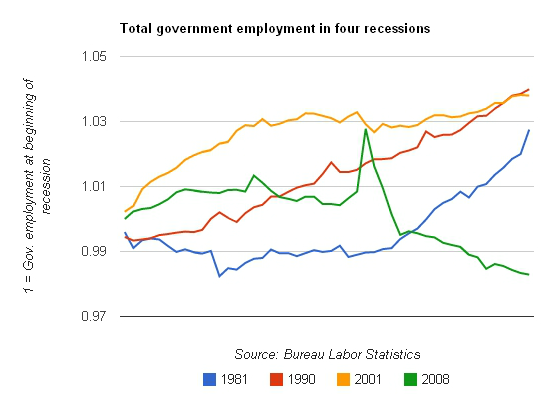

Public-sector austerity in one graph
On Friday, I ran some numbers on public-sector employment: Since Obama was elected, the public sector has lost about 600,000 jobs. If you put those jobs back, the unemployment rate would be 7.8 percent. [SNIP]
Today, Ben Polak, chairman of the economics department at Yale University, and Peter K. Schott, professor of economics at the Yale School of Management, widen the lens, with similar results: There is something historically different about this recession and its aftermath: in the past, local government employment has been almost recession-proof. This time it’s not. [SNIP] Go to like to read the rest of Ezra Klein’s article. Thank you.
 Data Driven Viewpoints