Home » Business (Page 3)
Category Archives: Business
Higher Wages – Good for Families, Good for Economy & Good for Business
Below is another graphic that speaks for itself. Not only does paying higher wages improve the US economy and the lives of every citizen, it also makes good business sense.
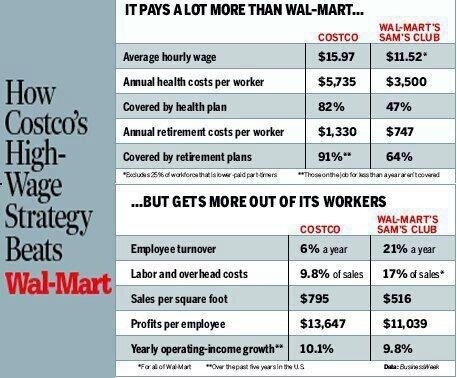
I have written extensively on wage history and the case for a living wage, wealth distribution in America, our global business competitiveness, the dangers of our growing wealth inequality, and many other issues effecting middle and working class Americans, including and post on class warfare.
In a Labor Day message from former Secretary of Labor, Robert Reich, he, ” breaks down what it’ll take for workers to get a fair share in this economy — including big, profitable corporations like McDonald’s and Walmart to pony up and finally pay fair wages.
There is a petition that you can sign if you click on the above link. Please consider it your Labor Day obligation to those who struggled and even died to give you the benefits we still have today.
Lobbying Produced a 22,000% Return for Corporations per One Study
Is lobbying Congress a good investment?
This is normally a nearly impossible question to answer, but a unique set of circumstances allowed researchers to conclude that Corporate lobbying for a tax amnesty provision in the 2004 American Jobs Creation Act(AJCA) yielded a 22,000% return. Yea, I would say it was worth it.
One reason why the question can’t normally be answered is that the financial information needed to answer the question can almost only be found on Corporate tax returns. All tax returns are confidential and only the IRS can see them. But a unique opportunity to study this question presented itself through a tax amnesty provision in the AJCA.
The University of Kansas School of Business ceased the opportunity. Researchers found that they were able, in this unique situation, to publicly obtain all the information need to analyze the return on lobbying expenditures. As stated in this study, “This is the first study to provide actual values of the financial savings arising from tax law changes, and the first to use data that has been audited by independent accounting firms.”
Cudos to the authors, Alexander, Mazza and Scholtz, and to the University of Kansas School of Business for this important piece of research.
Measuring Rates of Return for Lobbying Expenditures: An Empirical Analysis under the American Jobs Creation Act
Raquel Meyer Alexander
University of Kansas – School of Business
Stephen W. Mazza
University of Kansas – School of Law
Susan Scholz
University of Kansas – Accounting and Information Systems Area
April 8, 2009
Abstract:
The lobbying industry has experienced exponential growth within the past decade. The general public, the media, and special interest groups perceive lobbying to be a powerful mechanism affecting public policy. However, academic research finds inconclusive results when quantifying the rate of return on political lobbying expenditures. In this paper we use audited corporate tax disclosures relating to a tax holiday on repatriated earnings created by the American Jobs Creation Act of 2004 to examine the return on lobbying. We find firms lobbying for this provision have a return in excess of $220 for every $1 spent on lobbying, or 22,000%. Repatriating firms are more profitable overall, but surprisingly, profitability is not a predictor of repatriation amount. Rather, industry and firm size are most predictive of repatriation. Cash on hand, a proxy for ability to repatriate, is not associated with the repatriation decision or the repatriation amount. This paper provides compelling evidence that lobbying expenditures have a positive and significant return on investment.
Working Paper Series
GO TO THE WEBSITE AND DOWNLOAD THE FULL REPORT HERE http://bit.ly/Abj1Or
From the report:
|
[Top 20] Companies Repatriating $500M or More
(105 companies total1)
|
||||
|
Amount
|
Amount Repatriated/
|
|||
|
Rank
|
Company
|
Repatriated
|
Total Assets2
|
Revenue2
|
|
1
|
PFIZER
|
37,000
|
30%
|
70%
|
|
2
|
MERCK & CO
|
15,900
|
37%
|
68%
|
|
3
|
HEWLETT PACKARD
|
14,500
|
19%
|
18%
|
|
4
|
JOHNSON & JOHNSON
|
10,800
|
20%
|
23%
|
|
5
|
IBM
|
9,500
|
9%
|
10%
|
|
6
|
SCHERING-PLOUGH
|
9,400
|
59%
|
114%
|
|
7
|
DU PONT
|
9,100
|
26%
|
33%
|
|
8
|
BRISTOL-MYERS SQUIBB
|
9,000
|
30%
|
46%
|
|
9
|
ELI LILLY & CO
|
8,000
|
32%
|
58%
|
|
10
|
PEPSICO
|
7,500
|
27%
|
26%
|
|
11
|
PROCTOR & GAMBLE
|
7,200
|
13%
|
14%
|
|
12
|
INTEL
|
6,200
|
13%
|
18%
|
|
13
|
COCA-COLA
|
6,100
|
19%
|
28%
|
|
14
|
ALTRIA GROUP
|
6,000
|
6%
|
9%
|
|
15
|
MOTOROLA
|
4,600
|
15%
|
15%
|
|
16
|
DELL
|
4,100
|
18%
|
8%
|
|
17
|
MORGAN STANLEY
|
4,000
|
1%
|
10%
|
|
18
|
CITIGROUP
|
3,200
|
0%
|
3%
|
|
19
|
ORACLE
|
3,100
|
15%
|
26%
|
|
19
|
WYETH
|
3,100
|
9%
|
18%
|
1st Qrt Report: Wages Sharply Down, Bank Profit at Record High
This is an mportant story that I want to share with readers of this blog. I encourage everyone to watch the video. Feel free to add your comments.
The Real News Network
Bank Profits Soar, Wages Suffer Sharpest Decline in 60 Years
Bill Black: The economy is recovering – unless you work for a paycheck. – June 9, 2013
JAISAL NOOR, TRNN PRODUCER: Welcome to The Real News Network. I’m Jaisal Noor in Baltimore. And welcome to the latest edition of The Black Financial and Fraud Report with Bill Black, who now joins us from Kansas City, Missouri. Bill is an associate professor of economics and law at the University of Missouri-Kansas City. He’s a white-collar criminologist and former financial regulator. And he’s the author of the book The Best Way to Rob a Bank Is to Own One.
Thank you for joining us, Bill.
BILL BLACK, ASSOC. PROF. ECONOMICS AND LAW, UMKC: Thank you.
NOOR: So, Bill, what can you tell us about this latest news from the first-quarter? Bank profits soared to record levels while wages suffered their sharpest decline since 1947.
BLACK: What it all adds up to, of course: it is a very good time and a very good country to be a plutocrat, because the rich are getting richer at a staggering rate and poor people are actually getting poorer, just like the same saying goes.
So we’ve got a series of news that it has just come in this week. One thing shows that we have the largest decline in wages. Boy, that’s a big win. And that follows–that’s for the first quarter of 2013. And that follows what was a huge quarter for income in the fourth quarter, in other words the last three months of 2012. But, of course, there’s a footnote on that. And that huge quarter at the end of last year was to beat the tax increase. So that was the massive payment of bonuses to the wealthiest Americans. So they made sure the wealthiest Americans got their money before the tax increases kicked in.
And what happened as soon as we got back to the regular economy? Well, wages haven’t simply stalled; they’ve actually gotten negative. And productivity is up, which is supposed to mean that wages are up, but wages have gone in the opposite direction. So that’s the news on the wages front.
On the bank profit front, hey, we’ve got the highest reported profits ever for the first quarter of this year. Now, the twist in all of this is that the statistics, when you look at them closely, show the banks weren’t all that profitable in their regular operations, because, of course, they’re not making all that much in the way of loans and such. They’re mostly sitting on their money.
So how did the banks report record profits, but when they were doing their day-to-day business they weren’t earning all that much in the way of super profits? And the answer to all of that is that they reversed out a whole bunch of reserves for future losses, which is the same game they played leading up to the crisis. So reserves for those massive future losses, they’ve made them lower and lower. At the end of 2006, they had gotten to the lowest level of reserves against future losses in history since the savings and loan debacle. And we all know how disastrously this ended. Well, guess what? We’re at the record low again in 2007.
And this is how the accounting works. Every dollar they take out of reserves for future losses is an additional dollar they can pay in bonuses to the top executives. So the wealthier are getting wealthier at a record rate in banking as well.
So what else is happening? Well, we have record stock market appreciation. In fact, there’s a neat headline that says that when you disregard inflation–which of course you can’t–the losses that people suffered in the Great Recession have now been made back. It took a lot of years to do it, but they’ve made it back. But, of course, there’s a footnote, and the footnote says this: well, regular people haven’t, but people who own stock have made out like bandits. They’ve had a recovery measured by $1.5 trillion, and 80 percent of that gain goes to the 20 percent of richest Americans. So, hey, stock market–great news for the wealthy.
Well, but there was also some potential good news. So housing prices have finally started to go upwards. And that’s good news for all kinds of Americans who own their homes. But, again, there’s a little hitch in all of this, ’cause it turns out that for the first time in American history, a huge portion of these gains are going to massive corporations and investment firms and hedge fund types, and they are because they’re making massive purchases of homes at distressed prices to serve as what we call in the trade vulture funds and to sell it back to regular folks when those housing prices have appreciated. So a lot of this gain in housing prices is not going to regular people; it’s going to go to the hedge fund executives, who are already the wealthiest people in the world.
And how does all of this sum it up? Well, I did a paper recently on the Nobel Prize awarded to Mr. Myerson. Dr. Myerson got this award in 2007 when the world was blowing up, and he got the award for proving that fraud couldn’t exist in the financial sector. And he proved this by assuming that fraud couldn’t exist. And his mechanism for assuming that fraud doesn’t exist is plutocracy. And indeed he says the great advantage of the market system compared to socialism is that we have billionaires, and he says that people who are not that rich, in other words, ordinary multimillionaires who are CEOs, if they act rationally–that’s his word–will loot their corporations. And so the only safe thing we can do is to make some segment of Americans billionaires–in fact, probably multibillionaires–so they can run our largest corporations and made–be made into mega-billionaires. So you get a Nobel Prize for creating a system that leads to recurrent intensifying financial crises that caused $10 billion in losses in the United States and the loss of $10 million jobs. And we are told that we’re supposed to be happy and bless the system because it creates plutocrats who have incomes in the multibillion dollars who, when there is a crisis–in the words of Myerson in another article, people who are poor should pay taxes to bail out billionaire bankers, because that will be good for the poor people. That’s the status of economics in the modern era.
NOOR: So, Bill, it would seem like the dominoes are in a row for another massive financial meltdown. Would you disagree?
BLACK: No, that’s exactly what they’re putting in place. And they’re going to make the folks wealthy on both ends, right? We’re told that they have to be made billionaires so that they can invest prudently during the expansion phase of the bubble. And as soon as they destroy the economy, we’re told that we have to bail them out and make them ever wealthier. And the way we do all of these things increases the rewards to fraud and reduces the penalty to fraud, and especially in the modern era where you can dilute with impunity under the administration’s too-big-to-prosecute-or-even-indict standard.
NOOR: And finally, Bill, where are the movements that are challenging these policies?
BLACK: Well, they’re certainly not in either of the major parties. There are, of course, progressives within the Democratic Party, and they do some things, but in truth, both parties’ leadership are heavily dependent on funding from the largest banks and from other plutocrats. You’ve just seen the the Obama administration put a Pritzker in a cabinet position where the Pritzkers have a terrible reputation. And you saw that the Republicans, who usually block anyone that Obama nominates, were more than happy to have one of those wealthy folks, who is one of their kind, in a cabinet position.
So the dissent remains on places that are not typically found in the mainstream media, the Occupy movements and such. And, you know, it’s going to be the next crisis before there’s any serious chance of serious reform.
NOOR: Thank you for joining us, Bill.
BLACK: Thank you.
NOOR: And thank you for joining us on The Real News Network.
Bio – William K. Black, author of THE BEST WAY TO ROB A BANK IS TO OWN ONE, teaches economics and law at the University of Missouri Kansas City (UMKC). He was the Executive Director of the Institute for Fraud Prevention from 2005-2007. He has taught previously at the LBJ School of Public Affairs at the University of Texas at Austin and at Santa Clara University, where he was also the distinguished scholar in residence for insurance law and a visiting scholar at the Markkula Center for Applied Ethics. Black was litigation director of the Federal Home Loan Bank Board, deputy director of the FSLIC, SVP and general counsel of the Federal Home Loan Bank of San Francisco, and senior deputy chief counsel, Office of Thrift Supervision. He was deputy director of the National Commission on Financial Institution Reform, Recovery and Enforcement. Black developed the concept of “control fraud” frauds in which the CEO or head of state uses the entity as a “weapon.” Control frauds cause greater financial losses than all other forms of property crime combined. He recently helped the World Bank develop anti-corruption initiatives and served as an expert for OFHEO in its enforcement action against Fannie Mae’s former senior management.
Market Logic’s Irrational Origin
In a side comment by Tim Worstall in his recent Forbes commentary, he says: “… if the social costs of climate change were clearly and obviously larger than the consumer benefits of CO2 emissions then we wouldn’t actually have a problem with climate change at all.” He says people would see the soical costs and stop using fossil fules.
That’s like saying smokers would stop smoking if they believed their collective habit raised national health care costs and caused premature death among their cohorts. People still smoke who believe this because human behavior is not so rational. Both of these are also examples of just how limited the logic of the market place really is. It’s limited because it relies on collective human behavior rather than human intellect for its logic. And this is precisely why we sometimes need government actions to supersede illogical market outcomes.
Taxes and America’s Social Contract
The American social contract is threadbare in certain parts of America. Areas of this great country are falling into disrepair, dissolution as if under a spell . In places like the Camden, New Jersey and now Josephine County, Oregon, public safety has been compromised by the failure of will to raise taxes. Below you will find a very disturbing report on the latter situation from Oregon Public Broadcasting. It dramatically highlights what can go wrong when citizens can’t make the connection between good government and the tax revenue it takes to have it. First, let’s consider the various segments of our population who oppose raising taxes.
There are those who see themselves through the lens of American individualism. They value self-reliance and see this as a patriotic duty. They tend to think less of those who are more collaborative or more dependent or unsuccessful. They tend to discount the contribution of the public commons to their own welfare and don’t often recognize how massively interdependent our advanced society really is. They believe that less government is best for everyone. These folks are less willing to contribute to tax supported government services other than for military defense. They are ideological individualist. They may include libertarians. On the extreme fringe they may include anarchists or survialists.
There are those who are suspicious or uncomfortable with Ameican pluarism. These folks most often live in parts of the country where there is little diversity or only a single other minority group. But folks who hold this belief can also be found everywhere. They believe a disproportionate amount of their taxes go to support other ethnic or cultual groups whose members don’t share their same values or work ethic. They sometimes fear other groups are taking advantage of government largess. As a result, they are more resentful of paying taxes and more critical of wasteful governement spending. They are pluralism-adverse. At the extremes this group may include racists and hate group. A highly nationalistic subset of this pluralism adverse group believes the federal government has already broken faith with the people and threat our liberty. For them, paying taxes is akin to paying tribute to a foreign potentate.
There are some religious fundamentalists who believe all secular government is evil. For them, anything that expands government is evil as well, including raising taxes.
There are those who believe taxes compete or interfere with commerce and the free market. They think that taxes only reduce the capital available for business and contribute to government regulations. They don’t see government spending as stimulating for the economy. For them, the provision of services to those who aren’t successful contributors to the economy is an unfair redistribution of wealth. This group are more likely to have higher incomes and to pride themselves in their ability to avoid paying taxes. In the extreme they tend to see society as made of the have and have nots, the makers and the takers.
I believe all these groups are being aggitated and moulded into an anti-government political movement to reduce the power of government to regulate powerful corporate interests. But regardless of what you or I believe, the truth of who we are becoming is reflected in the hopes and fears of this 911 caller in Josephine County, Oregon.
With No Officers To Respond To 911 Calls, Josephine Co. Considers Tax Levy
OPB | May 14, 2013 3:40 p.m. | Updated: May 15, 2013 10:50 a.m. | Grants Pass, Oregon
http://www.opb.org/news/article/josephine-county-tax-levy-would-add-deputies-fund-the-jail/
Corporate Taxes Fall as Profits Soar
The Economist states it just right. Big corporations are avoiding their tax obligation. They have no sense of duty or obligation towards the peoples government which created corporations and the condition in which they have flourished. Increasingly, government is a gadfly to corporate profit making as citizens insist, through their government, that we breath clean air, drink pure water and eat healthy foods. Corporations are so large and powerful today that the only checks on their power is big government… hence the sustained attacks they are waging on big government. But when governments no longer have the power or ability to collect taxes from the elite or the largest corporations, they are close to colapsing. That is the message I take away from this latest report. I encourage everyone to go there and read more.
Taxing for some
America’s corporation-tax receipts falter even as company profits soar
THE pressure on tax-avoiders is mounting. In the latest episode Tim Cook, Apple’s boss, was called before a Senate subcommittee to explain why the tech giant had paid no tax on $74 billion of its profits over the past four years—though it has done nothing illegal. This comes at a time when America’s corporate profits are at a record high, thanks to the swift sacking of workers at the start of the recession, lower interest expenses, and the fact that cheap labour in emerging markets has eroded union power, allowing firms to move production offshore and defy demands for pay rises. Meanwhile corporation tax, which makes up 10% of the taxman’s total haul (down from about a third in the 1950s) has plummeted. An increase in businesses structuring themselves as partnerships and “S” corporations, which subject profits to individual rather than corporate income tax, is in part to blame. But tax havens are also culprits, as they lower their tax levels to lure in bigger firms.

International Corporate Plans to Oversee National Governments
Have you ever heard of the Trans-Pacific Partnership Agreement?
This posting is not so much an article on the Trans-Pacific Partnership agreement being negotiated as it is a gateway to articles on the subject. It is important to learn about this subject because, as Dave Johnson wrote in OpEdNews, “You will be hearing a lot about the upcoming Trans-Pacific Partnership (TPP) agreement. TPP’s negotiations are being held in secret with details kept secret even from our Congress. But giant corporations are in the loop.”
I would like to suggest you watch the DemocracyNow video from last June (see below) to UNDERSTAND this pending trade agreement and why it is a really big deal. Note, however, that the video of an awards cerimony was actually an anti-TPP activist’s hoax.
Here is an excerpt from Public Citizens analysis of TPP: ” TPP is a “trade” agreement between several Pacific-rim countries that is actually about much more than just trade. It will be sold as a trade agreement (because everyone knows that “trade” is good) but much of it appears to be (from what we know) a corporate end-run around things We the People want to do to reign in the giant corporations — like Wall Street regulation, environmental regulation and corporate taxation. ” [Note: Once finalized, this trade agreement will remain open ended so that any other nations may sign on to it in the future.]
http://www.democracynow.org/2012/6/14/breaking_08_pledge_leaked_trade_doc
Ruppert Murdoch, Ayn Rand and A Sociopathic Economy
Rupert Murdoch, chairman and CEO of News Corp., and one of the richest men on the planet, recently claimed that free markets are morally superior to more social based ideas of morality and fairness. “We’ve won the efficiency argument,” he claimed. Now he hopes to persuade us that free markets are morally superior and that socialism fails because of its “denial of fundamental freedoms.” In Murdoch’s world the idea that market success is based on greed is a false characterization that creates confusion. He believe that markets succeeds where governments fail, not because of greed, but because people are given “… incentives to put their own wants and needs aside to address the wants and needs of others.”
It sounds great! But before you buy into this idea you should know he goes on to say, “To succeed, you have to produce something that other people are willing to pay for.”
Therein lies the rub. To succeed you must “produce.” For Murdoch, distributive justice is the natural outcome of these purely commercial transactions. He quotes Arthur Brooks at the American Enterprise Institute who defines fairness as, “… the universal opportunity to enjoy earned success”. The key words here being “earned success.” Accordingly, producers are entitled to all they earn because if their product wasn’t successful, consumers are free to not buy their product. This is a cruel argument to make in the face of an elderly person having to choose between buying food or medicine, of course. Nevertheless, in this view every sale in a free market system automatically results in a fair distribution of wealth. No other social factors should apply. In fact, to take from producers what they’ve earned to support the lives of less successful or non-producing human beings is immoral, in Murdoch’s view.
“What’s fair about taking money from people who’ve earned it and giving it to people who didn’t,” Murdoch asks.
But Murdoch’s whole notion, which closely mirrors that of Ayn Rand, ignores the whole complex social economy in which commerce and every other human activity actually takes place. It rejects the wisdom that markets only exist to serve societies needs. Markets are manmade entities and not a natural phenomenon, but Murdoch’s narrow view treats markets as natural entities that are morally superior to society. It limits the meaning of production to that which has a monetary exchange value. It assigns social value to the creators of products according to their market success, measured in material gain. It does not account for the material contributions of the public domain in making commerce and stable markets possible. Even though the monetary value of a product is co-dependent on a consumers’ willingness to pay, it does not assign any social value to the consumer. Only the source of a buyers money gives them any social status.
This leaves open the question of how, or even whether, to assign social value to those not immediately involved in commercial production. These folks include children, the disabled, the elderly, the unemployed, those who care for children, woman on maternity leave, all government employees, military personal, clergy, law enforcement, etc. Murdoch’s view begs the question; What is a person worth when their value to society cannot be directly measured by their market place success?
Murdoch’s views are shared by many of today’s corporate elite. It is the makers vs. takers mentality. It is a view that can only be described as anti-social at best, sociopathic at its extreme. It opposes all government interventions in the market place and opposes most government regulations. It is a philosophy designed to restricts the ability of ordinary citizens (i.e. government) to assure that our markets and commerce works for the good of society and not just for the benefit of the economically powerful. It implicitly confers ownership and control of the markets to the most powerful market makers while failing to acknowledge the corrupting effects of power on financially successful human beings. By denying the humanity of markets it denies the vulnerability of markets to human weaknesses. This puts society at risk and cripples humanity from solving some of the really big challenges we face as a species. How we chose to define distributive justice is arguably the most important economic question of our time. How we ultimately marshal our economic resources to solve our really big problems depends on how we ultimately organize our economy.
[Ruppert Murdoch’s views as expressed can be found at the following URL: http://nation.foxnews.com/rupert-murdoch/2013/04/22/rupert-murdoch-op-ed-case-market-s-morality?utm_source=feedly&utm_medium=feed&utm_campaign=Feed%3A+FoxNation+(Fox+Nation)]
Corporations Open New Push for Even More Favorable Tax Laws
Beware America! The push is on for yet another round of self-serving corporate tax reform. A press release from the Business Roundtable announced the release of a new report touting the economic benefits of “revenue neutral” corporate and individual tax reforms. Below is a summary of the findings from the press release and a link to the report. But before you read it, consider what the real trend is in corporate tax revenues compared with what individuals contribute.
HERE IS THE TRUTH! Corporate tax rates do not reflect what corporations actually pay in income taxes, and the effective corporate tax rates, as well as the percentage of tax revenues they contribute have been in decline for decades.
Decline in Corporate Tax Burden Over 40 Years

The shift in the percentage of total taxes paid by individuals has grown substantially over the years. Individual income taxes raised 41% of the total income tax revenue in 1943 compared to 79% of total revenues today. And the shift in tax receipts from corporations to individuals cannot be explained by a shift away from C corporations (who pay the corporate income tax) to S corporations (who don’t). An analysis of that shift in corporation type is an insignificant contributor to the overall shift in the tax burden. [http://rdwolff.com/content/massive-shift-tax-burden-corporations-individuals-statistical-mirage ]
Shifting the tax burden from corporations to individuals over the past 40 years is yet another factor contributing to the current decline in domestic consumer spending. Wage suppression, the shifting of the tax burden from the rich to the middle class, coupled with the decline in the tax burden on corporations are all that is needed to explain the decline of America’s middle class, the rise in poverty and the growth of government spending in social support programs. The people are going broke, the government is going broke trying to prop us up and the rich are becoming richer and more powerful each year.
PRESS RELEASE
BUSINESS ROUNDTABLE RELEASES ECONOMIC CASE FOR CORPORATE TAX REFORM
Comprehensive Data Analysis Shows Tax Reform Would Ensure U.S. Competitiveness and Lead to U.S. Economic Growth
Corporate Tax Reform – The Time Is Now
http://usahomecourt.org/resources/business-roundtable-releases-economic-case-corporate-tax-reform
Key components of the Roundtable’s analysis include: [also known as “talking points”]
- U.S. Companies’ Fiercest Competitors Enjoy Lower Home-Country Tax Rates: It is well known that the U.S. combined (federal and state) statutory tax rate is the highest of any developed nation, averaging 39.1 percent. As the analysis points out in detail, American companies now find that their closest foreign competitors are based in countries with lower corporate tax rates and international tax systems more favorable to their global operations than the U.S. rules. Since 2000, 30 of the 34 Organisation for Economic Co-operation and Development (OECD) countries have reduced their corporate tax rate.
- High Rates are a Drag on the U.S. Economy: Researchers at Cornell and the University of London report that a one-percentage-point decrease in the average corporate tax rate would result in an increase in real U.S. GDP of between 0.4 to 0.6 percent within one year of the tax cut.
- Double Tax on Foreign Earned Income Hurts American Companies and U.S. Competitiveness: Within the OECD, of companies headquartered outside the United States, 93 percent of the world’s top 500 companies (based on Fortune’s 2012 list) are headquartered in countries that use “territorial” tax systems, where income earned abroad is not taxed again when earnings are repatriated, unlike under the current U.S. system. This is up from only 27 percent of the same countries utilizing territorial systems in 1995 – signaling a significant trend towards the more competitive method of taxation.
- Under current law, foreign earnings are effectively “locked out” of the United States: An estimated $1.7 trillion in accumulated foreign earnings was held by the foreign subsidiaries of American companies in 2011. If only half of that amount came back to the United States in response to enactment of a market-based territorial tax system, the funds freed up for use at home would exceed the increased government spending and tax relief provided under the 2009 American Recovery and Reinvestment Act.
- Effective U.S. Corporate Tax Rate 12+ Percentage Points Higher than OECD Countries: Data in the new document disproves claims of low “effective” rates (amount of tax paid after deductions) paid by U.S. corporations, citing a new World Bank study of corporate income taxes in 185 countries for 2013 that finds that tax payments are higher for companies operating in the United States as a percentage of income than the average of other OECD and non-OECD countries. In fact, the U.S. effective tax rate (ETR) of 27.6 percent is more than 12 percentage points higher than the average of other OECD countries and 11 percentage points higher than the average of non-OECD countries. The analysis also explains why using the ratio of corporate income tax to GDP is an improper measure of effective rates.
- U.S. Workers Bear the Burden of the Outdated U.S. Corporate Tax System: Corporate Tax Reform – The Time Is Now also analyzes a number of recent studies that find that workers bear between half and three-quarters of the burden of the corporate income tax. These findings suggest reducing the corporate income tax rate would provide benefits to workers through higher wages.
Some Minor Edits to The Declaration of Independence
[Please note, paragraphs one and two of the Declaration of Independence have been modified to read as follows]:
When in the Course of human Commerce, it becomes necessary for Businesses to dissolve the political bands which have connected Owners with national geography, and to assume among the powers of the earth, the separate and equal station to which the Laws of Nature and a Free Market economy entitle them, a decent respect to the opinions of international Competitors requires that we declare the causes which impel us to the separation.
We hold these truths to be self-evident, That all men are created for Commerce, that Corporations are endowed by their Creators with certain unalienable rights, that among these are Perpetuity, Market Liberty and the pursuit of Profits.–That to secure these rights, Governments are instituted, deriving their just powers from the consent of Corporations, –That whenever any form of Government becomes destructive of Commercial Interests, it is the right of business Owners to alter or to abolish it, and to institute new Government, laying its foundation on such principles and organizing its powers in such form, as to them shall seem most likely to preserve and expand Market Shares. Etc, etc…
Thank you for your gracious consent to these changes.
 Data Driven Viewpoints